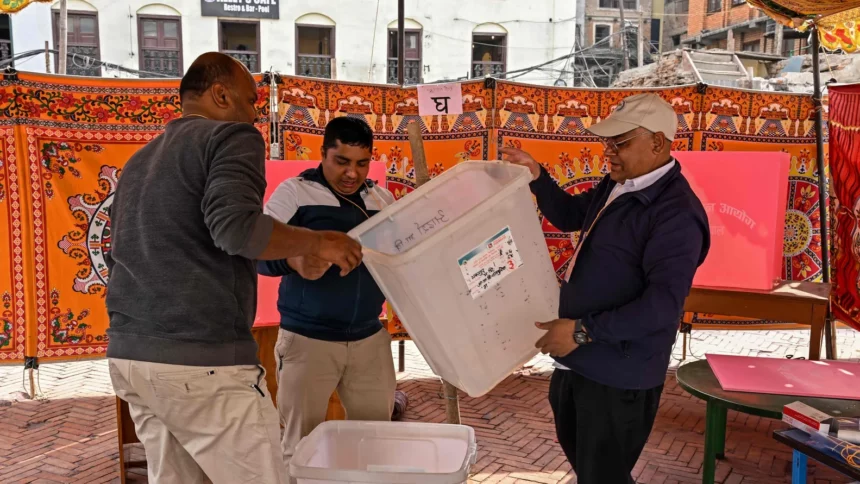
Voting for Nepal’s general elections concluded on March 5 with an estimated 60 percent voter turnout, according to preliminary data released by the Election Commission of Nepal. The nationwide polls were conducted for all 275 seats of the House of Representatives of Nepal, marking the first major national election since the political turmoil that erupted in 2025. The voting process was largely peaceful, with citizens across the country participating in the democratic exercise from early morning until evening.
Polling began at 7:00 am and continued until 5:00 pm across more than 23,000 polling stations nationwide. Nearly 18.9 million registered voters were eligible to cast their ballots in the parliamentary election, which is considered one of the most significant political events in Nepal in recent years. Election authorities reported steady participation throughout the day, with turnout gradually increasing as the hours progressed.
India welcomed the successful conduct of the elections. Responding to media queries, Randhir Jaiswal, spokesperson for the Ministry of External Affairs India, said New Delhi appreciated the enthusiastic participation of Nepali citizens in exercising their democratic rights. He congratulated Nepal’s interim government and all stakeholders for ensuring that the polls were conducted smoothly despite the extraordinary circumstances faced by the country last year.
Jaiswal also noted that India had provided logistical support to Nepal at the request of the Nepali government to facilitate the election process. He expressed hope that India would continue working closely with the new government once it is formed to strengthen the longstanding ties between the two neighbouring nations.
Key contenders and political backdrop of the election
The election has attracted significant international attention because it comes after months of political instability in Nepal. The country witnessed widespread youth-led protests in September 2025, which eventually forced former prime minister K. P. Sharma Oli to resign from office. The protests reflected growing frustration among young citizens over economic challenges, political instability, and limited employment opportunities.
Following Oli’s resignation, Nepal formed an interim administration led by former chief justice Sushila Karki. Her government was tasked with overseeing the electoral process and ensuring a peaceful transition of power after the vote.
After casting her vote at a polling station in Dhapasi, Kathmandu, Karki stated that her responsibility as interim prime minister was nearing completion and that the election would determine the country’s future direction. She also expressed hope that the transfer of power to the newly elected government would happen quickly.
Several prominent leaders are competing for the position of prime minister once the results are declared. Among the key contenders are former Kathmandu mayor Balen Shah, former prime minister K. P. Sharma Oli, and Gagan Kumar Thapa, a senior leader of the Nepali Congress party.
A total of 65 political parties are participating in the election, making it one of the most competitive contests in recent years. More than 3,400 candidates are contesting for seats in Parliament under Nepal’s mixed electoral system.
Under this system, 165 members of Parliament are elected directly through the first-past-the-post method, where voters choose a candidate from their constituency. The remaining 110 seats are filled through proportional representation, with parties receiving seats based on their nationwide vote share.
Analysts believe that, as in previous elections, it may be difficult for any single party to secure a clear majority in the 275-member parliament. To form the government, a party or coalition needs at least 138 seats. This raises the possibility that Nepal could once again see a coalition government after the election results are announced.
Youth participation and key issues shaping the vote
One of the most notable features of the 2026 Nepal elections has been the strong participation of young voters. According to the Election Commission, nearly one million new voters—mostly from Generation Z—registered for the election. Many of these first-time voters actively participated in the polling process.
Election officials reported that youth engagement in politics has increased significantly following last year’s protest movement. The demonstrations brought political reform and employment opportunities for young people to the forefront of national debate.
The issue of youth migration has emerged as a central theme during the election campaign. Nepal has witnessed a large number of young citizens leaving the country to work abroad, particularly in the Gulf countries, Malaysia, and other parts of Asia. Limited employment opportunities at home have been cited as the main reason behind this trend.
Political parties across the ideological spectrum have highlighted this issue in their campaign promises, pledging to create more jobs within Nepal so that young citizens do not feel compelled to migrate overseas for employment.
Despite minor disturbances reported in a few areas, the election process remained largely peaceful. Election officials confirmed that voting concluded without major incidents across most constituencies.
Counting of votes is scheduled to begin shortly after the completion of polling. Initial results are expected within the next 24 hours, although the final official results may take longer to confirm.
According to officials from the Election Commission, results for the 165 directly elected seats could take several days to finalize, while the complete results for all parliamentary seats may take up to two weeks to be formally announced.
The outcome of the election is expected to play a crucial role in shaping Nepal’s political future and determining how the country addresses economic challenges, youth employment, and governance reforms in the coming years.