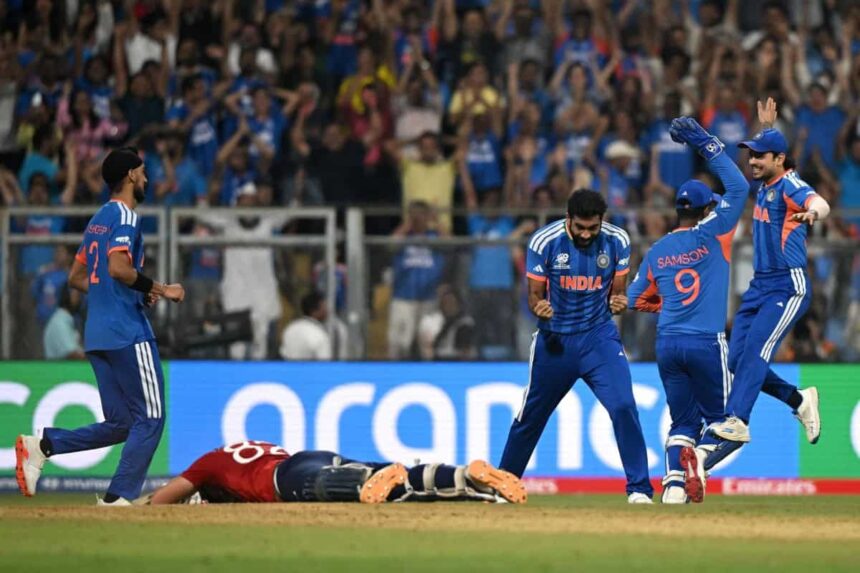
India defeated England by seven runs in a dramatic semifinal of the ICC Men’s T20 World Cup at the Wankhede Stadium on March 5 to secure a place in the tournament final. The high-scoring contest saw India post a massive total before holding their nerve in the final overs to restrict England to 246/7 while chasing 254. With this victory, the Indian team moved one step closer to defending its world title and will face New Zealand national cricket team in the final scheduled at the Narendra Modi Stadium on March 8.
The semifinal turned into one of the most exciting matches of the tournament as both teams played aggressive cricket. Despite a remarkable century from England’s Jacob Bethell, India managed to defend their total in the closing moments of the match. The result also marked India’s entry into consecutive T20 World Cup finals, highlighting their consistency in the shortest format of the game.
Samson powers India to record knockout total
After being asked to bat first, India produced an explosive batting performance to post 253/7 in 20 overs, one of the highest totals ever recorded in a knockout match of the tournament. The innings was anchored by a spectacular knock from Sanju Samson, who smashed 89 runs from just 42 deliveries.
Samson’s innings was filled with attacking strokes as he hammered eight fours and seven sixes. The right-handed batter dominated the English bowlers from the beginning and maintained a rapid scoring rate throughout his stay at the crease. His aggressive approach set the tone for India’s massive total.
The knock also marked Samson’s second consecutive half-century in the tournament and placed him in the record books. During the innings he hit 16 sixes in the current edition of the T20 World Cup, surpassing the previous Indian record held by Rohit Sharma, who had struck 14 sixes in the 2024 edition.
Samson’s score of 89 also equalled the highest score by an Indian batter in a T20 World Cup knockout match. The record was previously held by Virat Kohli, who had scored an unbeaten 89 against West Indies national cricket team during the semifinal of the 2016 T20 World Cup, coincidentally at the same venue.
India’s innings also benefited from several valuable contributions from other batters. Shivam Dube played an aggressive cameo of 43 runs, while Ishan Kishan added 39 runs to strengthen the middle order. Tilak Varma chipped in with 21 runs and Hardik Pandya contributed 27 runs, ensuring that India maintained momentum throughout the innings.
For England, Will Jacks and Adil Rashid were the most effective bowlers, picking up two wickets each. However, the English attack struggled to contain the Indian batting lineup as boundaries continued to flow.
India’s total of 253/7 became one of their highest scores in T20 World Cup history, second only to the 256 they had earlier scored against Zimbabwe national cricket team during the same tournament.
Bethell’s century keeps England in the fight
England’s chase began with early setbacks as India’s bowlers struck quickly during the powerplay. Phil Salt was dismissed for just five runs by Hardik Pandya, while England captain Harry Brook fell after scoring 25 runs.
India tightened their grip when mystery spinner Varun Chakaravarthy removed Jos Buttler for 25. Soon afterwards, Tom Banton was dismissed by Axar Patel, leaving England in trouble during the early stages of the chase.
However, the match turned dramatically when Jacob Bethell launched a counterattack. The young batter produced an extraordinary innings, smashing boundaries at will and keeping England alive in the chase. He reached his half-century in just 19 balls, putting immense pressure on the Indian bowlers.
Bethell then continued his aggressive assault and completed his century in only 43 deliveries. The knock became the second-fastest century in the history of the T20 World Cup, just behind Finn Allen, who had scored a hundred off 33 balls earlier in the tournament.
Bethell formed a crucial partnership with Will Jacks as the pair added 77 runs in just 33 deliveries, dramatically shifting the momentum of the match in England’s favour. Later, Bethell and Sam Curran added another quick 50-run partnership off only 27 balls, bringing England closer to the target.
The game remained evenly balanced heading into the final overs. With England still within striking distance, India needed a breakthrough to regain control. That moment arrived when Hardik Pandya dismissed Sam Curran in the 19th over, breaking the dangerous partnership.
India finally gained relief in the last over when Jacob Bethell was run out while attempting a quick run. At that stage England required 30 runs from the final six deliveries, making the target extremely difficult.
Fast bowler Jofra Archer provided late drama by hitting three consecutive sixes, but England ultimately fell short by seven runs. Pandya finished as India’s most successful bowler with figures of 2/38.
Despite India’s victory, it was a challenging outing for Varun Chakaravarthy. Although he took a wicket, he conceded 64 runs in his four overs, registering one of the most expensive bowling spells in T20 World Cup history.
The thrilling semifinal saw a combined total of 499 runs scored by both teams and a remarkable 34 sixes hit during the match, the highest in a single T20 World Cup game. The dramatic contest kept fans on the edge of their seats until the final ball and set the stage for a highly anticipated championship clash between India and New Zealand.