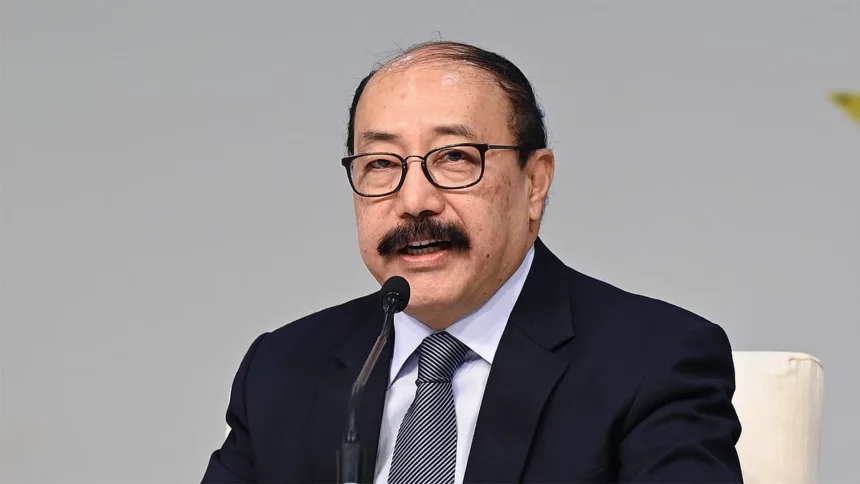
As India grapples with the implementation of 50 per cent tariffs on its exports to the United States, former Foreign Secretary and Rajya Sabha MP Harsh Vardhan Shringla has expressed cautious optimism about India’s ability to manage the fallout while seeking long-term solutions. The tariffs, imposed by the Donald Trump administration, target a wide array of Indian goods and are seen as a measure to exert pressure on India’s energy trade with Russia. HV Shringla emphasized that despite the immediate economic challenge, the enduring strategic partnership between Prime Minister Narendra Modi and President Donald Trump could pave the way for a mutually beneficial resolution, including a potential Free Trade Agreement (FTA) in the future. Drawing from his experience in diplomacy and participation in high-level interactions, HV Shringla underscored India’s resilience and adaptability, highlighting ongoing efforts to diversify markets, strengthen technological capacities, and maintain strong bilateral relations amid the trade disruption.
The PM Modi-Donald Trump Connection and Free Trade Aspirations
Harsh Vardhan Shringla highlighted that the foundation of India’s approach to managing the tariff imposition rests on the close and personal rapport shared between Prime Minister Narendra Modi and former US President Donald Trump. He referenced landmark events such as “Howdy PM Modi” in Houston and “Namaste Donald Trump” in Ahmedabad, which were significant in strengthening bilateral ties and fostering mutual trust between the leaders. According to HV Shringla, the relationship is not a product of recent developments but has been nurtured over years, beginning in Donald Trump’s first term. These high-profile engagements symbolized a strategic convergence of interests, emphasizing shared values and the potential for cooperation in trade, defence, and technology. HV Shringla stressed that while the 50 per cent tariff presents an immediate economic hurdle, the underlying strategic partnership provides a platform for dialogue and negotiation to minimize adverse effects on Indian exports.
He clarified that while there have been speculations in the media suggesting an imminent Free Trade Agreement, his stance was one of measured hope rather than certainty. HV Shringla emphasized that India remains committed to exploring avenues for a “satisfactory mutually beneficial” FTA with the United States, noting that such an agreement could significantly mitigate the impact of tariffs and open new avenues for bilateral trade. He underscored that diplomacy and trade negotiations require patience and careful strategy, asserting that India’s ability to navigate these challenges lies in leveraging its strengths, existing trade frameworks, and the personal rapport shared between the two leaders.
According to HV Shringla, India’s strategic approach is to maintain continuity in dialogue while seeking practical solutions. The former diplomat highlighted that the tariffs, though challenging, do not signal a breakdown in India-US relations. Rather, they reflect the transactional nature of trade policy and the US’s strategic priorities at a specific point in time. HV Shringla noted that India’s engagement with the US must be framed in a broader context of long-term cooperation, emphasizing the potential for technological collaboration, defence partnerships, and mutual support in global forums. By underscoring the personal and political connection between PM Modi and Donald Trump, HV Shringla suggested that the path toward resolution is rooted in sustained dialogue and a commitment to shared objectives.
He also pointed to the role of upcoming diplomatic appointments, particularly the selection of Sergio Gor as the next US Ambassador to India, as a positive development that could facilitate deeper understanding and negotiation. HV Shringla stressed that diplomatic channels are central to addressing trade challenges and that India must maintain proactive engagement to ensure that tariffs do not permanently disrupt economic ties.
Minimizing Tariff Impact and Exploring Alternative Markets
Beyond the political and diplomatic dimensions, HV Shringla outlined concrete strategies for mitigating the immediate economic consequences of the 50 per cent tariffs. India faces significant exposure, particularly in labour-intensive sectors such as textiles, gems and jewellery, and seafood exports, which collectively account for a substantial portion of employment in the country. According to reports by the Global Trade Research Initiative (GTRI), around 66 per cent of India’s total exports to the US, valued at $86.5 billion, are vulnerable to 50 per cent or higher duties, potentially affecting $60.2 billion worth of goods. HV Shringla emphasized that while the situation is serious, India is actively working to minimize the impact through diversification of export markets and the utilization of existing Free Trade Agreements with countries like the United Kingdom, Australia, and the United Arab Emirates.
He noted that by strategically redirecting exports to alternative markets, India can offset some of the losses incurred due to US tariffs. Furthermore, HV Shringla highlighted ongoing negotiations for a Free Trade Agreement with the European Union, which, if concluded, could create additional opportunities for Indian exporters to maintain competitiveness and sustain growth in global trade. This multi-pronged strategy reflects India’s emphasis on resilience and adaptability in the face of international economic disruptions.
HV Shringla also underscored India’s commitment to building domestic capacity in critical sectors. In particular, he pointed to initiatives in semiconductor manufacturing, rare earth mineral development, and emerging technologies as essential for long-term economic resilience. By investing in high-value and technologically advanced sectors, India aims to reduce dependency on imports and enhance its position in global supply chains. These efforts, he noted, would complement the diversification of export markets, enabling India to navigate tariff-related challenges without undermining broader economic growth objectives.
He reassured stakeholders that India’s long-term strategy is built on the principle of sustainable growth. While labour-intensive industries face immediate pressure from the tariffs, the government’s focus on strengthening technological capabilities, promoting innovation, and deepening trade relations with multiple partners positions India for resilience in the coming decades. HV Shringla expressed confidence that by leveraging existing FTAs and ongoing negotiations, India can strategically redirect trade flows, safeguard employment, and maintain momentum in sectors critical to national economic security.
Additionally, HV Shringla emphasized that the India-US relationship extends beyond trade, encompassing shared values, democratic principles, and strategic alignment in defence and technology. He expressed belief that these foundational ties would allow both countries to navigate temporary disruptions, including tariff impositions, without jeopardizing long-term partnership objectives. According to HV Shringla, the strength of bilateral relations lies not only in trade volumes but in the depth of collaboration across multiple dimensions, providing a stable platform to address challenges collectively.
The former diplomat also highlighted the importance of forward-looking planning in emerging technologies. India is actively investing in semiconductor capacity, rare earth minerals, and other high-tech domains, often in collaboration with the US and other strategic partners. HV Shringla stressed that these investments are designed to ensure that India remains competitive globally while mitigating risks from geopolitical and trade uncertainties. This dual approach—diversifying export markets and strengthening domestic technological capacity—represents a comprehensive strategy to sustain India’s economic growth and international trade presence.
Furthermore, HV Shringla addressed concerns regarding labour-intensive sectors, acknowledging that the immediate impact of tariffs could be significant. However, he framed the challenge as temporary and manageable through targeted interventions, including financial support for affected exporters and diversification strategies to reduce dependence on the US market. By emphasizing proactive measures and strategic planning, he conveyed optimism about India’s ability to weather the tariff imposition and emerge stronger in the long term.
HV Shringla’s commentary highlighted the importance of maintaining a long-term perspective amid short-term disruptions. He cautioned against viewing tariffs solely as a crisis, instead framing them as an opportunity to accelerate structural reforms, strengthen trade partnerships with alternative markets, and invest in emerging sectors. This perspective underscores India’s strategic approach to global trade, which prioritizes resilience, adaptability, and sustained growth, even in the face of geopolitical and economic pressures.
The broader implication of HV Shringla’s analysis is that India must balance immediate economic realities with strategic objectives. While the tariffs present tangible challenges, they also create incentives to diversify trade, invest in high-value sectors, and deepen diplomatic engagement with key partners. By leveraging existing FTAs, negotiating new agreements, and strengthening domestic capacities, India can transform the challenge posed by 50 per cent tariffs into an opportunity for long-term economic and strategic gain.
Strategic Outlook and Long-Term Implications
HV Shringla emphasized that the 50 per cent tariffs, while impactful, should be viewed within the broader context of India-US relations, which encompass defence, technology, and global cooperation. The former diplomat stressed that enduring partnerships, built on shared democratic values and mutual strategic interests, provide a platform for resolving trade disputes through dialogue and negotiation. He highlighted that India’s engagement with the US is multifaceted, spanning trade, defence collaboration, technology partnerships, and strategic coordination in international forums. This comprehensive approach ensures that temporary trade measures do not destabilize the broader bilateral relationship.
He also reiterated that India’s focus on diversification and technological self-reliance is critical for sustaining growth amid global uncertainties. By investing in semiconductor manufacturing, rare earth minerals, and other emerging technologies, India aims to secure its position in global supply chains while mitigating risks posed by geopolitical tensions and trade restrictions. HV Shringla highlighted that such initiatives are essential for long-term resilience, enabling India to navigate both current tariffs and potential future disruptions with greater agility.
HV Shringla concluded that India’s strategic vision combines short-term measures to mitigate tariff impacts with long-term initiatives to strengthen economic and technological capacities. This dual approach allows India to manage immediate challenges while positioning itself for sustained growth and enhanced global competitiveness. By leveraging diplomatic relationships, diversifying export markets, and investing in critical sectors, India can minimize the adverse effects of the 50 per cent tariffs and continue advancing its economic and strategic objectives.
Through HV Shringla’s perspective, it becomes evident that India’s response to US tariffs is not solely reactive but part of a comprehensive, forward-looking strategy. By balancing trade negotiations, diplomatic engagement, market diversification, and technological development, India is preparing to navigate immediate challenges while ensuring long-term economic resilience and strategic stability. His insights underscore the importance of leveraging relationships, strategic foresight, and domestic capacity-building to address complex global trade dynamics effectively.