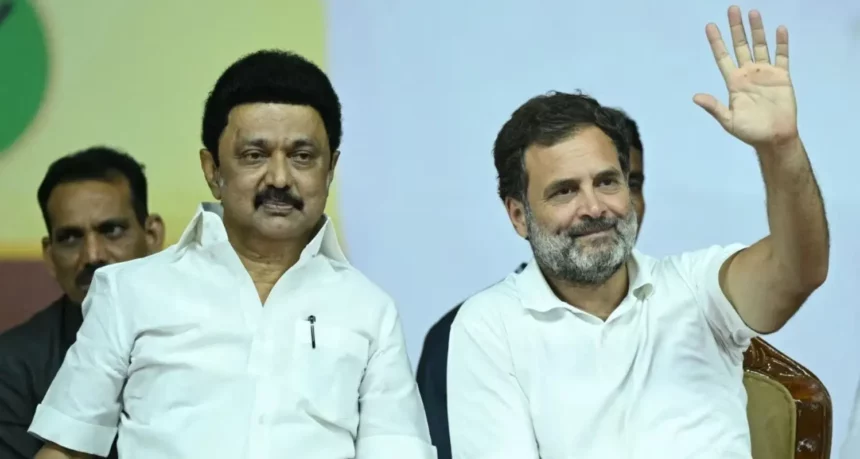
Tamil Nadu Chief Minister MK Stalin traveled to Bihar on Wednesday to participate in Congress leader Rahul Gandhi’s Voter Adhikar Yatra, underlining his party’s support for the nationwide opposition campaign aimed at protecting democratic rights. Stalin, accompanied by his sister and Thoothukudi MP Kanimozhi Karunanidhi, arrived in Darbhanga to join the ongoing 16-day yatra that is highlighting alleged irregularities in Bihar’s voter list revision exercise. The DMK chief’s visit coincides with a crucial phase of the campaign, which has attracted attention across political and civil society circles for its focus on voter disenfranchisement and alleged biases favoring the ruling BJP in the state. By participating, Stalin not only reinforces the strategic alignment between the DMK and Congress but also signals a broader opposition coalition standing united on issues of democratic accountability and fair electoral processes. The Tamil Nadu leader is expected to address a large public gathering in Darbhanga, voicing support for Gandhi’s campaign before returning to Chennai in the evening, further cementing his party’s active engagement in pan-Indian political mobilization.
MK Stalin’s Participation and Political Messaging
MK Stalin departed from Chennai in a special chartered flight at approximately 7:30 am on Wednesday, alongside his sister Kanimozhi Karunanidhi. Both leaders are set to join the Voter Adhikar Yatra along National Highway 57, where Rahul Gandhi is leading the day’s march. The participation of Stalin and Kanimozhi at this juncture reflects the growing practice of opposition parties collaborating across state and national lines to amplify their stance against policies perceived as undermining democratic institutions. The Voter Adhikar Yatra itself, launched on August 17 from Sasaram, is a 16-day march covering approximately 1,300 kilometers across Bihar, culminating in Patna on September 1. Congress has framed the march as an effort to defend citizens’ rights against alleged voter deletions and irregularities in the ongoing revision of the electoral rolls, particularly targeting claims that nearly 65 lakh names were removed to weaken anti-BJP voting strength.
During the rally in Darbhanga, Stalin is expected to deliver a keynote address, emphasizing the DMK’s condemnation of the electoral roll exercise and reaffirming solidarity with the Congress in defending democratic rights. By actively participating, Stalin projects the DMK’s national presence and strengthens the political narrative that voter rights and fair elections are non-negotiable aspects of India’s democratic framework. The DMK chief’s public address is anticipated to highlight the party’s critique of the BJP’s policies in Bihar while underscoring the necessity for collaborative opposition efforts to safeguard constitutional principles and electoral integrity.
Beyond the immediate political messaging, Stalin’s presence at the Voter Adhikar Yatra also represents a symbolic reinforcement of inter-party solidarity. By engaging with the Congress-led campaign, the DMK signals that issues such as voter suppression, fair representation, and electoral transparency transcend regional boundaries. This cross-state engagement reflects a strategic calculation by opposition parties to present a united front in the face of increasingly centralized and dominant governance by the BJP at both state and national levels. Moreover, Stalin’s participation underlines the DMK’s willingness to invest political capital in campaigns outside its traditional southern strongholds, thereby expanding the party’s national influence and reinforcing its identity as a principled defender of democratic norms.
Implications for Opposition Politics and Voter Advocacy in Bihar
Rahul Gandhi’s Voter Adhikar Yatra has been organized as a response to alleged manipulations in the electoral roll revision exercise, which the Congress claims disproportionately affected voters with anti-BJP leanings. The campaign has garnered attention due to its scale, covering over a thousand kilometers, and for highlighting concerns of disenfranchisement and democratic rights violations. Gandhi’s strategy has included inviting leaders from opposition-ruled states, thereby ensuring broader representation and strengthening the narrative of a collective opposition stand. MK Stalin’s participation is particularly significant given the DMK’s longstanding focus on democratic values, minority rights, and social justice, positioning the party as a credible partner in nationwide opposition efforts.
The public gathering in Darbhanga is expected to draw a large audience, reflecting the intensity of political engagement in the region and the resonance of voter rights issues among local citizens. Stalin’s address will likely focus on solidarity with the Congress’s mission, critique the BJP’s handling of the electoral roll process, and advocate for heightened citizen participation in safeguarding democratic processes. By participating in a high-visibility event, Stalin simultaneously signals to both local constituents and national observers that the DMK is committed to pan-Indian democratic advocacy, leveraging the Voter Adhikar Yatra as a platform for political mobilization beyond regional confines.
The visit also underscores the evolving dynamics of opposition politics in India, where collaboration across state boundaries is increasingly central to shaping narratives against the ruling party. By joining Gandhi’s yatra, Stalin strengthens the perception of a cohesive opposition front, capable of coordinating actions and messaging on critical democratic issues. The strategic timing of the visit—midway through the 16-day march—ensures maximum media attention and amplifies the opposition’s critique of electoral practices, potentially influencing public opinion ahead of upcoming state and national elections. The DMK’s support adds gravitas to the campaign, reinforcing the message that protecting voter rights is not limited to any single party but is a collective democratic responsibility.
MK Stalin’s engagement in Bihar is also reflective of the DMK’s broader political philosophy, emphasizing inter-party collaboration, democratic accountability, and opposition unity. By participating in a high-profile event outside Tamil Nadu, Stalin positions his party as an influential voice in national discourse, demonstrating the strategic importance of aligning with Congress-led initiatives while retaining the DMK’s distinct political identity. The visit strengthens alliances, highlights shared concerns regarding electoral fairness, and amplifies the call for citizens’ active participation in defending democratic principles.
The Voter Adhikar Yatra, including MK Stalin’s involvement, symbolizes a concerted effort by opposition parties to contest not only procedural irregularities but also the perceived centralization of political power by the ruling party. It provides a stage to spotlight citizen grievances, reinforce advocacy for transparent electoral practices, and consolidate public sentiment around democratic rights. The DMK chief’s presence enhances the credibility and visibility of the yatra, signaling that democratic advocacy is a shared responsibility among diverse regional and national parties. By foregrounding issues of voter rights and participatory democracy, the event contributes to shaping public discourse, encouraging civic engagement, and maintaining pressure on institutional actors to uphold electoral integrity.
Overall, Stalin’s participation in Rahul Gandhi’s Voter Adhikar Yatra reflects a nuanced political strategy aimed at reinforcing opposition unity, elevating voter rights discourse, and projecting a vision of inclusive and participatory democracy. The DMK chief’s presence in Darbhanga amplifies the impact of Gandhi’s campaign, demonstrating the significance of cross-party collaboration in addressing pressing national issues. By aligning with the Congress on voter advocacy while maintaining regional political credibility, Stalin exemplifies the evolving nature of opposition politics in India, where strategic alliances, public engagement, and issue-based mobilization play critical roles in shaping democratic outcomes.
Through this active engagement, the DMK continues to signal its commitment to protecting democratic norms, advocating for fair electoral practices, and fostering collaboration across states. The participation of leaders like MK Stalin in high-profile initiatives like the Voter Adhikar Yatra underscores the interplay between regional political influence and national democratic advocacy, highlighting the importance of coalition-building, strategic messaging, and proactive leadership in India’s multiparty political landscape.