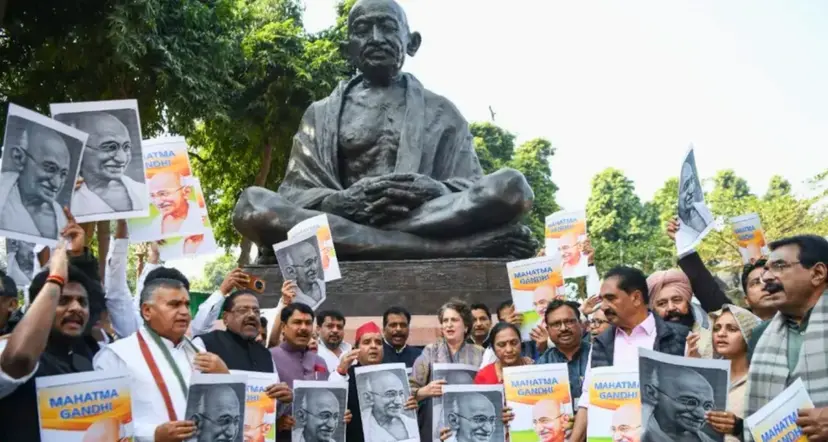
A nationwide strike call by MGNREGA workers has intensified the political debate around rural employment and welfare policies after labour organisations and farmer groups announced mass protests against the Centre’s decision to discontinue the Mahatma Gandhi National Rural Employment Guarantee Act. The strike, scheduled for May 15, is expected to witness participation from thousands of workers, farmers, and rural activists across several states.
The protest has been jointly called by the NREGA Sangharsh Morcha and the All India Kisan Sabha (AIKS), which have accused the government of weakening one of India’s most significant rural welfare programmes. The agitation comes days after the Union Government issued a notification stating that the MGNREGA Act would stand repealed from July 1, triggering concern among labour rights groups and rural communities dependent on the scheme.
The proposed strike is likely to become one of the biggest rural mobilisations in recent years, particularly in states where the employment guarantee scheme has played a major role in supporting vulnerable households during economic distress, droughts, and agricultural downturns.
MGNREGA, introduced in 2005, has long been regarded as a cornerstone of India’s rural welfare framework. The scheme guarantees wage employment to rural households willing to undertake unskilled manual work and has often been described as a safety net for millions of economically weaker families. Over the years, it has supported agricultural labourers, small farmers, women workers, migrant labourers, and unemployed youth across rural India.
Labour unions and farmer organisations say the government’s move to discontinue the programme could have devastating consequences for rural livelihoods at a time when inflation, climate uncertainty, and job scarcity are already placing immense pressure on low-income families.
The All India Kisan Sabha described the repeal decision as a direct attack on the legal right to employment guaranteed under the Act. In its statement, the organisation argued that MGNREGA had become the “only legal guarantee of employment” available to rural workers and accused the government of systematically weakening the programme over the past few years.
According to AIKS leaders, several policy changes and administrative decisions had already reduced the effectiveness of the scheme before the repeal announcement. These include alleged budget cuts, delays in wage payments, technical issues linked to digital attendance systems, and exclusion caused by mandatory technological verification processes.
Farmer leaders claim that many genuine workers have faced difficulties accessing work due to biometric authentication failures, internet connectivity problems, and irregular fund releases. They argue that these barriers disproportionately affect elderly labourers, women, and workers living in remote villages with poor digital infrastructure.
The organisations behind the strike have also raised objections to the VB-G RAM (G) Act, which they claim undermines workers’ rights and weakens the employment guarantee framework. Protest leaders say the new system shifts focus away from a rights-based welfare approach and creates uncertainty for rural workers who depend on guaranteed employment during difficult agricultural seasons.
The strike call has gained support from several labour unions, peasant organisations, and grassroots activist networks across multiple states. Preparations for demonstrations, sit-ins, rallies, and village-level meetings have reportedly intensified in states such as Rajasthan, Bihar, Madhya Pradesh, Jharkhand, Chhattisgarh, West Bengal, Tamil Nadu, and Kerala.
Organisers expect women workers to participate in large numbers, given that female participation under MGNREGA has historically remained high. The scheme has often been praised for increasing women’s economic participation in rural areas by providing accessible local employment opportunities.
Over the years, MGNREGA has also been credited with reducing distress migration from villages to urban centres. During periods of economic disruption, including droughts and the COVID-19 pandemic, the programme played a critical role in offering temporary income support to millions of families who lost regular employment opportunities.
Economists and rural development experts believe the scheme significantly improved rural purchasing power in several regions by injecting wages directly into village economies. Many studies have linked MGNREGA employment with increased household spending on food, healthcare, and education.
Critics of the repeal decision argue that discontinuing the programme could negatively affect rural demand at a time when India’s agricultural sector continues to face structural challenges. They warn that reduced income opportunities may further widen economic inequality between urban and rural populations.
The protesting groups have placed several demands before the government as part of the nationwide agitation. Among the major demands is the rollback of the repeal notification and restoration of the employment guarantee framework. Worker unions are also seeking expansion of the programme to provide at least 200 days of guaranteed employment annually instead of the existing limit.
In addition, organisations have demanded an increase in daily wages under the scheme to ₹700, linked directly to inflation rates. Activists argue that current wage levels remain inadequate given the rising cost of food, transportation, fuel, and essential commodities.
Farmer leaders say the issue is not merely about employment but also about rural dignity and economic survival. Many rural families use MGNREGA wages to manage household expenses during periods when agricultural work is unavailable. Seasonal unemployment remains a persistent challenge in many districts, especially during drought conditions or crop failures.
Political reactions to the repeal announcement have also intensified. Opposition parties have criticised the government for allegedly dismantling a crucial social welfare mechanism. Several opposition leaders accused the Centre of ignoring the struggles faced by rural communities and prioritising fiscal concerns over social protection.
Government supporters, however, argue that reforms in the rural employment system are necessary to improve efficiency and reduce leakages. Some policymakers believe existing welfare mechanisms require restructuring to align with changing economic conditions and technological advancements.
The Centre has not yet issued a detailed response to the strike call, but officials are expected to closely monitor the protests as demonstrations unfold across different states. Security arrangements are likely to be strengthened in districts where large gatherings are anticipated.
Experts believe the political implications of the protest could extend beyond labour rights and welfare policy. Rural employment schemes have historically influenced voter sentiment, particularly in agrarian states where economic distress and unemployment remain key political issues.
The timing of the strike is also significant because it comes amid broader debates over inflation, unemployment, and welfare spending. Rising fuel prices, food inflation, and agricultural uncertainty have already increased financial stress on rural households in many parts of the country.
Labour activists argue that reducing welfare protections during a period of economic pressure could deepen social vulnerabilities. They maintain that employment guarantee programmes remain essential for ensuring basic economic security in rural India.
Several social activists and academics have also voiced concern over the possible repeal of MGNREGA. Some experts argue that the scheme represented one of the world’s largest public employment programmes and had become an internationally recognised model for social protection.
They point out that beyond employment generation, MGNREGA projects often contributed to rural infrastructure development through construction of ponds, roads, water conservation systems, and land improvement works. These projects not only provided wages but also strengthened local economies and agricultural productivity.
As the May 15 strike approaches, attention is now focused on how widespread the participation will be and whether the protests can influence the government’s position. Worker organisations insist the agitation will continue if the repeal notification is not withdrawn.
For millions of rural workers, the uncertainty surrounding the future of MGNREGA has created anxiety about income security and employment opportunities. Many fear that without the scheme, rural distress could intensify, especially in economically weaker regions with limited industrial or non-farm employment options.
The coming days are expected to witness heightened political and social debate around rural employment rights, welfare spending, and the future of labour protection in India. Whether the protests lead to policy reconsideration remains uncertain, but the issue has already emerged as a major flashpoint in the national conversation on economic justice and rural livelihoods.