In a landmark election for the Union Territory of Jammu & Kashmir, the first Rajya Sabha polls since the abrogation of Article 370 witnessed intense political maneuvering and surprising results. The National Conference (NC) secured three of the four seats, while the Bharatiya Janata Party (BJP) captured the fourth seat in a closely contested race, sparking discussions about potential cross-voting, political strategies, and the evolving dynamics of regional politics. The elections not only highlighted party strengths and internal alliances but also reflected the complexity of legislative procedures, voting patterns, and strategic decision-making in a post-Article 370 political landscape, drawing attention from both national and regional political observers.
National Conference Sweeps Majority of Seats Amid Tight Contest
The first-ever Rajya Sabha elections in Jammu & Kashmir since the revocation of Article 370 saw the National Conference making a strong showing by winning three out of the four seats. NC candidates Chowdhary M Ramzan, Sajjad Kichloo, and G.S. Oberoi emerged victorious, while the BJP’s Satpal Sharma clinched the fourth seat in a nail-biting contest. The elections were conducted under three notifications, with seats three and four being contested under a single notification issued by the Election Commission of India (ECI), and the remaining seats requiring candidates to secure a minimum number of votes from the 88-member J&K Legislative Assembly. During the polling, 86 lawmakers voted in person, while incarcerated legislator Mehraj Malik used a postal ballot, and People’s Conference chief Sajad Lone chose to abstain from voting, adding further intrigue to the results.
The first two seats saw decisive victories for the NC, with Chowdhary M Ramzan, a four-time MLA from Handwara constituency, receiving 58 votes and defeating BJP’s Ali Mohammad. Similarly, Sajjad Kichloo, representing Kishtwar assembly, also secured 58 votes, overcoming BJP candidate Rakesh Mahajan. G.S. Oberoi, a longtime member and treasurer of the NC, managed to win the third seat with 31 votes, defeating Satpal Sharma. While these results reflected the NC’s dominance, the fourth seat became the center of attention, as BJP’s Satpal Sharma secured a win by receiving 32 votes against NC’s Imran Nabi Dar, who managed 22 votes.
The outcome raised questions regarding potential cross-voting, as the BJP appeared to have gained four extra votes beyond its nominal legislative strength. NC chief minister Omar Abdullah congratulated his colleagues but underscored that no NC legislator had cross-voted, leaving political analysts and party members to speculate about the source of these additional votes. BJP leaders dismissed allegations of manipulation, attributing their victory to genuine support from legislators and criticizing the NC for attempting to consolidate votes along regional or religious lines. The political discourse surrounding this unexpected result highlighted the intricate balance of power, negotiations, and influence within the J&K assembly.
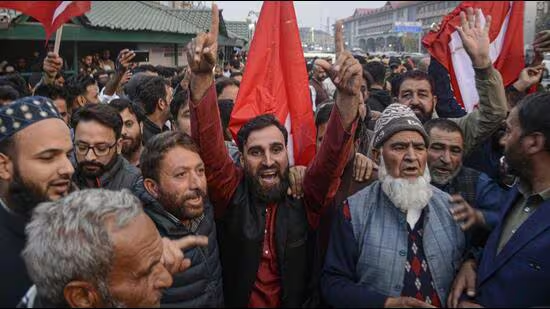
The NC’s success in the first three seats reaffirmed its organizational strength and deep-rooted presence in Jammu & Kashmir politics. Extensive celebrations broke out across regions, with workers and supporters expressing their elation through rallies, slogans, and public festivities. Handwara, the constituency of Ramzan, witnessed public celebrations, including firecrackers, while BJP supporters organized flag rallies in Srinagar to mark their candidate’s success. The contrast in celebrations illustrated the dual nature of political victories in J&K, where regional allegiances, historical party influence, and emerging political strategies intersect to shape outcomes in both legislative and public arenas.
Political Implications and Allegations of Fixed Voting
The BJP’s surprise victory in the fourth seat sparked speculation and intense political debate. Opposition voices, notably from the People’s Conference, labeled the results as a “fixed match,” accusing the NC and BJP of collusion to manipulate outcomes. Sajad Lone openly questioned the counting of votes and the allocation of ballots, suggesting that the process may have been influenced by strategic miscalculations or clandestine agreements among legislators. He argued that the fourth seat’s contest was always going to be close, particularly given the NDA’s numerical position in the assembly, and criticized the NC for apparently over-polling votes for the third seat, which may have inadvertently benefited the BJP.
The composition of the J&K Legislative Assembly played a critical role in shaping the elections. With 41 NC lawmakers, 28 from BJP, six from Congress, three from PDP, one from CPI(M), and seven independents, the stage was set for a competitive election. The secret ballot system allowed party-affiliated MLAs to submit their votes under scrutiny from party agents, while independents had no mandatory reporting obligations. This framework created opportunities for unpredictability, strategic alliances, and potential deviations from party lines, making the final results difficult to anticipate. The NC’s victory in three seats affirmed its ability to mobilize support effectively, while the BJP’s win indicated the presence of a calculated political strategy or unexpected legislative alignment.
The electoral procedure, overseen by the Election Commission of India, required candidates for seats one and two to secure a minimum of 45 votes, whereas candidates for seats three and four needed 29 or 30 votes to win. The meticulous process, combined with voter secrecy and independent oversight, was intended to ensure fairness and transparency. Nevertheless, the controversy surrounding the fourth seat highlights the challenges inherent in managing electoral integrity in a politically charged environment. Analysts noted that the dynamics of cross-voting, abstentions, and strategic over-polling could significantly influence outcomes, adding layers of complexity to legislative elections in regions marked by diverse political representation and historical tensions.
Celebrations, debates, and allegations extended beyond J&K to neighboring Punjab, where the Aam Aadmi Party’s Rajinder Gupta was elected unopposed to the Upper House after Sanjeev Arora resigned following the 2024 assembly elections. This juxtaposition of a smooth, uncontested election in Punjab against the intensely contested, politically fraught Rajya Sabha elections in J&K underscores the variability of political engagement, regional electoral dynamics, and party strategies in different parts of India. The contrast also provides insight into how local political landscapes, voter alignment, and historical party dominance influence outcomes in national parliamentary elections.
Omar Abdullah, in his public statements, praised the NC winners while emphasizing transparency and integrity, indirectly raising questions about the fourth seat. He highlighted the importance of observing legislative behavior, investigating invalidated votes, and scrutinizing potential inducements or pressures that could affect decision-making among MLAs. Similarly, BJP leaders framed their win as a reflection of genuine confidence in the party’s policies and leadership, dismissing cross-voting allegations as political rhetoric. The clash of narratives further illustrates the intertwining of procedural governance, electoral strategy, and partisan interpretations in shaping public perception and political legitimacy in Jammu & Kashmir.
The broader implications of these elections extend beyond immediate party victories. They reflect ongoing adjustments in the political architecture of J&K following the revocation of Article 370, demonstrating how regional parties, national actors, and independent legislators navigate a redefined legislative environment. The delicate balance between local representation, national political priorities, and legislative procedures creates a highly strategic setting, where outcomes are influenced not only by numerical strength but also by alliances, negotiations, and the ability to mobilize support effectively across multiple constituencies.
The NC’s triumph in three seats consolidates its influence and sends a clear message about its continued relevance in J&K politics. Simultaneously, the BJP’s unexpected victory signals an evolving political landscape where national parties are increasingly asserting their presence, leveraging strategic opportunities, and capitalizing on potential uncertainties or miscalculations among opponents. The interplay of regional loyalty, historical political dominance, and emergent legislative strategies creates a multi-layered narrative, reflecting the complexity of contemporary parliamentary politics in Jammu & Kashmir.
The election also drew attention to procedural mechanisms, such as secret ballots, minimum vote thresholds, and party oversight, which are designed to maintain fairness while accommodating legislative discretion. Analysts and political commentators have observed that these mechanisms, while promoting integrity, also introduce possibilities for strategic voting, cross-voting, and tactical abstentions, all of which can significantly affect outcomes. The fourth seat’s unexpected result serves as a case study in the nuanced interactions between formal electoral rules, political strategy, and the individual choices of legislators, highlighting the delicate balance of power in a restructured Union Territory.
Overall, the J&K Rajya Sabha elections represent a pivotal moment in the region’s political history. The combined effects of party organization, legislative composition, strategic alliances, and procedural rules have produced a result that is both predictable in part and unexpectedly dynamic in others. The celebrations, political rhetoric, and allegations surrounding the fourth seat underscore the ongoing tensions and strategic maneuvering that characterize electoral politics in Jammu & Kashmir today. The results serve as a microcosm of broader regional and national political dynamics, illustrating how party strength, strategy, legislative behavior, and voter representation converge to shape outcomes in a complex and evolving democratic framework.
The post-election landscape will likely continue to be shaped by debates over cross-voting, allegations of fixed results, and strategic calculations by both regional and national actors. As Jammu & Kashmir adjusts to its post-Article 370 political environment, these Rajya Sabha elections provide critical insights into legislative strategy, party influence, and the operational intricacies of parliamentary representation. The NC’s dominance, BJP’s surprise win, and the associated controversies collectively highlight the multifaceted nature of political competition in the Union Territory, offering lessons on electoral strategy, legislative behavior, and the delicate management of political alliances.