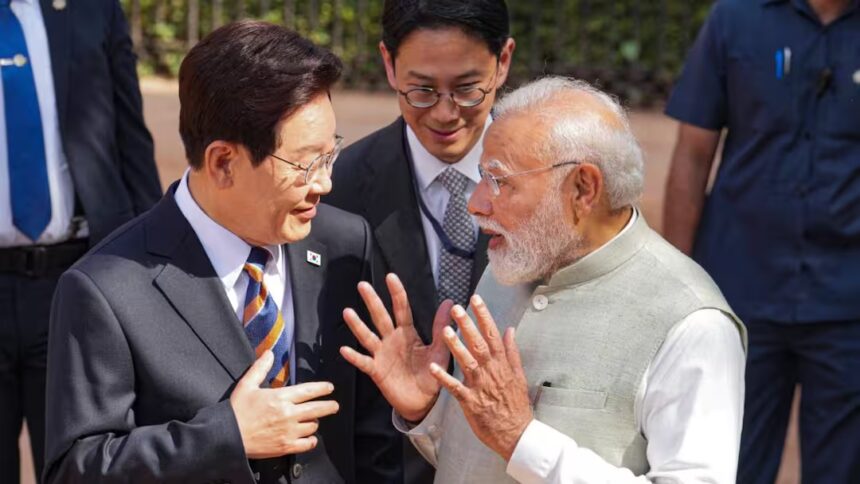
South Korean President Lee Jae-myung’s visit to India marks a significant moment in the evolving bilateral relationship between the two nations. Accompanied by First Lady Kim Hea-kyung, Lee received a ceremonial welcome at Rashtrapati Bhavan, where President Droupadi Murmu and Prime Minister Narendra Modi were present. The visit comes at a time of global economic uncertainty and shifting geopolitical dynamics, highlighting the growing importance of India and South Korea as strategic partners.
Focus on Trade, Technology and Strategic Cooperation
The core agenda of discussions between Lee Jae-myung and Narendra Modi includes strengthening cooperation in shipbuilding, artificial intelligence, semiconductors, and critical technologies. Both nations are seeking to expand their collaboration in emerging sectors that are increasingly shaping the global economy.
Officials indicated that talks will also cover trade and investment opportunities, with a focus on enhancing supply chain resilience amid global disruptions. The ongoing instability in global markets, partly driven by geopolitical tensions, has prompted both countries to diversify and secure their economic partnerships.
The two leaders are expected to review progress under the existing economic partnership agreement signed in 2010. Bilateral trade has seen significant growth since then, rising from $14.2 billion to nearly $26.89 billion in 2024–25, reflecting the deepening economic ties between the two nations.
Strengthening Security and Regional Stability
Beyond economic cooperation, discussions will also address regional and global security concerns. South Korea’s National Security Adviser highlighted the importance of maintaining peace on the Korean Peninsula and enhancing cooperation in the Indo-Pacific region.
Energy security is another key concern, especially in light of recent tensions in West Asia that have impacted global oil supply routes. South Korea, heavily dependent on energy imports, is looking to strengthen partnerships that can help mitigate such risks.
India and South Korea share common interests in maintaining a rules-based international order and ensuring stability in their respective regions. The talks are expected to reinforce cooperation in these areas, including maritime security and defence dialogue.
Ceremonial Welcome and Diplomatic Engagements
Lee Jae-myung was accorded a ceremonial reception at Rashtrapati Bhavan, featuring traditional cultural displays and a guard of honour. The visit underscores the importance both nations place on diplomatic engagement and cultural exchange.
During his stay, Lee and First Lady Kim Hea-kyung visited Rajghat to pay tribute to Mahatma Gandhi. The gesture reflects the shared respect for historical figures and values that underpin the relationship between India and South Korea.
The visit is being described by India’s Ministry of External Affairs as an important milestone in advancing the “Special Strategic Partnership” between the two countries. It also highlights the growing alignment of interests in areas such as technology, trade, and global governance.
Expanding Economic and Industrial Collaboration
One of the major outcomes expected from the visit is enhanced collaboration in industrial sectors such as shipbuilding and semiconductor manufacturing. South Korea is a global leader in these industries, and India is looking to leverage this expertise to boost its domestic manufacturing capabilities.
The discussions are also likely to explore joint ventures and investments that can benefit both economies. With India’s growing market and South Korea’s technological strength, the partnership offers significant opportunities for mutual growth.
Efforts to modernize and expand the existing economic partnership agreement may also be on the table, aimed at addressing current trade challenges and unlocking new areas of cooperation.
Deepening Cultural and Diplomatic Relations
In addition to economic and strategic discussions, the visit also emphasizes cultural diplomacy. The presence of the First Lady and participation in ceremonial events highlight the importance of people-to-people connections in strengthening bilateral ties.
India and South Korea have steadily built a strong relationship based on shared democratic values, economic cooperation, and mutual respect. The visit by President Lee Jae-myung is expected to further deepen this relationship and pave the way for future collaboration.
As both countries navigate a complex global environment, their partnership is likely to play an increasingly important role in shaping regional and global dynamics.