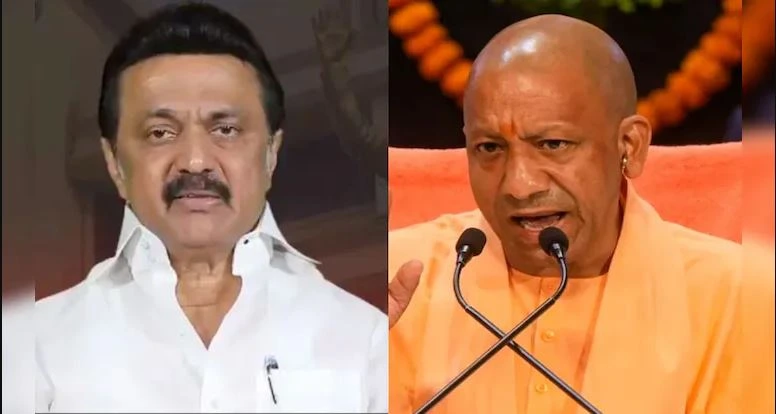
Tamil Nadu Chief Minister MK Stalin has strongly countered Uttar Pradesh Chief Minister Yogi Adityanath’s remarks on the language debate, calling them not just ironic but “political black comedy at its darkest.” His response comes amid the ongoing dispute over the three-language formula and the delimitation exercise, both of which have become major flashpoints between the Dravida Munnetra Kazhagam (DMK) government and the Bharatiya Janata Party (BJP)-led Centre.
In an interview with ANI, Yogi Adityanath had accused the DMK of creating divisions based on language and regional identity to protect its vote bank. He argued that learning multiple languages, including Hindi, should be encouraged and emphasized that Tamil is one of India’s most ancient and respected languages. Referring to the Kashi-Tamil Sangamam initiative, he credited Prime Minister Narendra Modi for fostering cultural ties between Tamil Nadu and Varanasi, questioning why the DMK opposed Hindi so strongly.
Responding to these remarks, MK Stalin dismissed the BJP’s accusations, clarifying that Tamil Nadu does not oppose any language but rejects “imposition and chauvinism.” He stated that the BJP was rattled by the state’s firm stand on the two-language policy and delimitation. MK Stalin took to social media to express his views, saying, “And now Hon’ble Yogi Adityanath wants to lecture us on hate? Spare us. This isn’t irony—it’s political black comedy at its darkest. We don’t oppose any language; we oppose imposition and chauvinism. This isn’t riot-for-votes politics. This is a battle for dignity and justice.”
The DMK has been a vocal critic of the three-language policy under the National Education Policy (NEP), accusing the Centre of trying to impose Hindi on non-Hindi-speaking states. The Tamil Nadu government has consistently opposed the move, arguing that the state has long adhered to a two-language policy, promoting Tamil and English.
Another major issue fueling tensions between Tamil Nadu and the BJP-led Centre is the impending delimitation exercise, set to take place after 2026. MK Stalin has argued that the process, which will redraw parliamentary constituencies based on population shifts, will disadvantage the southern states. He contends that Tamil Nadu and other southern states implemented successful family planning measures, leading to slower population growth. As a result, these states could lose parliamentary representation compared to northern states, despite contributing significantly to India’s GDP and national progress.
The political battle between the DMK and the BJP over language and representation highlights deep-rooted ideological differences. While the BJP sees the promotion of Hindi as a unifying factor, the DMK views it as an attempt to undermine regional identities. As the debate intensifies, it remains to be seen how this ideological clash will shape national politics in the coming years.