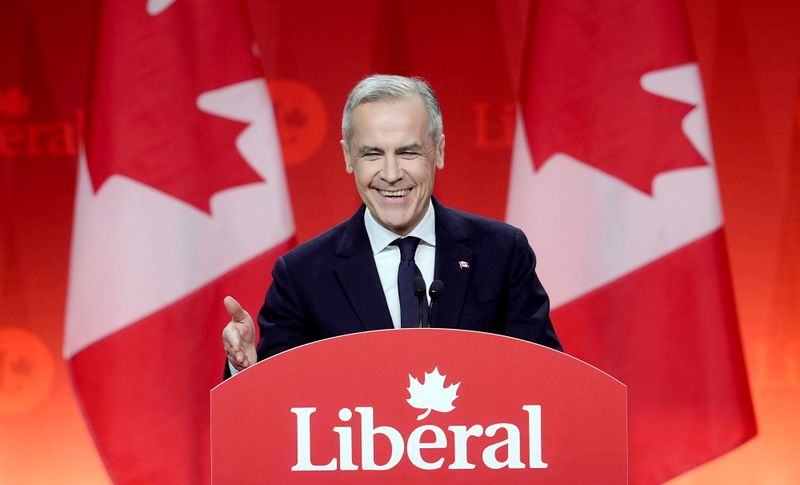
Mark Carney, a former central banker, is set to become Canada’s next prime minister after securing a decisive victory in the governing Liberal Party’s leadership race. Mark Carney, who won with an overwhelming 85.9% of the vote, will replace outgoing Prime Minister Justin Trudeau, who announced his resignation in January but remains in office until his successor is sworn in. Mark Carney’s leadership comes at a critical time, as Canada navigates trade tensions with the United States and seeks to strengthen economic partnerships with other global allies, including India.
Speaking recently in Calgary, Alberta, Mark Carney addressed questions regarding tariffs imposed on Canada by the United States and emphasized the need for trade diversification. He expressed interest in rebuilding Canada’s trade relations with India, stressing that any commercial engagement must be based on shared values. Mark Carney stated that if he becomes prime minister, he looks forward to developing stronger ties with India, which could present new economic opportunities for both countries.
Mark Carney has extensive experience with India’s economy, having served as chair of Brookfield Asset Management’s board until January 2025. Brookfield, a major global investment firm, manages approximately $30 billion in assets across key sectors in India, including real estate, infrastructure, renewable energy, private equity, and special investments. Given this background, industry leaders expect Mark Carney’s administration to take a pragmatic approach to economic and trade relations with India.
Ritesh Malik, chair of the Canada-India Foundation, welcomed Mark Carney’s remarks, highlighting his experience as an economist and his understanding of India’s economic significance. Ritesh Malik believes that Mark Carney’s top priority will be foreign policy with a strong focus on trade and commerce, which could lead to improved bilateral relations. He further noted that Mark Carney’s global perspective and geopolitical awareness could introduce a fresh diplomatic approach, potentially fostering stronger economic and strategic ties between Canada and India.
The prospect of renewed trade relations comes after a period of diplomatic strain between India and Canada. Tensions escalated following Justin Trudeau’s statement in the House of Commons on September 18, 2023, in which he claimed there were “credible allegations” linking Indian agents to the killing of pro-Khalistan figure Hardeep Singh Nijjar in British Columbia. This statement led to a major diplomatic fallout, prompting Canada to pause negotiations on the Early Progress Trade Agreement, which both nations had been optimistic about finalizing in 2023.
Mark Carney, born on March 16, 1965, in Fort Smith, Northwest Territories, and raised in Edmonton, Alberta, brings a strong financial background to his new political role. He served as governor of the Bank of Canada from 2008 to 2013 and later led the Bank of England from 2013 to 2020, becoming the first non-British citizen to head the institution since its founding in 1694. Mark Carney also served as the United Nations’ special envoy for climate action and finance from 2020. He spent 13 years as an executive at Goldman Sachs, working in financial hubs like London, Tokyo, New York, and Toronto before transitioning to public service.
Despite his extensive experience in economics and global finance, Mark Carney has no prior political background. He holds Canadian, UK, and Irish citizenships but has committed to retaining only Canadian citizenship, a move seen as politically prudent. His wife, Diana Carney, is British-born, and they have four daughters. Mark Carney earned his bachelor’s degree in economics from Harvard University in 1988 and later obtained master’s and doctoral degrees in economics from Oxford University. A sports enthusiast, he played ice hockey during his time at Harvard as a backup goalie.
As Mark Carney prepares to take office, his leadership could redefine Canada’s foreign policy priorities, with India potentially emerging as a key trade partner. His administration’s approach to strengthening economic ties and resolving past diplomatic tensions will be closely watched in both countries.