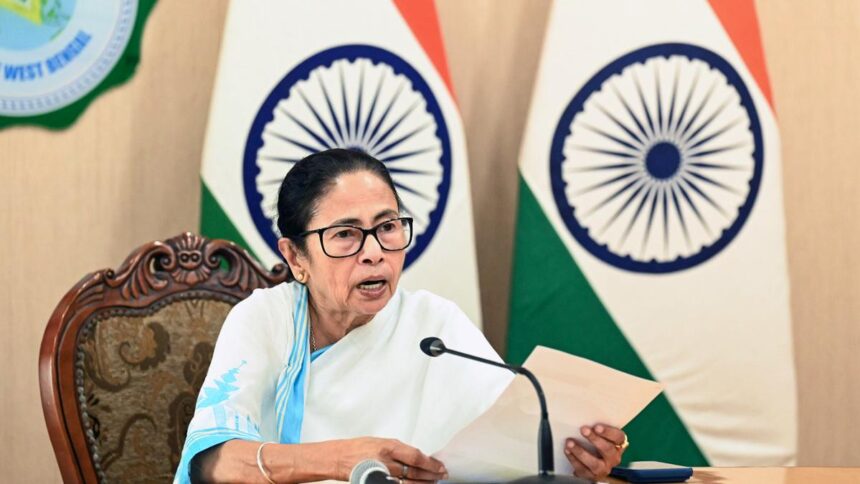
West Bengal Chief Minister Mamata Banerjee has unveiled a sweeping initiative aimed at bringing back migrant workers to the state by providing them monthly financial aid, skill training, and rehabilitation support under a new scheme titled Shramashree. The move, announced in Kolkata, is being viewed as both a welfare measure and a politically significant step in the run-up to the 2026 Assembly elections, with Mamata Banerjee alleging that Bengali workers in other states are facing harassment, discrimination, and linguistic persecution.
A Bid to Bring Migrant Workers Back Home
The announcement of Shramashree comes at a time when West Bengal has been grappling with the long-standing issue of outward migration, particularly of its unskilled and semi-skilled workforce. According to Mamata Banerjee, nearly 22 lakh migrant workers from Bengal are currently employed in states across India, many of them in NDA-ruled regions. She claimed that these workers and their families often face harassment, discrimination, and in some cases, criminalisation for simply speaking Bengali in workplaces and local communities.
During her press conference in Kolkata, the Chief Minister spoke emotionally about the plight of these workers. “Most of the 22 lakh of our migrant workers and their families who are outside have been harassed for speaking in Bengali in these states. Those speaking in Bengali are being singled out and treated like criminals, put in jail or pushed back to Bangladesh. The Bengali workers who are returning are in a helpless situation because of linguistic persecution and harassment. They are being criminalised, and which is why we have taken a decision,” she said.
The Shramashree scheme has been designed as a multi-layered support mechanism that will not only ensure immediate financial relief but also help workers reintegrate into Bengal’s workforce through training, job placement, and social welfare measures. Under the scheme, returning workers will be provided a one-time travel allowance to facilitate their return journey, after which they will receive a monthly rehabilitation grant of Rs 5,000 for a period of 12 months. This financial cushion, Mamata Banerjee argued, would give workers time and security to look for new opportunities within the state without the pressure of immediate survival.
Skill training forms the second critical pillar of Shramashree. The state government plans to leverage its Utkarsha Bangla programme, which has already been active in providing vocational training to youth, to impart new skills to returning migrants. These training programmes will be designed to align with the state’s current and emerging sectors such as construction, textiles, small-scale industries, and services. By tailoring the training to match individual workers’ prior experience and abilities, the government aims to create pathways for long-term employment and entrepreneurship.
Alongside Utkarsha Bangla, the state’s Karmashree programme will also be integrated into Shramashree. This scheme has been central to job creation in Bengal, providing employment opportunities through job cards. Mamata Banerjee highlighted that over 78 lakh job-card holders have already benefited from this initiative, which has generated over 91 crore man-days of work at a cost of Rs 19,000 crore to the state exchequer. She noted that migrant workers returning under Shramashree would also be absorbed into this ecosystem, thereby expanding their access to employment opportunities.
Welfare Measures and Political Undertones
Mamata Banerjee’s announcement went beyond just financial aid and skill training, extending to a wider safety net of welfare provisions. Recognising that many migrant workers may not have a stable home in West Bengal, the government has pledged to establish community kitchen centres for those without housing. These centres will ensure that no worker or their family faces food insecurity upon return. Furthermore, for children of migrant workers, the state will facilitate enrolment in local government schools, ensuring continuity of education and reducing disruption caused by relocation.
In addition, returning workers and their families will be integrated into other existing state welfare schemes, which include healthcare coverage, food subsidies, and housing support under the broader umbrella of Bengal’s social security programmes. This holistic approach reflects Mamata Banerjee’s effort to present herself as a leader deeply invested in the welfare of Bengal’s working class, particularly those who have been compelled to seek livelihoods outside the state due to economic necessity.
However, while the scheme is framed as a humanitarian and welfare-driven initiative, the political undertones are unmistakable. The announcement comes less than a year after Mamata Banerjee’s Trinamool Congress faced setbacks in the Lok Sabha elections, and with the 2026 Assembly polls on the horizon, the Chief Minister is clearly positioning herself to reclaim ground by consolidating support among Bengal’s migrant families. Migrant workers not only represent a significant portion of Bengal’s population but also wield influence in rural communities where remittances form a crucial part of household income. By offering a dignified return pathway, Mamata Banerjee is seeking to transform a section of this electorate into a strong political base.
Critics, however, argue that the timing of the announcement betrays its electoral intent. Opposition parties, particularly the Bharatiya Janata Party (BJP), have accused Mamata Banerjee of exploiting the plight of migrant workers to shore up votes ahead of 2026. They point out that large-scale migration from Bengal has been a persistent issue for decades, and question why such comprehensive measures are being rolled out only now, in the run-up to elections. BJP leaders have also rejected Mamata Banerjee’s allegations of harassment of Bengali workers in NDA-ruled states, terming them politically motivated exaggerations designed to inflame linguistic and regional sentiments.
Yet, Mamata Banerjee’s strategy may resonate with a significant section of the population that has witnessed the hardships of migration firsthand. During the COVID-19 pandemic, the struggles of migrant workers returning from other states had captured national attention, and many families in Bengal had directly experienced the challenges of displacement, job loss, and discrimination. By invoking memories of those difficult times and linking them to current political narratives, Mamata Banerjee is attempting to strike an emotional chord with voters.
The economic dimensions of the scheme also add to its potential impact. With Rs 5,000 monthly aid for 12 months, plus the cost of travel allowance, skill training, and integration into job schemes, the government is committing a significant financial outlay. While Mamata Banerjee did not provide a detailed breakdown of the budgetary implications, it is clear that implementing Shramashree at scale will require substantial resources. The state’s capacity to fund such an ambitious programme, given its existing fiscal pressures, remains an open question. Nonetheless, the political dividends may outweigh the economic costs if the scheme successfully galvanises migrant families as a consolidated vote bank.
Beyond the political battlefield, the Shramashree scheme reflects broader questions about India’s labour economy. Migration from states like Bengal, Bihar, and Uttar Pradesh to industrial hubs in western and southern India has been a defining feature of the country’s workforce mobility. These migrants often work in low-paying, insecure jobs in construction, hospitality, manufacturing, and services, forming the invisible backbone of urban economies. Their treatment in host states, issues of linguistic discrimination, and lack of social security have long been debated but rarely addressed comprehensively. Mamata Banerjee’s framing of the problem as one of harassment and persecution provides a sharp political narrative that may influence national discussions on internal migration.
Moreover, the promise of skill training and integration into state-run job schemes raises questions about the sustainability of Bengal’s own labour market. Can the state absorb a large influx of returning workers without straining its existing employment ecosystem? Will the skill training provided under Utkarsha Bangla be sufficient to ensure meaningful, long-term employment, or will workers eventually be compelled to migrate again? These are pressing questions that will determine the long-term success of the initiative.
At the same time, the scheme underscores the role of welfare politics in shaping electoral outcomes in West Bengal. Over the years, Mamata Banerjee has built her political brand on a series of targeted welfare initiatives—ranging from Kanyashree for girls’ education to Lakshmir Bhandar for women’s income support. Each of these has created dedicated constituencies of beneficiaries, contributing to her image as a pro-people leader. Shramashree fits neatly into this pattern, potentially creating a new constituency of support among migrant families.
By linking financial aid, job training, education, and housing support into one package, Mamata Banerjee is attempting to craft a comprehensive model of reintegration that not only addresses immediate needs but also projects a vision of dignity for returning workers. Whether this vision translates into electoral success will depend on the implementation of the scheme and the ability of her government to deliver on its promises in the months leading up to the 2026 elections.