The controversy surrounding the Assam Public Service Commission (APSC) has deepened after a question on the Manipur violence, included in an examination paper for agricultural development officers, triggered outrage from the Meitei Heritage Society and sections of civil society. The criticism stems from the alleged “one-sided portrayal” of the ethnic conflict in Manipur, with accusations that the question maligned Meitei groups while ignoring documented atrocities committed by Chin-Kuki militants. While the APSC has denied any mala fide intent, the incident has sparked heated debates about academic neutrality, examination integrity, and the dangers of bias in competitive assessments.
APSC’s Denial and Clarification Amid Mounting Pressure
The row erupted after a question in the APSC examination selectively identified Meitei organisations as perpetrators of rights abuses during the Manipur ethnic clashes, while failing to mention Chin-Kuki militant groups, who, according to multiple investigative agencies, were also responsible for violence, killings, and displacements. The Meitei Heritage Society argued that such framing distorted the reality of the conflict, unfairly stigmatised one community, and risked influencing candidates preparing for public service with incomplete and misleading narratives.
The APSC leadership, however, was quick to distance itself from responsibility for drafting the contentious question. Chairman Debaraj Upadhaya, speaking to the press, explained that the commission does not directly prepare question papers. Instead, papers are developed by question setters drawn from reputed universities and colleges, followed by moderation from external experts. According to him, neither the commission’s officials nor the chairman himself had access to the content before examinations.
“We don’t set the question papers. They are given to different setters. Then they are sent to moderators. Question setters and moderators are not our people, but all from different universities and reputed colleges,” Upadhaya clarified. He further emphasised that the APSC is a neutral body with no political leanings, asserting, “We cannot see the questions as these are locked by the moderators. There is no politics involved in it.”
Despite these clarifications, public anger has not subsided. Critics argue that since the examination was under the jurisdiction of the APSC, the responsibility ultimately rests with the commission to ensure fairness and neutrality. Sources from within Guwahati confirmed that a meeting was likely to be convened by the APSC to discuss the controversy, and that communication would be sent to the question setters and moderators regarding the issue.
The Principal Controller of Examination, identified as the appropriate authority to comment on the specifics of the question, has been tasked with addressing allegations of bias. The APSC leadership reiterated that the commission harboured no prejudices against any community and that all processes were conducted bona fide. Yet, the failure to pre-empt such a question has opened the floodgates to concerns about transparency and accountability in state recruitment examinations.
The Meitei Heritage Society’s Strong Objections and Broader Context of the Manipur Conflict
The most scathing response has come from the Meitei Heritage Society, a civil society organisation that has consistently highlighted the sufferings of the Meitei community during the Manipur crisis. In a detailed letter addressed to the APSC chairman, the organisation accused the examination question of selectively maligning the Meitei community while ignoring the atrocities committed by Chin-Kuki militants. The Society argued that this partial portrayal contradicted documented evidence from the country’s leading investigative agencies, including the National Investigation Agency (NIA).
“Why were these militant groups and CSOs not listed as options in the question, despite being named by the country’s top investigative agencies?” the Society asked, enclosing a list of NIA-handled cases involving Chin-Kuki militant groups. These cases included arrests for heinous crimes such as kidnappings and killings of Meitei civilians, including women and children. Some arrests, the letter noted, were carried out by the Assam Police, with trials ongoing in Assam’s courts.
The organisation emphasised that the ethnic violence in Manipur, which began in May 2023, has tragically impacted both communities, displacing over 60,000 people and claiming more than 260 lives. While atrocities were committed on both sides, the question in the APSC examination created a one-dimensional portrayal, the Society argued, fostering a misleading impression among aspirants and the wider public.
“To single out Meitei groups in an examination question—while ignoring documented atrocities committed by armed Chin-Kuki militants—reflects bias and creates a misleading narrative for aspirants preparing for public service,” the letter asserted. It demanded that the commission issue a clarification, declare the question “null and void,” and ensure it was not used in evaluating candidates.
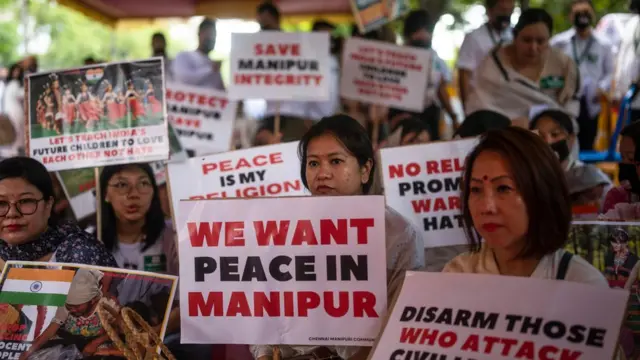
The Meitei Heritage Society’s intervention comes against the backdrop of the ongoing ethnic strife in Manipur. The conflict has its roots in disputes over land rights, political representation, and identity-based demands. The Meiteis, who dominate the valley areas, and the Kukis, including Any Kuki Tribes (AKT), who are prominent in hill regions, have been locked in violent clashes since May 2023. What began as protests against the possible inclusion of Meiteis in the Scheduled Tribe list spiralled into widespread violence, killings, arson, and displacement.
Government data suggests that over 260 people have died since the conflict erupted, while nearly 50,000 to 60,000 individuals have been displaced, living in relief camps under precarious conditions. Both sides accuse each other of grave human rights abuses, and peace efforts have struggled to bridge the chasm of distrust and bitterness that the violence has entrenched.
The APSC controversy, in this context, risks further inflaming tensions by appearing to validate one community’s narrative over another’s. For communities already scarred by violence, perceived biases in state institutions and examinations only deepen alienation and mistrust.