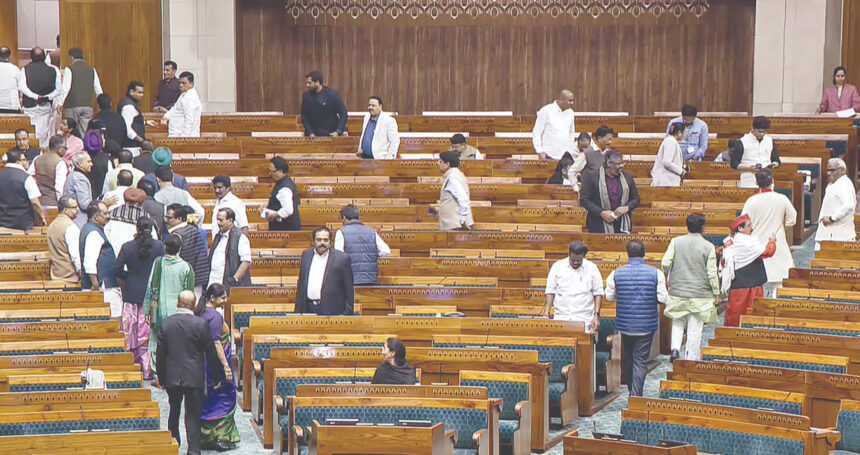
The Lok Sabha on Wednesday passed the Sustainable Harnessing and Advancement of Nuclear Energy for Transforming India, or Shanti Bill, marking a significant shift in India’s nuclear energy framework as the government moved to allow private participation in the atomic energy sector, even as opposition parties staged a walkout raising concerns over safety and liability.
The passage of the Shanti Bill came after an intense debate in the Lower House, during which the government defended the proposed changes as essential for meeting India’s growing energy needs, aligning with global clean energy trends, and unlocking stalled investments in nuclear power. The Bill was passed by a voice vote after opposition members walked out in protest, arguing that the proposed framework diluted supplier liability and could potentially expose citizens to greater risks in the event of a nuclear accident. The government, however, maintained that the legislation strengthens safety mechanisms while modernising the sector to reflect contemporary technological and economic realities.
Replying to the discussion, Union Minister of State in the Prime Minister’s Office Jitendra Singh, who oversees the Department of Atomic Energy, said the Bill was brought in response to long-standing concerns within the industry over India’s nuclear liability regime. According to him, the existing legal framework had created what he described as a “silent phobia” among equipment suppliers, discouraging both domestic and international players from participating in India’s civil nuclear programme for more than a decade.
Singh said the Shanti Bill seeks to remove structural bottlenecks that prevented collaboration, investment, and technological advancement in the sector. He argued that India could not afford to remain isolated at a time when the world was rapidly transitioning towards cleaner and more sustainable sources of energy. The minister emphasised that nuclear power was a crucial component of India’s long-term energy strategy and an indispensable tool for reducing carbon emissions while ensuring energy security.
Government’s case for reforming nuclear liability and expanding clean energy
During the debate, the government laid out its rationale for introducing the Shanti Bill, presenting it as a comprehensive effort to modernise India’s nuclear energy framework without compromising safety or regulatory oversight. Jitendra Singh explained that one of the core problems with the existing Civil Liability for Nuclear Damage law was the broad definition of “supplier,” which placed potential liability on a wide range of entities involved in nuclear projects. This, he said, deterred suppliers from entering the Indian market due to the fear of open-ended legal exposure.
According to the minister, the new Bill clarifies and rationalises liability by placing primary responsibility on the operator of a nuclear facility. He stated that the government would deal directly with the operator, while the operator would manage contractual arrangements with suppliers. This, he argued, was in line with international practices and conventions followed by most nuclear energy-producing countries.
Singh also highlighted that operator liability under the proposed framework has been rationalised through graded caps linked to reactor size. This approach, he said, would encourage the adoption of newer technologies, including small modular reactors, which are increasingly being viewed as safer, more flexible, and cost-effective options for expanding nuclear capacity. By tailoring liability caps to the scale of operations, the government aims to strike a balance between accountability and innovation.
Addressing concerns about compensation in the event of a nuclear incident, the minister said the Shanti Bill introduces a multi-layered mechanism to ensure that affected individuals receive full and timely compensation. This mechanism includes operator liability, a proposed Nuclear Liability Fund backed by the government, and access to additional international compensation through India’s participation in the Convention on Supplementary Compensation. Singh argued that this layered approach strengthens, rather than weakens, the compensation framework.
The minister further stated that the Bill does not dilute safety standards in any manner. He said that safety norms, security controls over fissile material, spent fuel, and heavy water, as well as periodic inspections, would remain firmly under government oversight regardless of private participation. According to him, the state’s role as a regulator and guardian of nuclear safety remains unchanged.
Singh described the Shanti Bill as a milestone legislation that would give a new direction to India’s developmental journey. He linked the reforms to India’s growing role in global geopolitics, arguing that a country aspiring to be a major global player must align itself with international benchmarks and strategies. He noted that the global energy landscape is rapidly shifting towards clean energy, and India has set an ambitious target of achieving 100 gigawatts of nuclear energy capacity by 2047.
The government also argued that the Bill is necessary to meet India’s rising energy demand and to increase the share of nuclear power in the country’s overall energy mix to around 10 per cent. Singh said that without private participation and modernised laws, achieving these targets would be extremely difficult, given the scale of investment and technological collaboration required.
Opposition objections, safety concerns, and parliamentary confrontation
The passage of the Shanti Bill was accompanied by strong opposition protests, with several parties arguing that the government was rushing through a far-reaching reform without adequate scrutiny. Opposition members contended that by limiting supplier liability, the Bill effectively allows manufacturers of nuclear equipment to escape accountability in the event of an accident, thereby placing citizens at greater risk.
Congress members, in particular, flagged multiple provisions of the Bill and urged the government to refer it to a parliamentary standing committee for detailed examination. They argued that changes of such magnitude, especially in a sensitive sector like nuclear energy, warranted thorough deliberation and consultation with experts, stakeholders, and the public.
Congress leader Manish Tewari opposed the Bill during the debate, warning that the removal of supplier liability clauses could have serious consequences in the event of a nuclear incident. He argued that suppliers play a critical role in the safety and reliability of nuclear installations, and exempting them from liability could weaken accountability across the supply chain. Tewari also expressed concern over provisions in the Bill that propose the repeal or modification of the Atomic Energy Act of 1962 and the Civil Liability for Nuclear Damage Act of 2010.
Opposition members questioned whether the proposed framework adequately protects citizens’ rights and interests, particularly in densely populated regions where nuclear facilities may be located. They argued that nuclear accidents, though rare, can have catastrophic and long-lasting consequences, and therefore require the strictest possible liability and compensation regimes.
Responding to these criticisms, Jitendra Singh clarified that the Shanti Bill does not introduce an entirely new legal regime but instead brings modifications to existing laws to address practical challenges that have emerged over time. He said most parts of the Bill were already in existence in some form and that the proposed changes were aimed at improving clarity, efficiency, and alignment with global norms.
The minister also pointed out that the Bill seeks to grant statutory status to the Atomic Energy Regulatory Board, which was previously set up through an executive order. By giving the regulator a clear legal mandate, the government aims to strengthen oversight, transparency, and accountability in the nuclear sector. Singh argued that this move addresses long-standing demands for a more robust and independent regulatory framework.
Another significant feature of the Bill, according to the government, is the proposal to establish an Atomic Energy Redressal Council. This body would provide a specialised forum for resolving disputes related to nuclear energy without forcing stakeholders to rely solely on lengthy court proceedings. The government said this would improve efficiency and reduce uncertainty for both operators and affected parties.
Despite these assurances, opposition members remained unconvinced and continued to argue that the Bill prioritises investment and industry interests over public safety. The walkout during the vote underscored the depth of disagreement between the government and the opposition on the issue. Critics accused the government of using its numerical strength to push through legislation without building broader consensus.
The debate over the Shanti Bill also reflected larger political and ideological differences over the role of private players in strategic sectors. While the government framed private participation as essential for growth, innovation, and global competitiveness, opposition parties warned against excessive reliance on private entities in areas involving national security and public safety.
As the Bill now moves forward following its passage in the Lok Sabha, it is expected to shape the future trajectory of India’s nuclear energy programme. The government sees it as a critical step towards meeting clean energy targets, enhancing energy security, and positioning India as a serious player in global nuclear cooperation. At the same time, the concerns raised by the opposition highlight the continuing debate over how best to balance development, safety, accountability, and public trust in one of the most sensitive sectors of the economy.