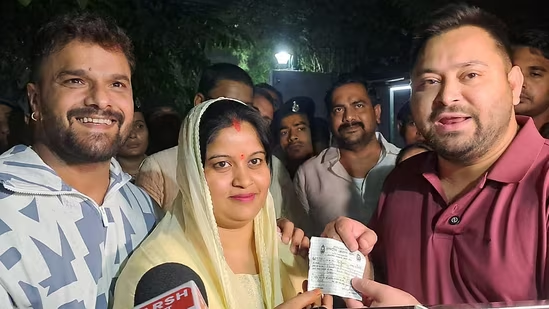
A day after his video praising Prime Minister Narendra Modi went viral, Bhojpuri singer-actor and Rashtriya Janata Dal (RJD) leader Khesari Lal Yadav launched a sharp critique against the BJP-led government at the Centre, questioning its long-term vision for Bihar. Addressing his supporters and the media, Yadav said that despite two decades of the National Democratic Alliance’s rule in Bihar and nearly fifteen years of BJP’s dominance at the Centre, the state continues to lag behind in key areas such as employment, industrial development, higher education, and healthcare. His comments, coming just days after joining the RJD and filing his nomination from Chapra constituency for the upcoming Bihar Assembly elections, have added a new twist to the state’s political discourse.
From admiration to accusation: Yadav’s sharp turn in tone
Khesari Lal Yadav, known for his immense popularity in Bhojpuri cinema and music, sparked conversation when he recently described himself as a “big fan” of Prime Minister Modi. The video, which surfaced on social media and was later amplified by the BJP’s official X (formerly Twitter) handle, showed Yadav lauding the prime minister’s leadership and vision. However, within 24 hours, the narrative shifted dramatically. While maintaining that he still “admires” Modi personally, Yadav questioned why that same vision had failed to uplift Bihar.
“I absolutely admire him, and I still do. He’s never been bad,” Yadav said in his statement. “But why hasn’t his vision been extended to our Bihar? They have been in power at the Centre for fifteen years and have been ruling Bihar for twenty years. Yet, why haven’t people here found proper employment, good universities, or modern hospitals? Why do we only get trains and not factories?”
His comments were a clear attack on the NDA’s development claims in Bihar, particularly targeting the gap between promises and implementation. Yadav’s tone reflected frustration shared by many in Bihar over the state’s persistent economic stagnation. In his view, the state continues to suffer due to policy neglect and misplaced political priorities.
Invoking Modi’s much-lauded “Gujarat model,” Yadav urged the prime minister to bring similar transformation to Bihar. “You have made Gujarat so much better; I want you to make Bihar as good as half of Gujarat,” he said, emphasizing that Bihar deserves equal attention and development opportunities.
Yadav’s remarks came as a surprise to many, given his earlier praise of Modi and his attempts to maintain a balanced political stance. His criticism, however, has been interpreted as a strategic move to align with the RJD’s core narrative—that Bihar’s problems are rooted in years of NDA governance, which has failed to address unemployment, industrial backwardness, and poor infrastructure.
Questioning ‘Jungle Raj’ narrative and highlighting Bihar’s stagnation
Responding to Prime Minister Modi’s frequent references to the so-called “Jungle Raj” under previous RJD governments, Khesari Lal Yadav countered the claim by turning the argument back on the ruling alliance. “Even today, people here are scared of setting up factories because they hear from their own leaders that there is Jungle Raj,” he said. “Your government has been in power for twenty years, and even then, you say there is Jungle Raj — then what have you changed?”
Yadav’s statement challenges one of the BJP’s strongest campaign narratives in Bihar. For years, the NDA has invoked the term “Jungle Raj” to describe alleged lawlessness and corruption under the RJD’s earlier regimes. By suggesting that the ruling government’s own narrative continues to paint Bihar as unsafe, Yadav argued that the NDA has failed to change perceptions, let alone reality.
At the time of filing his nomination papers, Yadav identified migration as Bihar’s gravest challenge, accusing the government of “deliberately creating a labour class” by failing to generate local employment opportunities. He questioned how, despite long years of political stability, Bihar has not seen the establishment of even a single major factory. “How is it possible that the government has failed to set up a single factory in the last fifteen years?” he asked.
Yadav’s critique ties into a broader sentiment of disillusionment among Bihar’s youth, many of whom migrate to other states for jobs due to lack of industries and economic stagnation at home. His comments underline the RJD’s electoral strategy, which revolves around portraying the NDA as out of touch with Bihar’s realities, focusing on symbolic politics rather than structural reform.
The singer-turned-politician also reiterated the RJD’s promise to check outmigration by fostering employment within the state. He asserted that Bihar’s image has been “deliberately distorted” by the NDA, which he accused of projecting a “false perception” of lawlessness to cover its own administrative failures. According to Yadav, “the narrative of Jungle Raj” is a political tool used to divert attention from the government’s inability to deliver on jobs, industries, and basic infrastructure.
In his speech, Yadav said the people of Bihar deserve the same quality of life and progress as citizens of Gujarat, which has often been showcased by the BJP as a model of industrial and infrastructural growth. He lamented that while Gujarat boasts a thriving economy, robust industrial presence, and world-class infrastructure, Bihar continues to struggle for basic amenities.
The emotional tone of his remarks also reflected a sense of betrayal — admiration for the prime minister’s national leadership juxtaposed with deep disappointment over Bihar’s neglect. “Why don’t they give us factories?” Yadav asked rhetorically, a line that resonated widely on social media. For many, it encapsulated a decades-old grievance — that Bihar, despite its talent and population, remains sidelined in India’s growth story.
Migration, employment, and Bihar’s political identity
Migration remains one of Bihar’s most enduring issues, shaping both its economy and its politics. Every year, lakhs of workers leave the state in search of livelihood in cities like Delhi, Mumbai, Surat, and Kolkata. Yadav, speaking from his own roots in rural Bihar, has sought to connect this exodus with the government’s failure to generate opportunities at home. By linking migration with structural unemployment, he positioned himself as a voice of the working class and youth.
Yadav argued that successive governments have treated migration as inevitable instead of addressing its root causes. “Bihar’s people are hardworking; they build cities across India. But why can’t they build Bihar itself?” he said, questioning both the central and state leaderships. His argument reflected a broader RJD position — that Bihar’s development requires local empowerment, equitable investment, and an end to economic dependency on remittances.
His comments also struck a chord with migrant workers who often return to Bihar during elections but find little change in their home state. By criticizing the lack of industries, Yadav touched upon the emotional and economic heart of Bihar’s political debate — why the state, despite abundant human resources, remains among the least industrialized in India.
The controversy around his shifting tone — from praising Modi to confronting him — has also sparked discussions about authenticity and electoral strategy. While BJP leaders used his earlier video to claim cross-party admiration for Modi’s leadership, RJD supporters have portrayed his later remarks as evidence of courage and sincerity. Political observers believe Yadav’s statements reflect an emerging trend among Bihar’s younger politicians, who are seeking to combine popular appeal with issue-based politics.
Yadav’s entry into the RJD has already generated significant attention, given his influence among rural and youth voters, especially in Bhojpuri-speaking regions. His criticism of the NDA’s track record on jobs and industrial development mirrors the RJD’s broader campaign narrative, which centers on the slogan of “Rozgar aur Samman” (Employment and Dignity).
By directly questioning the Gujarat-Bihar comparison, Yadav highlighted the widening gap between the two states. Gujarat, under decades of pro-industrial policies, has evolved into a hub of manufacturing, trade, and infrastructure, while Bihar continues to depend heavily on agriculture and remittances. His statement — “Make Bihar as good as half of Gujarat” — was both a challenge and an appeal, blending admiration with confrontation.
Yadav’s rhetoric has added a new emotional edge to Bihar’s political climate, which often oscillates between nostalgia, frustration, and aspiration. His remarks symbolize a generational demand for accountability — not just from political parties but from a governance model that has failed to deliver substantive progress.
As the Bihar Assembly elections approach, Khesari Lal Yadav’s journey from film stardom to politics, and from admiration to criticism of the ruling establishment, captures the changing tone of Bihar’s electorate. His challenge to the prime minister — asking why Bihar cannot be “even half of Gujarat” — goes beyond political theatre. It reflects a deeper frustration among millions who believe Bihar’s potential has long been overshadowed by political inertia and misplaced priorities.
His words, echoing through the political corridors of Patna and beyond, mark not just a personal statement but a reflection of Bihar’s enduring question — when will its growth story finally begin?