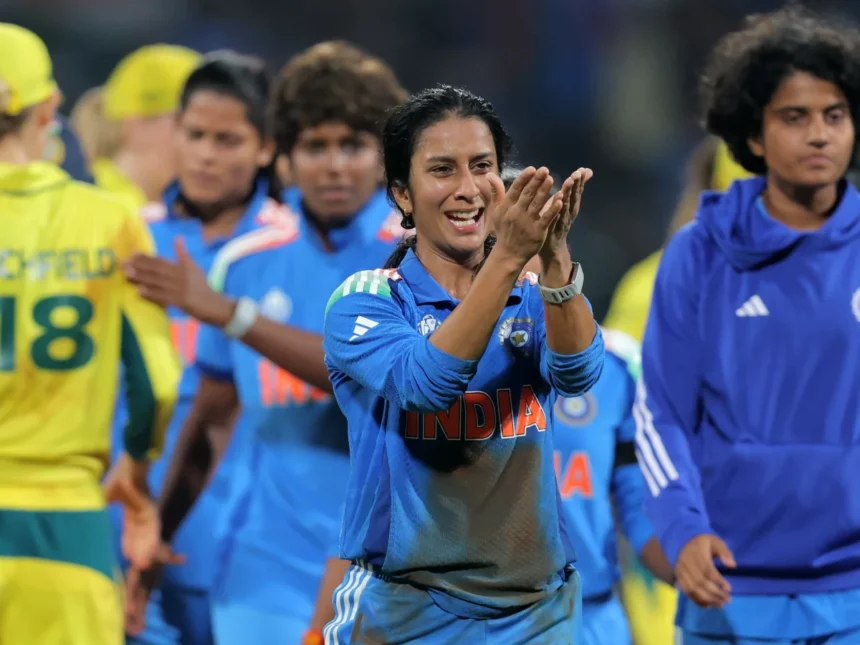
In one of the most exhilarating matches in women’s cricket history, India’s national team, led by Harmanpreet Kaur and powered by a sensational unbeaten century from Jemimah Rodrigues, stunned seven-time champions Australia to storm into the Women’s World Cup final. The victory, achieved at Navi Mumbai’s Dr. DY Patil Stadium, sent waves of pride and emotion across the cricketing world, prompting overwhelming reactions from icons such as Rohit Sharma, Sachin Tendulkar, Sourav Ganguly, and Gautam Gambhir. The triumph not only symbolized India’s sporting excellence but also represented the coming of age of women’s cricket in the country.
Jemimah Rodrigues’ Heroic Innings Leads India to a Record-Breaking Chase
On the eve of the semi-final clash, few believed India could defeat Australia — a team that had dominated world cricket for years and entered the contest as overwhelming favourites. Yet, as sport often defies prediction, the Indian women displayed unmatched determination and skill on the biggest stage. When the sun set over Navi Mumbai, history was rewritten in the most spectacular fashion.
Jemimah Rodrigues, the 25-year-old Mumbai-born batter, produced an innings for the ages. Her unbeaten 127 off 134 deliveries was a masterclass in composure, timing, and grit. It was not just a display of technical brilliance but a statement of belief — one that showed India’s women could chase down even the most daunting targets under pressure. With support from captain Harmanpreet Kaur, Rodrigues steered the side to victory as India hunted down Australia’s mammoth 339-run total with five wickets and nine balls to spare.
The chase had begun on shaky ground. Shafali Verma fell for 10, and Smriti Mandhana, despite looking fluent, was dismissed for 24. At 49 for 2 within ten overs, the pressure was immense. Yet it was at this moment that Jemimah and Harmanpreet took control, blending aggression with calm assurance. Together, they built a remarkable 167-run partnership that became the backbone of India’s chase.
Harmanpreet, ever the inspirational leader, played a magnificent innings of 89 before she was caught against the run of play by Annabel Sutherland. Her dismissal momentarily silenced the crowd, but Jemimah’s poise kept India steady. The support acts from Deepti Sharma (24) and Richa Ghosh (26) added crucial runs, and when Amanjot Kaur struck the winning boundary, the stadium erupted in unbridled joy. Jemimah fell to her knees in tears, embracing her captain as the magnitude of the moment sank in. It was more than a win — it was redemption, resilience, and history intertwined.
This victory marked India’s third entry into a Women’s World Cup final and the first since 2017. For a team that had battled years of underestimation and limited exposure, the win was validation of their evolution into a world-class cricketing force. The tricolour soared high as fans across the country celebrated an achievement that will be remembered for generations.
Legends React as India’s Women Capture the Nation’s Heart
As soon as India completed their record-breaking chase, social media platforms exploded with admiration and emotion. From the men’s team’s stalwarts to former captains, cricket legends expressed their pride and awe at the women’s incredible performance.
India’s current men’s captain, Rohit Sharma, who recently dominated Australia in the men’s ODI series, took to Instagram to share a photo of the victorious team with a simple yet heartfelt message: “Well done Team India.” His words reflected the collective pride of a billion fans who witnessed the defining moment in Indian cricket.
Sachin Tendulkar, the face of Indian cricket for decades, was among the first to pen a congratulatory message on X (formerly Twitter). “Fabulous victory! Well done @JemiRodrigues and @ImHarmanpreet for leading from the front. Shree Charani and @Deepti_Sharma06, you kept the game alive with the ball. Keep the tricolour flying high,” wrote the Master Blaster, whose words have always carried the weight of reverence in Indian sport. His mention of both batters and bowlers highlighted the collective nature of the team’s effort.
Sourav Ganguly, the former India captain and ex-BCCI president, lauded the team’s meteoric rise over the years. “Incredible stuff from the girls. How good they have become in the last 5 years! One more to go… just outstanding @BCCIWomen,” he wrote. Ganguly’s message underlined how the Indian women’s team has grown into a powerhouse under consistent domestic investment and greater exposure to global tournaments.
Gautam Gambhir, India’s men’s head coach and one of the fiercest competitors of his generation, praised the side’s mental toughness. “It ain’t over till it’s over! What a performance girls,” he posted, emphasizing the fighting spirit that defined India’s victory. His message echoed the sentiment of countless fans who witnessed India claw back from a precarious position to triumph against the best team in the world.
Yuvraj Singh, a two-time World Cup winner himself, offered perhaps the most emotional tribute. “There are wins that go beyond numbers on a scoreboard. This was one of them. Under pressure, with the world watching, @ImHarmanpreet played with the calm and conviction of a true leader while @JemiRodrigues brought pure focus and intent to play an innings of a lifetime! This partnership came from belief in their own game, in each other, and in what this team stands for. A historic semi-final to win and on to the finals now,” Yuvraj wrote.
His words perfectly captured the spirit of India’s win — a victory not just over a team, but over doubt, expectation, and history.
India’s Women Redefine the Future of the Game
Beyond the immediate euphoria, India’s semi-final win against Australia will be remembered as a turning point for women’s cricket in India. The performance reflected the depth, confidence, and maturity that has gradually built over the last decade. It also validated the efforts of domestic academies, coaches, and young aspirants who have worked tirelessly to elevate the game’s standards.
The leadership of Harmanpreet Kaur stood out once again. Having weathered criticism after the 2022 Commonwealth Games and the 2023 T20 World Cup exit, her determination and clarity under pressure in the semi-final silenced critics. Her partnership with Jemimah Rodrigues was the perfect balance of aggression and intelligence — a reflection of her evolution as both a batter and captain.
Jemimah’s century, meanwhile, might go down as one of the most significant knocks in Indian cricket history. Not only did she display technical brilliance, but she also showcased remarkable mental strength — pacing her innings perfectly, absorbing pressure, and attacking at the right moments. Her partnership with Harmanpreet was a lesson in controlled aggression, where both players trusted each other’s instincts completely.
India’s bowlers, though overshadowed by the batting heroics, deserve equal credit. Deepti Sharma’s tight spells in the middle overs, coupled with Shree Charani’s breakthroughs, restricted Australia’s scoring rate in the death overs. Their combined effort ensured that Australia’s total, though daunting, was still within reach.
As India now gears up for the final against South Africa on November 2 at the Dr. DY Patil Stadium, the momentum, belief, and emotion surrounding this team have reached unprecedented heights. The country’s cricketing legends, past and present, have rallied behind them — a rare moment of unity that transcends gender divisions within the sport.
What this victory ultimately signifies is more than a semifinal result. It represents the dawn of a new era — one where women’s cricket in India commands equal attention, admiration, and pride. When Amanjot Kaur struck the winning boundary and the Indian dugout rushed onto the field, the image of Jemimah and Harmanpreet embracing in tears encapsulated the emotion of millions of fans. The tricolour fluttered proudly under the Mumbai sky, as the players celebrated a victory that carried the weight of dreams fulfilled.
The roar of the crowd, the tears of the players, and the applause from legends like Tendulkar and Ganguly marked the night India’s women redefined glory — not just for themselves, but for Indian cricket as a whole.