New Delhi, January 19, 2026
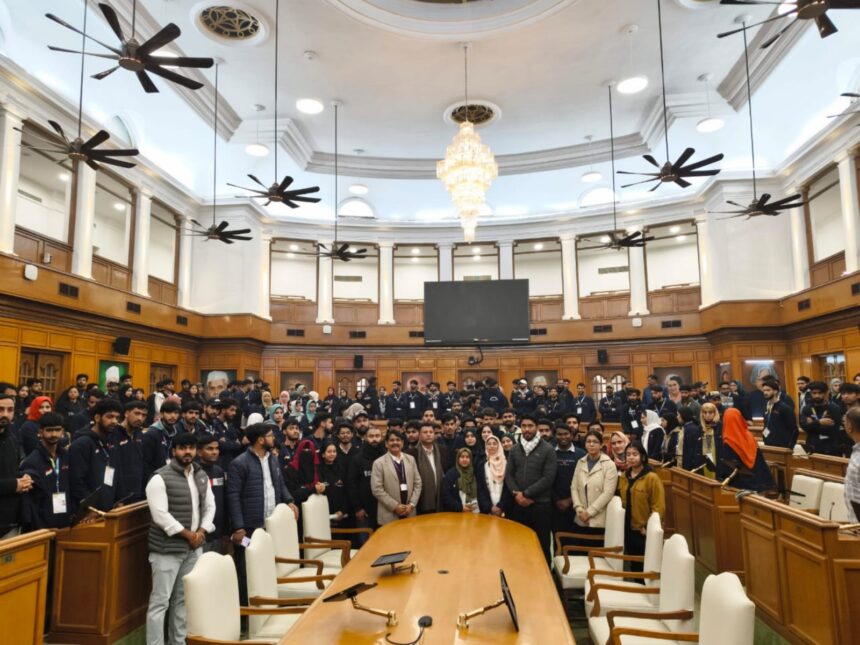
As part of the Mera Yuva Bharat initiative’s Kashmiri Youth Exchange Programme, a delegation of 170 youth from Jammu and Kashmir visited the Delhi Legislative Assembly on Monday, gaining first-hand exposure to parliamentary functioning, democratic processes, and modern legislative practices. The programme is being organised by the Ministry of Youth Affairs and Sports in collaboration with the Ministry of Home Affairs, Government of India, with the objective of strengthening national integration and encouraging youth engagement with democratic institutions.
The delegation comprised young participants from the districts of Anantnag, Kupwara, Baramulla, Budgam, Srinagar, and Pulwama. For many members of the group, this was their first visit to the national capital, making the experience both educational and memorable. Officials of the Delhi Legislative Assembly Secretariat welcomed the delegation and briefed them on the functioning, history, and transformation of the Vidhan Sabha.
During the visit, the youth were informed that under the leadership of Speaker Vijender Gupta, the Delhi Legislative Assembly has emerged as India’s first fully solar-powered legislative assembly. Officials highlighted that the Assembly has adopted environmentally sustainable practices while also embracing digital governance. The House proceedings are now conducted through a fully digitalised system integrated with the National e-Vidhan Application (NeVA), which enables paperless functioning, real-time access to legislative documents, and greater transparency in legislative work.
The delegation was also apprised of the Speaker’s vision to transform the Delhi Legislative Assembly into a cultural and heritage site of national significance. Assembly officials explained that efforts are underway to preserve and showcase the historical importance of the Vidhan Sabha building while maintaining its role as a modern legislative institution. The initiative aims to create a space that reflects both India’s democratic traditions and its evolving governance framework.
As part of the educational tour, the youth were familiarised with the procedures and processes followed during Assembly sessions. Officials explained the conduct of legislative debates, the significance of Question Hour, and the role of elected representatives in policy-making and governance. The participants were given insights into how laws are discussed, scrutinised, and passed, and how legislators raise issues of public importance within the House.
The historical and architectural significance of the Delhi Vidhan Sabha building was also a key focus of the visit. Participants were informed that the building once served as the seat of British India, housing the Central Legislative Council, which is today’s Parliament of India. It also functioned as a temporary Central Secretariat after the capital was shifted from Kolkata to Delhi in December 1911. Officials explained how the building has witnessed several landmark moments in India’s legislative and political history.
The youth were also introduced to the contributions of prominent leaders who played a role in shaping parliamentary traditions in India, including Vithalbhai Patel. Discussions focused on how early legislative leaders strengthened democratic practices and laid the foundation for parliamentary governance in the country. This historical context helped participants better understand the evolution of India’s legislative institutions.
Throughout the visit, members of the delegation actively interacted with officers of the Assembly Secretariat. They raised questions related to legislative functioning, public administration, and democratic practices, reflecting keen interest and curiosity about governance mechanisms. Officials responded by explaining how legislatures function within the constitutional framework and how citizens, particularly young people, can engage with democratic institutions.
The visit provided the Kashmiri youth with a comprehensive understanding of India’s constitutional legacy, democratic values, and governance structures. Officials noted that such exchange programmes play a crucial role in building awareness among young citizens and fostering a sense of participation in the democratic process. The interaction also aimed to encourage youth from different regions to connect with national institutions and understand their role in shaping public policy.
The Kashmiri Youth Exchange Programme under the Mera Yuva Bharat initiative seeks to promote mutual understanding, national unity, and leadership development among young people. The Delhi Legislative Assembly visit was described by officials as a meaningful step in exposing participants to best practices in governance, sustainability, and digital transformation.
The delegation concluded its visit with a deeper appreciation of India’s democratic institutions and a broader perspective on legislative governance. The experience is expected to inspire the participants to engage more actively with civic life and contribute positively to society upon returning to their respective districts in Jammu and Kashmir.