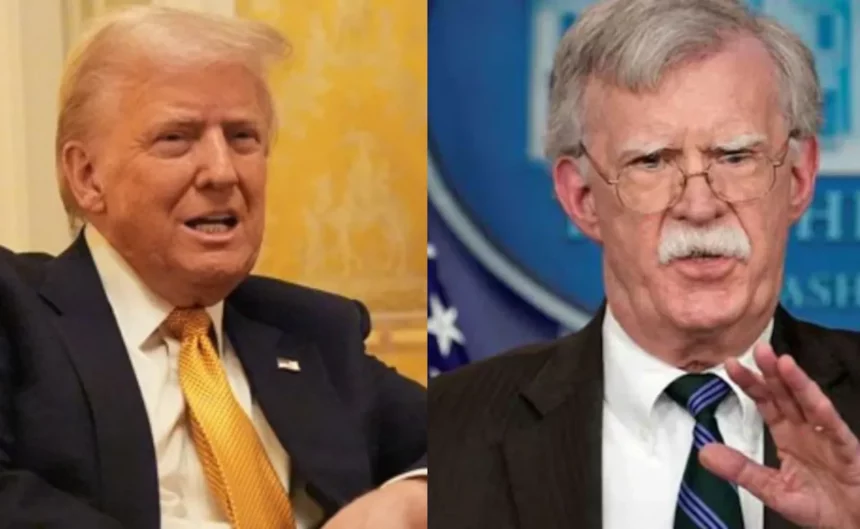
Former United States National Security Advisor John Bolton has launched a scathing attack on President Donald Trump, criticising both his claims of bringing peace between India and Pakistan and his imposition of heavy tariffs on New Delhi for its oil and defence dealings with Russia. John Bolton, who has served as both the US NSA and ambassador to the United Nations, described Donald Trump’s actions as “inappropriate” and “erratic,” while advising India to adopt a long-term view of its strategic partnership with Washington. His comments reflect a growing unease in policy circles over Donald Trump’s unconventional approach to international relations, which John Bolton characterised more as theatrical performance than as deliberate policy.
John Bolton Questions Tariffs on India While Sparing China, Turkey, and Pakistan
John Bolton was particularly critical of Donald Trump’s decision to target India with a steep 25 per cent reciprocal tariff, coupled with an additional levy of 25 per cent on purchases of Russian oil and military equipment. According to John Bolton, these measures were inconsistent and disproportionate, especially when compared to the treatment of other countries such as China, Turkey, and Pakistan, which continue to buy far larger quantities of Russian oil and weapons without facing similar punitive action. Speaking in an interview, John Bolton questioned why India, a close strategic partner of the United States, was singled out for penalties while adversarial nations were spared. He noted that such selective targeting undermined trust and highlighted Donald Trump’s impulsive and unpredictable style of governance.
John Bolton explained that the sanctions on India did not reflect the usual course of trade negotiations or diplomatic dialogue. Instead, he argued, they were emblematic of Donald Trump’s highly personal and unconventional approach to foreign policy, particularly his tendency to use tariffs and sanctions not as strategic tools but as instruments of political theatre. In John Bolton’s view, these actions diminished America’s credibility on the world stage, sending confusing signals to allies and adversaries alike.
The former NSA also underscored that Donald Trump’s broader handling of global crises, including Russia’s aggression against Ukraine, revealed inconsistencies in American policy. Despite penalising India for purchasing Russian oil, Donald Trump had not enforced equally stringent sanctions on Moscow itself, nor had he imposed penalties on Beijing, the world’s largest purchaser of Russian energy. This selective enforcement, John Bolton warned, projected an image of bias and weakened the legitimacy of US measures.
John Bolton’s remarks come at a time when India is seeking to balance its long-standing relationship with Russia against its deepening ties with the United States. He acknowledged that New Delhi faces difficult choices in navigating these competing pressures but emphasised that India should not be penalised for acting in accordance with its national interests. By disproportionately targeting India, John Bolton argued, Donald Trump risked alienating a vital partner in Asia and undermining years of careful diplomatic engagement between the two democracies.
Peace Claims and John Bolton’s Dismissal of Donald Trump’s India-Pakistan Narrative
Alongside his critique of Donald Trump’s trade and tariff policies, John Bolton also dismissed the former president’s repeated assertions that he had brokered peace between India and Pakistan. According to Donald Trump, he had played a decisive role in ending hostilities after a terrorist attack in Kashmir, but John Bolton contradicted this claim, clarifying that the ceasefire was the result of direct dialogue between the Directors General of Military Operations (DGMOs) of the Indian and Pakistani militaries. John Bolton stressed that Donald Trump’s self-congratulatory statements were not only inaccurate but also diminished the credibility of American diplomacy by exaggerating the role of the White House in South Asian affairs.
He added that in Washington there had been widespread concern about Donald Trump’s eagerness to take credit for developments that had little to do with him. John Bolton noted that India’s reliance on back-channel diplomacy and its decision to conduct quiet military-to-military talks with Pakistan reflected New Delhi’s preference for pragmatism over publicity. For India, the ceasefire was a matter of operational necessity and regional stability, not an opportunity for foreign leaders to claim political victory. John Bolton observed that India had consistently rejected the idea of third-party mediation in its disputes with Pakistan, preferring bilateral mechanisms. Donald Trump’s claims, therefore, were at odds with India’s long-established diplomatic stance.
John Bolton argued that Donald Trump’s handling of the India-Pakistan issue exemplified his broader approach to international affairs: erratic, self-serving, and often disconnected from established facts. By exaggerating his role, Donald Trump not only distorted the reality of events but also risked straining trust between India and the United States. John Bolton urged New Delhi to interpret such behaviour as unique to Donald Trump’s personality rather than as a reflection of American policy. He advised Indian policymakers to treat Donald Trump as a temporary phenomenon, reminding them that his presidency would last only a limited period of time.
In this context, John Bolton recommended that India continue pursuing its long-term strategy of deepening cooperation with Washington while maintaining autonomy in areas of national interest. He praised India’s measured response to Donald Trump’s pressure tactics, describing it as an example of restraint and maturity. According to John Bolton, India’s choice to avoid direct confrontation with Donald Trump and instead rely on back-channel diplomacy was the most effective way to safeguard its interests. Confrontation, he warned, would have only escalated tensions and complicated bilateral relations further.
John Bolton further noted that Donald Trump’s pressure tactics often had more to do with domestic political theatre than with foreign policy strategy. He described the imposition of tariffs and sanctions as part of Donald Trump’s performance-oriented style, aimed at appealing to his domestic audience rather than advancing coherent international objectives. This tendency, John Bolton suggested, weakened the United States’ reputation as a reliable partner and eroded global confidence in its commitments.
John Bolton’s critique carries weight given his prominent role in US foreign policy during his tenure as NSA. His comments reflect a growing consensus among seasoned policymakers that Donald Trump’s presidency introduced significant volatility into American international relations, particularly with allies. For India, John Bolton’s remarks serve as both a warning and a reassurance: a warning about the unpredictability of Trump’s actions, but also reassurance that these actions are not indicative of broader American attitudes.
John Bolton concluded his reflections by emphasising the need for India to maintain perspective. Donald Trump’s presidency, he argued, was temporary, and India should focus on advancing long-term relations with the United States rather than allowing short-term turbulence to dictate its strategic direction. The objective for New Delhi, John Bolton said, should be to minimise damage during Donald Trump’s tenure, preserve the fundamentals of the relationship, and repair any fallout once a more conventional administration takes office.