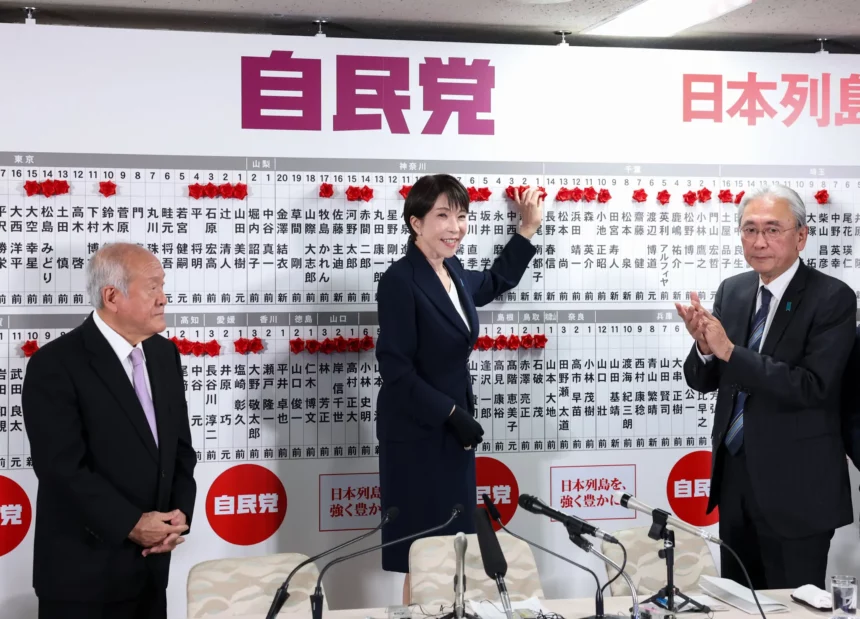
Japan’s political landscape has undergone a dramatic transformation following a snap general election that delivered Prime Minister Sanae Takaichi an overwhelming mandate, consolidating her authority barely months after assuming office. By dissolving Parliament just 110 days into her tenure, Takaichi took a calculated political risk that has now reshaped the balance of power in Tokyo. The scale of the victory has not only strengthened her grip over domestic policymaking but also repositioned Japan’s leadership posture on the global stage, particularly on issues of economic expansion, national security, immigration, and relations with China.
The Liberal Democratic Party’s sweeping performance has removed institutional roadblocks that previously constrained governance, enabling Takaichi to advance a hard-line agenda with unprecedented legislative ease. Voters’ endorsement has come amid economic anxiety, geopolitical uncertainty, and growing ideological polarisation, making the result one of the most consequential electoral outcomes in Japan’s post-war history.
Electoral Landslide Reshapes Parliamentary Power and Domestic Governance
The snap election delivered the Liberal Democratic Party a historic supermajority in the House of Representatives, marking the first time since the Second World War that a single political party has crossed the two-thirds threshold in Japan’s lower house. With 316 seats secured in the 465-member chamber, the ruling party has decisively overturned years of electoral setbacks that had relegated it to minority status in both houses of Parliament.
This parliamentary arithmetic fundamentally alters the mechanics of governance. With near-total control of the legislative process, Prime Minister Takaichi now faces minimal resistance in passing budgets, enacting laws, and reshaping institutional frameworks. Opposition parties, fragmented and numerically diminished, lack the capacity to delay or dilute government proposals, effectively neutralising parliamentary checks in the immediate term.
Takaichi justified the snap election as a democratic necessity, arguing that governing without a direct public mandate created moral and political unease. The electorate’s response suggests broad acceptance of that reasoning, with voter turnout exceeding the previous national election despite severe winter conditions across much of the country. The result reflects not merely party loyalty but a consolidation of public confidence in decisive leadership during a period of economic and strategic flux.
Markets responded swiftly to the outcome, interpreting the mandate as approval for expansionary fiscal policy. Equity indices surged as investors anticipated accelerated government spending, particularly in defence, industrial policy, and advanced technologies. The victory has emboldened the administration to pursue aggressive budgetary measures aimed at breaking Japan’s long-standing deflationary cycle, even as concerns persist over the nation’s already substantial public debt.
Domestically, Takaichi’s authority extends beyond economics. The electoral mandate strengthens her ability to push socially conservative legislation, recalibrate labour and wage policies, and tighten immigration controls. Right-leaning political forces, emboldened by parallel electoral gains, are pressing the government to act swiftly on wage stagnation and demographic pressures, amplifying expectations that reform will be both rapid and ideologically firm.
Foreign Policy Assertiveness, Security Expansion and Regional Tensions
Beyond domestic governance, the election outcome carries profound implications for Japan’s foreign policy orientation. Takaichi’s campaign rhetoric and policy commitments emphasised a muscular approach to national security, signalling a departure from the cautious incrementalism that has long defined Tokyo’s strategic posture. With legislative constraints largely removed, the government is now positioned to expand defence spending, pursue constitutional reinterpretations, and strengthen legal frameworks governing intelligence and counter-espionage.
Central to this agenda is Japan’s relationship with China. Takaichi’s vocal support for Taiwan and her explicit warning that Japan could intervene militarily in the event of an attack have already triggered economic retaliation from Beijing. Restrictions on seafood imports, tourism discouragement, and limitations on critical mineral exports have underscored the tangible costs of diplomatic confrontation. Yet the election result suggests domestic political insulation against such pressures, reinforcing the administration’s resolve to maintain a firm stance.
The mandate also enhances Takaichi’s leverage in dealings with the United States. Her alignment with Washington’s strategic priorities in the Indo-Pacific, coupled with explicit support from President Donald Trump, positions Japan as a central pillar of regional security architecture. The forthcoming bilateral engagement in Washington is expected to focus on military commitments, economic cooperation, and supply chain resilience, areas now backed by renewed electoral legitimacy.
At home, the electorate’s endorsement reflects a broader shift in political culture. Younger voters, in particular, have gravitated toward Takaichi’s assertive style, viewing it as a break from the cautious consensus politics of previous administrations. This generational support has reinforced her image as a leader willing to articulate clear positions on contentious issues, even at the risk of diplomatic friction.
The convergence of economic expansionism, security assertiveness, and ideological clarity marks a defining moment for Japan’s governance trajectory. With few institutional barriers remaining, the pace and scale of reform will now depend less on political feasibility and more on external constraints, including global markets, regional stability, and international alliances.