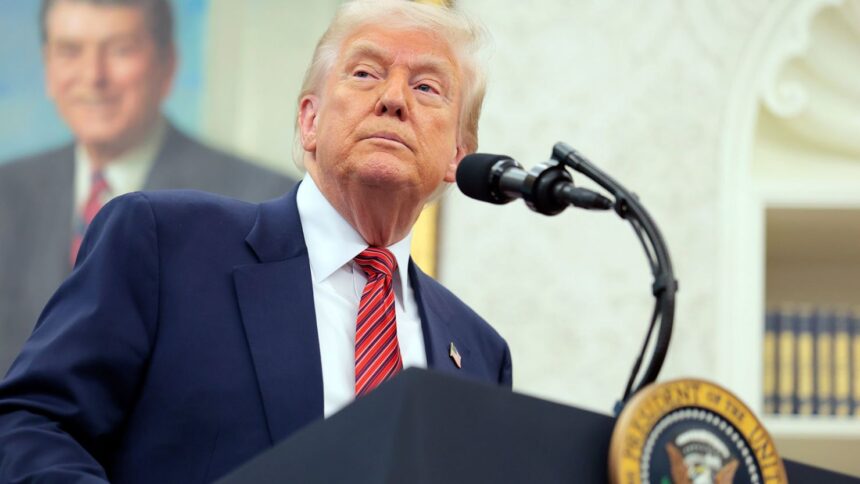
In a renewed and controversial assertion, US President Donald Trump has once again claimed that his intervention was instrumental in brokering peace between India and Pakistan following their military confrontation earlier this year. Speaking at a public event in Miami, Florida, Donald Trump said that his decision to threaten both countries with a suspension of trade deals was what ultimately led to the ceasefire agreement. The statement has revived intense debate over Donald Trump’s credibility and his repeated claims of single-handedly resolving international conflicts, with India officially rejecting any such involvement by the US.
Donald Trump’s renewed claim of ending India-Pakistan hostilities
Addressing his supporters in Miami, Donald Trump recounted what he described as his personal role in de-escalating hostilities between New Delhi and Islamabad. He claimed that during ongoing negotiations for trade deals with both countries, he learned through media reports that India and Pakistan were on the verge of war. Donald Trump stated that he immediately decided to use economic leverage to halt the escalating tensions between the two nuclear powers.
According to Donald Trump, he warned both nations that any ongoing trade discussions would be canceled if they continued their military confrontation. “I said, ‘I’m not going to make any trade deals with you guys unless you agree to peace.’ And that statement took both of them by shock,” Donald Trump said, as quoted by the US media. He alleged that eight aircraft had already been shot down during the conflict — an increase from his earlier claim of seven — and added that the situation was on the brink of a full-scale nuclear exchange.
He continued, saying that his firm stance prompted immediate action. “The two nations said, ‘No way, this has nothing to do with trade.’ I told them, ‘It has everything to do with trade. You are nuclear powers. I’m not trading with you if you are at war.’” Donald Trump claimed that the following day, both countries reached out to inform him that peace had been restored.
As per his version, this exchange took place on May 9, and by May 10, both India and Pakistan had publicly announced their decision to cease hostilities. Donald Trump said he received a call the next day saying, “We made peace.” According to him, the move validated his belief in the power of tariffs and economic pressure. “Tariffs did that. Without tariffs, that would have never happened,” he declared to a cheering crowd, calling the episode one of his administration’s key foreign policy victories.
Donald Trump went on to boast that he had “solved eight wars in nine months” since assuming office, portraying himself as a dealmaker capable of ending even the most complex international conflicts. His claims, however, have not been substantiated by any official record or statements from the nations involved.
India’s strong denial and the background of the military escalation
The Indian government, however, has repeatedly dismissed Donald Trump’s assertions as baseless and misleading. Officials in New Delhi have maintained that there was no mediation or intervention by the United States in the ceasefire understanding reached between India and Pakistan.
During the G7 Summit held in Canada earlier this year, Prime Minister Narendra Modi was reported to have categorically rejected Donald Trump’s claim in his conversation with the American leader. Following the meeting, Indian Foreign Secretary Vikram Misri issued a clear statement saying, “Prime Minister Modi told President Donald Trump clearly that during this period, there was no talk at any stage on subjects like the India-U.S. trade deal or U.S. mediation between India and Pakistan.”
The conflict in question stemmed from a severe terror attack in Jammu and Kashmir’s Pahalgam region in April, which killed 26 tourists. In retaliation, India launched a tri-service military operation named ‘Operation Sindoor,’ targeting terrorist camps in Pakistan and Pakistan-occupied Kashmir. The strikes triggered a brief but intense military exchange between the two sides, with Pakistan responding through cross-border shelling and air intrusions.
The situation escalated sharply, raising concerns among global observers about the possibility of a nuclear confrontation. However, after several days of confrontation, both countries issued coordinated statements declaring their intention to uphold a ceasefire understanding and prevent further escalation. While many analysts attributed this outcome to backchannel communication between military and diplomatic officials, Donald Trump continues to credit his trade-related threats for the truce.
Donald Trump’s tariff war and its implications for India and Pakistan
The US president’s claims about mediating peace are intertwined with his aggressive economic policy towards both India and Pakistan. Donald Trump has repeatedly used trade tariffs as tools of diplomacy, asserting that economic pressure can achieve what traditional diplomacy often cannot.
Under his administration, Pakistan faced a 19 percent tariff, while India was subjected to a far more punitive 25 percent levy on its exports to the United States. Donald Trump justified this move by accusing New Delhi of imposing “the highest tariffs on U.S. goods.” These measures strained bilateral trade ties and triggered criticism from American businesses and Indian trade groups alike.
Later, in a move that further intensified tensions, Donald Trump announced an additional 25 percent tariff on Indian goods, raising the total to 50 percent. He described the decision as a “penalty” for India’s continued purchase of Russian oil and its participation in the BRICS bloc — an alliance that, according to him, promotes policies hostile to U.S. interests. “India has to decide whether it wants to side with the United States or continue enabling anti-American alliances,” Donald Trump reportedly said while unveiling the additional tariffs.
The move sparked criticism in both Washington and New Delhi. Analysts warned that such measures could backfire, hurting American exporters and complicating strategic ties with India — a key partner in countering China’s influence in Asia. Despite this, Donald Trump framed the tariffs as part of a broader effort to restore American economic dominance and use trade as leverage to maintain peace.
In his Miami address, Donald Trump tied the India-Pakistan ceasefire directly to this economic approach, claiming that both countries were “brought to the table” through his threat of trade isolation. “Without tariffs, that would have never happened. It was about strength. They respected that,” he said.
India’s Ministry of External Affairs, however, has consistently maintained that the ceasefire understanding between India and Pakistan was reached independently through direct military and diplomatic channels, without any third-party involvement. Officials emphasized that India’s long-standing policy opposes foreign mediation in bilateral matters with Pakistan.
Despite repeated denials from New Delhi, Donald Trump has continued to present his version of events as fact in his political speeches, portraying it as proof of his ability to achieve results through unconventional means. His repeated emphasis on “solving wars” and “using trade to bring peace” has become a recurring theme in his foreign policy narrative, drawing both support and skepticism from audiences.
In the broader diplomatic context, the episode underscores the fragile dynamics of South Asian geopolitics and the sensitivity surrounding foreign involvement in India-Pakistan relations. While Donald Trump’s claims serve his political narrative of strength and negotiation prowess, India’s consistent denial reflects its commitment to strategic autonomy and rejection of external mediation in regional disputes.
As the debate continues, Donald Trump’s version of events remains unverified and at odds with official records, but it highlights his ongoing attempt to project himself as a decisive global powerbroker capable of shaping world affairs through bold and often controversial tactics.