India’s External Affairs Minister S. Jaishankar informed Parliament that dialogue remains the only viable path to peace in the increasingly volatile West Asian region. His remarks came during the second phase of the Budget Session of Parliament, where both the Lok Sabha and the Rajya Sabha witnessed heated exchanges over the ongoing conflict involving the United States, Israel, and Iran. Opposition leaders demanded an extensive debate on the implications of the war for India, particularly regarding energy security and the safety of Indian citizens in the region. The discussion highlighted the complex diplomatic and strategic challenges facing India as tensions escalate across West Asia.
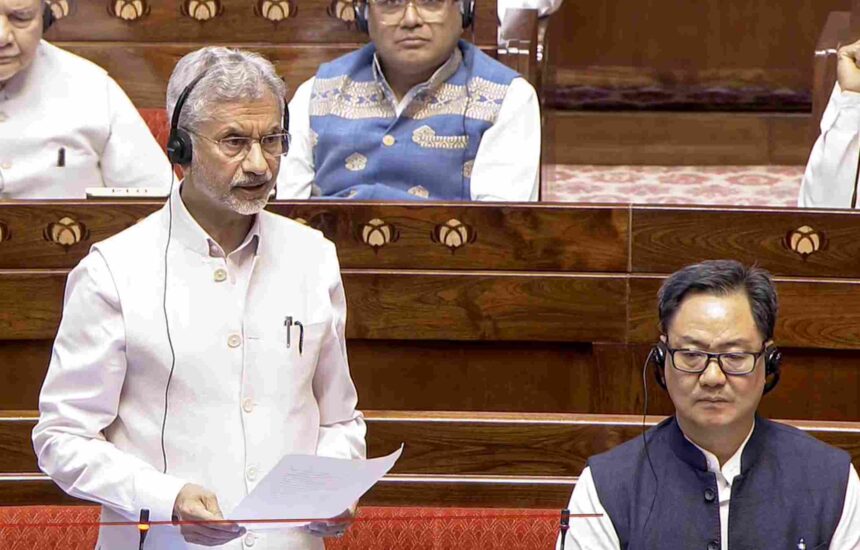
The External Affairs Minister first addressed the issue in the Rajya Sabha through a suo motu statement on the evolving situation in West Asia. Later, he repeated his remarks in the Lok Sabha while providing updates on the government’s preparations to evacuate Indian citizens from affected areas and manage potential disruptions in energy supply.
However, his statements were repeatedly interrupted by opposition members who insisted on a detailed discussion in Parliament. The situation escalated when several opposition lawmakers staged a walkout from the Rajya Sabha during the proceedings. Their protest reflected concerns about the government’s handling of the crisis and its potential impact on India’s economic and strategic interests.
Despite the disruptions, Jaishankar emphasized that India remains committed to promoting peace and stability in the region. He noted that maintaining communication with all relevant stakeholders is essential for reducing tensions and preventing further escalation of the conflict.
At the same time, the parliamentary session witnessed additional controversy over a separate motion seeking the removal of Om Birla as Speaker of the Lok Sabha. The debate on that motion contributed to the tense atmosphere in Parliament, with lawmakers from both sides exchanging sharp remarks.
Union Minister Kiren Rijiju responded to the opposition’s demands by stating that the government was open to discussion on the issue. He assured lawmakers that the government was prepared to debate concerns raised by the opposition regarding the conflict and its consequences for India.
Government outlines concerns about citizens, energy supply and regional stability
During his statement in Parliament, Jaishankar outlined several key concerns arising from the ongoing conflict in West Asia. One of the government’s primary priorities is the safety of Indian citizens living and working in the region.
The minister noted that nearly ten million Indians reside in Gulf countries, many of whom are employed in sectors such as construction, healthcare, and services. Any escalation in conflict could therefore have direct consequences for the welfare and safety of a large overseas Indian community.
In addition to the Gulf region, several Indian citizens are currently in Iran for education or employment purposes. The government has been closely monitoring the situation and coordinating with Indian diplomatic missions to ensure the safety of these individuals.
According to Jaishankar, the government has already initiated measures to assist Indian citizens who wish to return home. By March 8, approximately sixty-seven thousand Indians had crossed international borders from affected areas as part of ongoing evacuation and safety efforts.
Multiple ministries and government agencies are working together to manage these operations. The Ministry of External Affairs, in coordination with aviation authorities, immigration services, and security agencies, is ensuring that evacuation efforts are conducted efficiently and safely.
The minister also confirmed that India had suffered casualties as a result of the conflict. Two Indian merchant seafarers were killed during the hostilities, while another individual remains missing. These developments have further intensified concerns within the government regarding the safety of Indian nationals operating in conflict zones.
The Directorate General of Shipping had previously issued advisories warning Indian seafarers to exercise caution while operating in the region. In January, maritime authorities advised crew members to follow embassy guidance and avoid unnecessary travel to shore areas in potentially dangerous locations.
Jaishankar stressed that maintaining regional stability is of critical importance for India. West Asia remains one of the country’s most significant strategic regions due to its geographic proximity and its central role in global energy markets.
Any disruption in the region can quickly affect international supply chains, particularly in the oil and natural gas sector. As India imports a substantial portion of its energy requirements from West Asian countries, instability in the region could have serious economic consequences.
*Diplomatic challenges and calls for dialogue amid escalating conflict*
The External Affairs Minister also addressed the diplomatic challenges currently facing India as the conflict intensifies. According to Jaishankar, communication with Iranian leadership has become increasingly difficult due to the evolving security situation in the region.
Despite these challenges, India continues to maintain its position that dialogue and diplomacy remain the most effective means of resolving conflicts. The minister reiterated that peaceful negotiations are essential for restoring stability and preventing further escalation.
He also referred to recent interactions between India and Iranian authorities. Iran’s foreign minister had expressed gratitude to India for allowing the Iranian naval vessel IRIS Lavan to dock at Kochi Port. The gesture reflected ongoing diplomatic engagement between the two countries despite the broader regional tensions.
Meanwhile, opposition leaders in Parliament insisted that the government should hold a comprehensive discussion on the wider implications of the conflict. Among the most vocal critics was Mallikarjun Kharge, who demanded a detailed debate on energy security and India’s preparedness for potential supply disruptions.
Opposition lawmakers argued that rising geopolitical tensions could significantly affect global oil prices and supply routes, potentially increasing economic pressure on India. They called for greater transparency from the government regarding contingency plans for securing energy supplies.
The conflict involving the United States, Israel, and Iran has already led to heightened uncertainty in global markets. Military actions and retaliatory strikes have damaged infrastructure in parts of the region and increased fears of a broader regional confrontation.
Several senior Iranian leaders have reportedly been killed during the hostilities, further intensifying tensions. At the same time, attacks have been reported in parts of the Gulf region, raising concerns about the possibility of the conflict spreading beyond its current boundaries.
For India, the situation presents a complex diplomatic balancing act. The country maintains strategic partnerships with multiple nations involved in the conflict, while also prioritizing the safety of its citizens and the stability of its energy supply.
As Parliament continues to debate the issue, the government is likely to remain focused on managing these challenges through diplomatic engagement, coordination with international partners, and continued efforts to safeguard Indian nationals abroad.