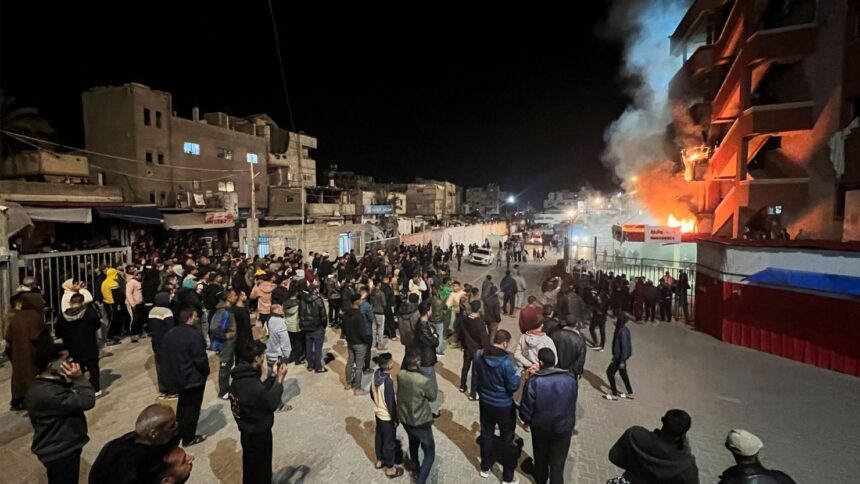
On the night of March 23, 2025, Israel’s military targeted Nasser Hospital in southern Gaza, killing one person and injuring others. The airstrike, which also ignited a large fire, severely damaged the hospital’s surgical building in Khan Younis. This attack follows a series of Israeli airstrikes that have reignited the conflict, overwhelming Gaza’s hospitals and resulting in a sharp increase in civilian casualties. Over 50,000 Palestinians have died since the war began, with many of the victims being women and children. As violence escalates, Israel’s military operations continue to devastate Gaza, while political unrest grows within Israel and tensions rise over the construction of new settlements in the West Bank.
Israel confirmed the airstrike, claiming it targeted a Hamas militant operating from the hospital. The Israeli military often blames Hamas for civilian casualties, asserting that the militant group operates in densely populated areas, including hospitals. Despite this, international humanitarian organizations have repeatedly condemned the targeting of medical facilities.
This attack is part of a broader conflict that has devastated Gaza, with the Health Ministry reporting that over 50,000 Palestinians have died since the beginning of the war. This includes numerous women and children, with 15,613 children among the victims, many under the age of one. The ongoing violence has displaced large portions of Gaza’s population, with tens of thousands forced to flee from neighborhoods like Tel al-Sultan in the south.
As the situation intensifies, Israel’s military operations have left large swaths of Gaza in ruins, with civilians caught in the crossfire. Many families have been displaced multiple times, seeking refuge in overcrowded tent camps. Meanwhile, the Palestinian Red Crescent reported losing contact with a 10-member team responding to the recent attacks in Rafah, further complicating the region’s humanitarian crisis.
The war has caused political unrest in Israel, with protests erupting over Prime Minister Benjamin Netanyahu’s government. Demonstrators are voicing their dissatisfaction, criticizing Netanyahu for handling the Gaza conflict and his government’s recent decision to express no confidence in the attorney general.
Amid the escalation, Israel’s government also approved the creation of new settlements in the West Bank, further intensifying tensions in the region. This decision has been met with international criticism, as such settlements are considered illegal under international law. As the violence continues to mount, the prospects for peace seem increasingly distant, with both sides entrenched in their positions and no end to the hostilities in sight.