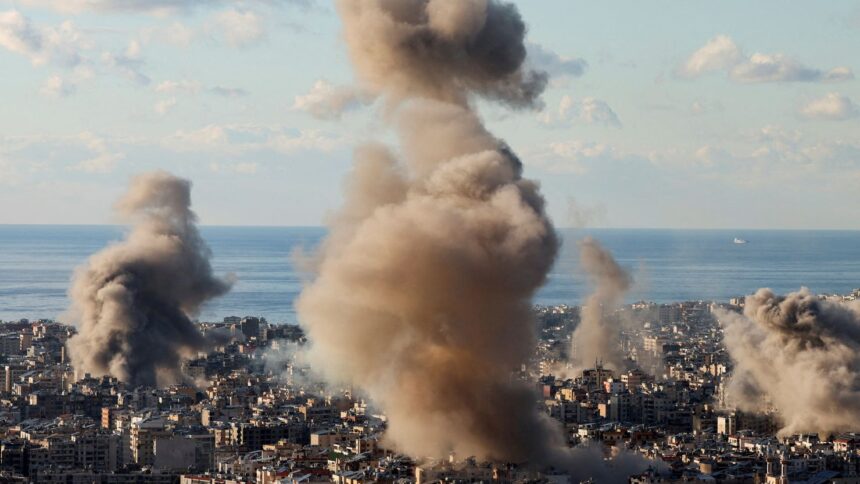
Israel has warned of intensifying military action against Hezbollah in southern Lebanon, signaling a possible escalation in one of the most volatile regions in the Middle East. The warning, issued by Israeli Defence Minister Israel Katz, came a day after a deadly Israeli airstrike killed four people in the Lebanese town of Kfar Reman. The statement marks a sharp rise in rhetoric, indicating that the fragile ceasefire agreement brokered in November 2024 is under growing strain. Katz accused the Lebanese government of failing to uphold its commitment to disarm Hezbollah, warning that Israel would not hesitate to take stronger measures if threats along its northern border persisted.
Israel’s Growing Frustration and Warning of Intensified Strikes
Israel Katz accused Beirut of “dragging its feet” on efforts to dismantle Hezbollah, saying that Lebanon had failed to fulfill its obligations under the US-mediated ceasefire agreement. “Hezbollah is playing with fire, and the president of Lebanon is dragging his feet,” Katz said in a strongly worded statement. “The Lebanese government’s commitment to disarm Hezbollah and remove it from southern Lebanon must be implemented. Maximum enforcement will continue and even intensify – we will not allow any threat to the residents of the north.”
His remarks came hours after the Israeli Defense Forces (IDF) confirmed a targeted airstrike in southern Lebanon that killed four members of Hezbollah’s elite Radwan Force. According to the IDF, the operation in Kfar Reman targeted the logistics chief of the militant group, who was allegedly involved in transferring weapons and rebuilding terror infrastructure in southern Lebanon. The IDF claimed that the strike was in direct response to Hezbollah’s ongoing violations of the ceasefire terms.
The IDF further reported that the other three individuals killed in the strike were also Radwan Force operatives. Lebanese media later identified the deceased as Jawad Jaber, Hadi Hamid, Abdullah Kahil, and Muhammad Kahil. The strike represents one of the deadliest incidents in recent months between Israel and Hezbollah, fueling fears of renewed hostilities that could destabilize Lebanon’s already fragile political landscape.
Despite the ceasefire signed in November 2024, Israel has continued to maintain troops in at least five strategic locations in southern Lebanon. The Israeli military argues that its presence and continued operations are necessary to prevent Hezbollah from regrouping and rearming. However, these actions have triggered increasing tensions with Beirut, which views the incursions as violations of Lebanese sovereignty.
Israel’s warnings also come amid broader regional anxieties, as both countries struggle to uphold the terms of the truce brokered by the United States. Under the deal, Lebanon had agreed that only state security forces would possess weapons, effectively mandating the disarmament of Hezbollah. However, nearly a year after the agreement, Hezbollah remains armed and operational, albeit weakened by continuous Israeli strikes.
Hezbollah’s Decline and Lebanon’s Political Pressure
Hezbollah, once the dominant political and military power in Lebanon, has been significantly weakened since Israel launched its large-scale offensive last year. That conflict claimed the lives of thousands of Hezbollah fighters, including the group’s long-time leader, Hassan Nasrallah, who was killed in an Israeli airstrike in September 2024. The war devastated large parts of southern and eastern Lebanon, leaving more than 1,100 women and children dead and creating widespread displacement.
Despite its heavy losses, Hezbollah has managed to retain a degree of influence in Lebanon’s political and social fabric. The group continues to receive backing from Iran, both financially and militarily, allowing it to maintain a reduced but still potent operational capability. However, its position has become increasingly precarious as domestic and international pressure mounts for disarmament.
Since the truce, Lebanon’s government has been caught in a difficult balancing act. On one hand, Beirut is under intense pressure from the United States, Saudi Arabia, and Hezbollah’s political rivals to enforce the ceasefire terms and disarm the militia. On the other hand, the Lebanese leadership must avoid triggering internal unrest or reigniting armed conflict with Hezbollah’s supporters.
According to reports from Lebanese army sources, security forces have been actively working to dismantle Hezbollah’s arms caches across the country. So extensive have these efforts been that the army reportedly exhausted its supply of explosives used for detonating confiscated weaponry. Yet, progress has been slow, largely because the Lebanese military seeks to avoid direct confrontation with Hezbollah while preserving fragile national stability.
Hezbollah, for its part, has publicly maintained its commitment to the ceasefire, refraining from launching attacks on Israeli targets. The group has not opposed the Lebanese army’s operations to seize and destroy unmanned weapons depots in the south. However, Hezbollah has repeatedly emphasized that the disarmament clause in the ceasefire applies solely to southern Lebanon, warning that it will not tolerate Israeli interference beyond that area.
This nuanced stance has created ambiguity, with analysts suggesting that Hezbollah’s statements are meant to preserve its influence while avoiding direct escalation. Nonetheless, its leadership has hinted that renewed conflict remains an option if Israel continues its aggressive posturing or attempts to undermine its strategic foothold.
On Thursday, Israeli ground forces launched another cross-border raid into southern Lebanon, resulting in multiple casualties. The raid provoked an immediate response from Lebanese President Joseph Aoun, who ordered the national army to confront any future incursions. Aoun, who had previously sought diplomatic dialogue with Israel, condemned the recent strikes as “provocative acts” undermining peace efforts.
The Lebanese president had earlier called for peace talks in mid-October, following the US-brokered Gaza ceasefire. However, his overtures were met with skepticism in Israel, which responded instead with increased airstrikes. Aoun accused Israel of deliberately escalating tensions, undermining diplomatic initiatives aimed at preventing another war in the region.
For Israel, the threat from Hezbollah remains a strategic priority. The group’s arsenal, though diminished, still includes an array of short- and medium-range missiles capable of targeting Israeli cities. Israeli intelligence has warned that Hezbollah could attempt to regroup or replenish its weapons through covert support from Iran and regional allies. This, according to Israeli officials, justifies continued military vigilance and preemptive strikes in Lebanese territory.
Regional observers note that the situation has reached a dangerous impasse. On one side, Israel views Hezbollah’s presence in southern Lebanon as a direct and unacceptable threat to its national security. On the other, Lebanon’s government faces enormous political risks in trying to fully enforce the disarmament clause. The result is a volatile stalemate, with sporadic violence threatening to unravel the fragile peace.
Tensions have also been exacerbated by regional dynamics. Iran continues to support Hezbollah as part of its broader strategy to counter Israel’s influence in the Middle East. Meanwhile, the United States and Saudi Arabia have intensified diplomatic and economic pressure on Beirut to curb Iranian-backed militancy. These competing interests have left Lebanon’s government struggling to assert sovereignty while avoiding a descent into renewed warfare.
Hezbollah’s leadership, now under a new generation of commanders, has adopted a more cautious strategy since the death of Nasrallah. The group’s public messaging emphasizes resilience and defense rather than open confrontation, reflecting an awareness of its weakened position. Yet, Hezbollah’s deep entrenchment within Lebanon’s political system complicates any effort to fully disarm it without risking civil conflict.
For ordinary Lebanese citizens, the renewed tensions come as yet another burden on a country already suffering from economic collapse, political paralysis, and humanitarian crises. Many residents of southern Lebanon, long accustomed to cycles of violence, have expressed frustration over the ongoing militarization of their region. There are growing calls within Lebanon for both Hezbollah and Israel to respect the ceasefire and prioritize reconstruction over confrontation.
Despite these appeals, the risk of escalation remains high. Israeli officials have made it clear that they will not tolerate any perceived threat along their northern border, while Hezbollah insists on its right to self-defense. With neither side willing to back down, the fragile peace achieved last year hangs in the balance.
As diplomatic channels struggle to contain the crisis, the situation in southern Lebanon has become emblematic of the broader instability plaguing the Middle East. Each exchange of fire, each accusation of ceasefire violation, deepens mistrust and narrows the prospects for lasting peace. The coming weeks will likely determine whether the region edges closer to reconciliation—or slides once again into the abyss of conflict.