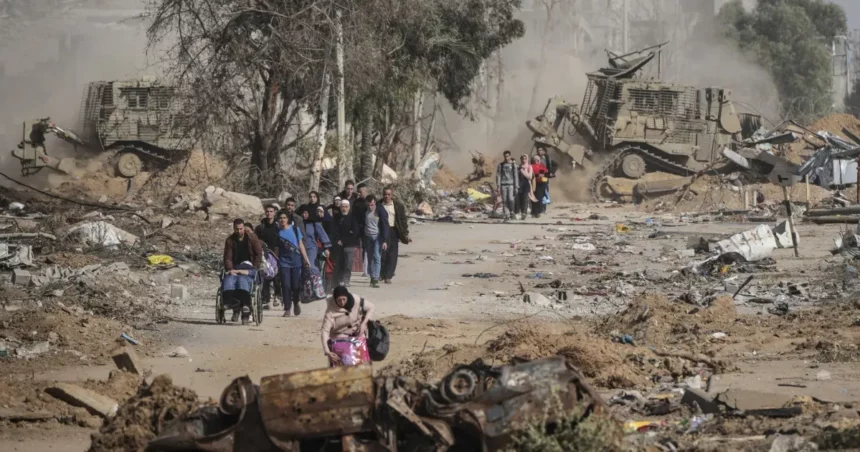
Gaza City is facing a dire humanitarian crisis as Israel targets essential infrastructure, leaving residents with no means of survival and forcing mass displacement. From schools to solar panels, water tanks, and charging points, critical lifelines for civilians are being systematically destroyed. Palestinians who resist leaving their homes under relentless bombardment are being pushed out by the deliberate elimination of basic necessities. The destruction of vital infrastructure is part of Israel’s broader plan to occupy Gaza City and exert control over the Strip, creating both physical and psychological pressure on civilians.
Destruction of Essential Infrastructure and Forced Displacement
Since mid-August, Israel has intensified its bombardment on Gaza City, targeting structures that sustain civilian life. High-rise buildings, schools sheltering displaced families, water tanks, rooftop solar panels, internet access points, and mobile charging stations have all been hit. These attacks are designed to leave Palestinians with limited options, compelling them to move southward in search of basic resources. Emad Sarsawi, a 43-year-old resident, described his struggle to stay in his home despite repeated attacks. For months, he had resolved to remain with his family regardless of the danger, but the systematic destruction of solar panels and other lifelines forced them to flee. Solar panels, for instance, had been essential to pump water and recharge electronic devices. With their destruction, families found themselves facing slow death from thirst and deprivation, highlighting the strategic and lethal impact of targeting infrastructure.
Since the onset of Israel’s wider campaign in October 2023, the Gaza Strip has endured a severe blockade, with electricity and water cut off, internet infrastructure bombed, and fuel supplies restricted. These measures have created widespread famine and left 2.2 million residents facing repeated blackouts and shortages. In recent weeks, Israel approved a plan to occupy Gaza, beginning with Gaza City. The bombardment has destroyed hundreds of housing units and resulted in over 1,800 deaths in a short span, contributing to a total of more than 64,800 Palestinians killed and 164,000 wounded since the conflict escalated. Over 80 percent of these casualties are civilians, according to leaked Israeli military data.
The next phase of this campaign is expected to involve a ground invasion of Gaza City, but the key challenge remains the hundreds of thousands of residents unwilling or unable to leave. Their reluctance to evacuate is compounded by overcrowding in other parts of the Strip and the difficulty of relocating, yet the ongoing destruction of essential infrastructure continues to push them toward displacement.
Targeting Lifelines: Schools, Solar Panels, and Charging Points
In the absence of household electricity, Gaza’s residents have relied on makeshift charging points operated by individuals using solar panels. These points provide a lifeline, allowing people to recharge phones, laptops, and other devices for minimal fees. However, Israeli forces have increasingly targeted these stations, disrupting residents’ access to communication and essential services. Ahmed Ubeid, a 26-year-old displaced resident, described how his neighborhood’s charging points were systematically shut down after targeted attacks, forcing him and his family to walk long distances to recharge their devices. This loss of power contributes directly to displacement decisions, as people seek areas where basic necessities remain functional.
Schools have also been a critical support network for displaced residents, functioning as shelters and providing water and electricity. Over the past week, the Israeli military issued expulsion orders to schools in Tal al-Hawa and other neighborhoods, effectively forcing hundreds of thousands of displaced Palestinians out of these makeshift shelters. Ubeid described living in a school with his family for over a year and a half, noting that these schools had become their only refuge. The closure of such shelters not only displaces people again but also cuts off access to vital services that sustain surrounding residential areas. Schools have been central to providing water for drinking, cooking, and washing, and their destruction leaves communities increasingly vulnerable to dehydration, starvation, and injury.
Residents are witnessing a calculated approach in which every structure that sustains life is systematically dismantled. Without access to water, electricity, or communication tools, those who insist on staying in their homes find themselves isolated, helpless, and exposed to slow and preventable death. Ubeid emphasized the psychological toll, explaining that residents feel increasingly abandoned and doubt their decisions to remain in Gaza City. This strategy highlights the deliberate targeting of lifelines as a tool for mass displacement, creating a controlled humanitarian crisis to weaken resistance and exert control over the city.
The destruction of water infrastructure and electricity networks also intensifies the existing famine conditions in Gaza. Repeated blackouts and water shortages over the past 23 months have devastated families’ ability to survive under siege. The strategic targeting of solar panels, schools, and other sources of energy and water amplifies these conditions, leaving residents dependent on scarce external aid or forced to flee to safer areas in the south. Humanitarian experts note that these measures violate international norms and contribute to long-term suffering among civilians, particularly children and the elderly.
In addition to the physical destruction, the disruption of communication networks compounds the crisis. Without functional phones or internet access, residents cannot call for help, receive updates on security conditions, or coordinate evacuation. Targeted attacks on mobile charging points and internet infrastructure isolate communities, further enhancing the effectiveness of displacement orders. Families are forced to move not just because of bombs falling nearby, but because their ability to sustain themselves in a modern urban environment has been removed.
This systematic approach has left Gaza City in a state of near-total dependence, where survival is contingent on access to functional infrastructure. Residents who remain are trapped in a cycle of displacement, deprivation, and uncertainty, illustrating the profound human cost of targeting essential services in an urban conflict. While Israel’s stated goal may involve territorial control and strategic objectives, the human consequences are catastrophic, with civilians forced to flee under extreme conditions or face death from starvation, dehydration, or lack of medical care.
The targeting of schools-turned-shelters also underscores the strategic calculation behind Israel’s approach. By dismantling support networks, the military ensures that residents cannot establish safe zones within the city, compelling mass movement and reducing the capacity for organized resistance. These measures also create broader logistical challenges for humanitarian agencies, limiting access to aid and making it difficult to provide basic relief.
Residents and aid organizations report that even temporary shelters, once functioning as lifelines, are now unsafe due to repeated bombings and expulsion orders. The destruction of water tanks, solar panels, and other community resources ensures that survival is increasingly difficult, creating extreme pressure on already displaced populations to seek refuge in southern Gaza or other areas. The systematic nature of these attacks reflects a deliberate and methodical strategy aimed at eroding the ability of civilians to remain in place.
As displacement continues, the psychological trauma for families, particularly children, is immense. People report feelings of hopelessness, confusion, and fear, as they are forced to abandon homes, belongings, and community networks. The targeting of lifelines creates an environment where survival is a daily challenge, with residents unable to plan or secure basic needs. The repeated destruction of essential infrastructure, combined with the threat of ground invasion, ensures that Gaza City’s civilian population is caught between imminent danger and untenable living conditions.
The ongoing situation also highlights the broader implications of modern urban warfare, where targeting civilian infrastructure can be used strategically to achieve military objectives. In Gaza, the destruction of solar panels, charging points, schools, and water facilities serves both as a method of displacement and as a tool of coercion. Civilians are forced to navigate a city where basic survival is no longer guaranteed, and every step of daily life depends on fragile, frequently destroyed infrastructure.
The humanitarian impact of this strategy is compounded by limited international access and the blockade, making aid delivery extremely difficult. Water, electricity, and food shortages continue to escalate, while displaced families compete for scarce resources in safer parts of the Strip. Experts warn that the deliberate targeting of civilian infrastructure could have long-lasting consequences, including increased mortality, chronic illness, and a generation of children traumatized by prolonged exposure to conflict and deprivation.