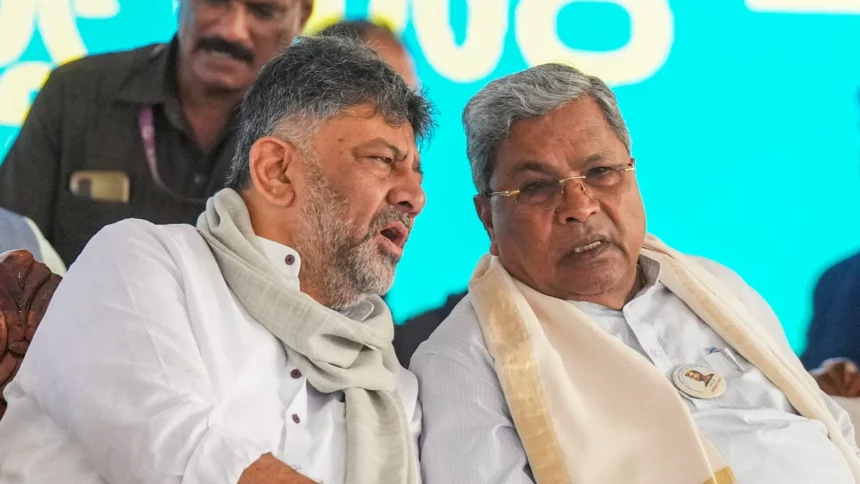
The Congress government in Karnataka has entered a fresh phase of political uncertainty, following a series of high-profile visits by top ministers and party leaders to New Delhi that have fuelled intense speculation about an impending cabinet reshuffle and possible changes in leadership dynamics. While Chief Minister Siddaramaiah and Deputy Chief Minister D. K. Shivakumar publicly dismissed the possibility of any leadership transition, conflicting statements by senior ministers and the growing movement of influential Congress figures toward the national capital have raised questions about internal cohesion and strategic planning ahead of the winter session of the state legislature. The situation has been further complicated by competing interpretations of the meetings taking place at the party’s central leadership level, creating a cloud of uncertainty over whether the developments reflect routine administrative consultations or a deeper reorganisation of political power within the state unit.
Rising speculation as senior ministers issue conflicting signals
The latest round of speculation gathered momentum when Home Minister G. Parameshwara, one of the senior-most figures in the state cabinet, indicated that the party was preparing for a cabinet reshuffle. Speaking to reporters, he argued that the process was an expected administrative mechanism under the leadership of the chief minister and the Congress high command. Although he did not suggest any immediate leadership transition at the top, his remarks hinted at internal churn and appeared to acknowledge that the upcoming changes were likely significant. Parameshwara added that it was widely reported in the media that the central leadership had approved the reshuffle, suggesting that such authorisation reflected an evolving assessment of ministerial performance and regional political considerations.
Parameshwara’s comments gained additional weight because they came shortly after Chief Minister Siddaramaiah’s reported meeting with Rahul Gandhi in New Delhi. While Siddaramaiah insisted that the meeting was solely focused on reviewing the Bihar election results, party insiders suggested that discussions on the cabinet were part of the conversation. Siddaramaiah, however, downplayed the speculation, reiterating to journalists in Bengaluru that there was “no conversation about the cabinet reshuffle at all” during his interaction with Gandhi. He further stated that he would return to New Delhi on Monday if his pending appointment with Prime Minister Narendra Modi was confirmed.
The ambiguity surrounding Siddaramaiah’s statements added to the sense of political unease. While the chief minister has maintained that leadership change is not under consideration, internal party discussions suggest that a reshuffle—if it takes place—may be substantial enough to affect the internal equations between his camp and that of D. K. Shivakumar. These equations have shaped much of the state Congress’ internal functioning since the party’s victory in the 2023 Assembly elections.
Deputy Chief Minister Shivakumar, who cancelled a planned trip to Hyderabad and prolonged his stay in Delhi, offered carefully measured responses when asked about the ongoing speculation. Claiming that he had no knowledge of Siddaramaiah’s meeting with Rahul Gandhi, he said that any questions related to reshuffling or leadership change should be directed to the chief minister. Shivakumar emphasised that the Congress remained a structured organisation in which decisions were taken by the party leadership, and that he would follow whatever direction was provided. Defending Siddaramaiah’s meetings with senior national leaders, he said the chief minister had every right to consult the party president, the Union home minister or even the prime minister, and that such engagements should not be viewed as abnormal.
Adding to the complexity, Shivakumar’s brother, former Bengaluru Rural MP D. K. Suresh, arrived in Delhi on the same day and said he was aware of the speculation only through media reports. Suresh declined to comment on the likelihood of a reshuffle, remarking that the final decision lay entirely with the chief minister and the Congress high command.
Behind these parallel statements lies a growing recognition among party insiders that pressure has been building within the Congress to accommodate multiple regional and caste-based demands that have intensified since the government completed its first year in office. With one cabinet berth lying vacant and several ministers facing internal criticism, many legislators have been lobbying openly for representation. This pressure is particularly visible in constituencies where senior leaders believe that redistribution of responsibilities could help the party consolidate its base ahead of the 2024–25 national election cycle and the ongoing administrative commitments in the state.
According to leaders based in Delhi, the Congress high command has been evaluating proposals that could lead to the replacement of eight to twelve ministers, though no final decision has been taken. The reshuffle, if approved, would be one of the largest undertaken by the Siddaramaiah government and could significantly alter the political landscape in Karnataka.
As speculation grew, several state Congress insiders circulated names of legislators believed to be front-runners for ministerial positions. Among them were N. A. Harris, Rizwan Arshad, B. K. Hariprasad, Belur Gopalakrishna, H. C. Balakrishna, Shivalinge Gowda, Prasad Abbayya, M. Krishnappa, Saleem Ahmed, R. V. Deshpande, Laxman Savadi, A. S. Ponnanna, Roopakala Shashidhar and Malur Nanjegowda. The inclusion of such a broad list reflected both the intensity of the competition and the diversity of interests that the party leadership must balance.
Hubballi-Dharwad East MLA Prasad Abbayya openly stated that he was a strong contender for a cabinet post but added that he would abide by the decision of the Congress high command, reflecting the disciplined messaging being maintained by aspirants despite the heightened uncertainty.
Internal fault lines intensify as leadership seeks clarity from high command
The possibility of a reshuffle has revived long-standing tensions within the Karnataka Congress, particularly between the camps of Siddaramaiah and Shivakumar. While both leaders have repeatedly affirmed that their partnership remains stable and mutually respectful, their supporters have engaged in subtle manoeuvring to safeguard their political influence. Party insiders say that the Shivakumar camp is concerned that a reshuffle might marginalise some of its key supporters, thereby weakening the deputy chief minister’s long-term prospects. At the same time, there is growing belief that Siddaramaiah is pressing for administrative changes that would allow his government to strengthen its performance narrative ahead of upcoming national political cycles.
Public Works Minister Satish Jarkiholi, a senior and influential figure within the party, added fuel to the debate by calling for the leadership to clarify ongoing speculation. Jarkiholi explained that his recent visit to Delhi was not political and was instead connected to accompanying KPCC general secretary Sunil Hanumannavar for a meeting with AICC general secretary Randeep Singh Surjewala. Nevertheless, he acknowledged that discussions about cabinet positions and organisational restructuring were inevitable in a state with over six crore people and a complex political landscape. When questioned about reports suggesting he could be appointed KPCC president, Jarkiholi said that only the high command could make such a decision.
Jarkiholi emphasised that the party leadership was closely monitoring all developments in Karnataka. He noted that the high command was observing the confusion surrounding the issue of leadership, and suggested that it would benefit both the government and the party if the top leadership clearly communicated its decisions. His comments echoed a broader sentiment among mid-level leaders and legislators who feel that lack of clarity from the central leadership has prolonged internal tensions and created unnecessary uncertainty.
The discussions in Delhi have come at a crucial political moment, with the winter legislative session scheduled to begin on December 8. The Siddaramaiah government faces several key governance challenges, including implementing its flagship welfare schemes, responding to the financial pressures arising from drought-like conditions in parts of the state, managing institutional tensions with the Union government and addressing concerns raised by civil society groups. Against this backdrop, the question of ministerial performance has taken on new urgency, especially in departments where delivery challenges have been persistent.
The Congress high command is also aware that Karnataka remains one of the party’s strongest states following the 2023 electoral victory, and ensuring stability within its government is essential for the broader national strategy. The ongoing discussions reflect efforts to optimise governance, reward loyalty, and prepare the administration for the next electoral cycle. At the same time, the party must navigate the sensitivities of balancing the ambitions of Siddaramaiah’s and Shivakumar’s factions, both of which command significant support within the legislative party.
The lack of straightforward communication from the high command has created a vacuum filled largely by speculation, and the presence of multiple senior Karnataka leaders in Delhi over the past week has only intensified that speculation. With no final statements from the central leadership, legislators, ministers and party observers remain unsure whether the government is preparing for a moderate reshuffle or a sweeping reorganisation that could redefine its political structure.