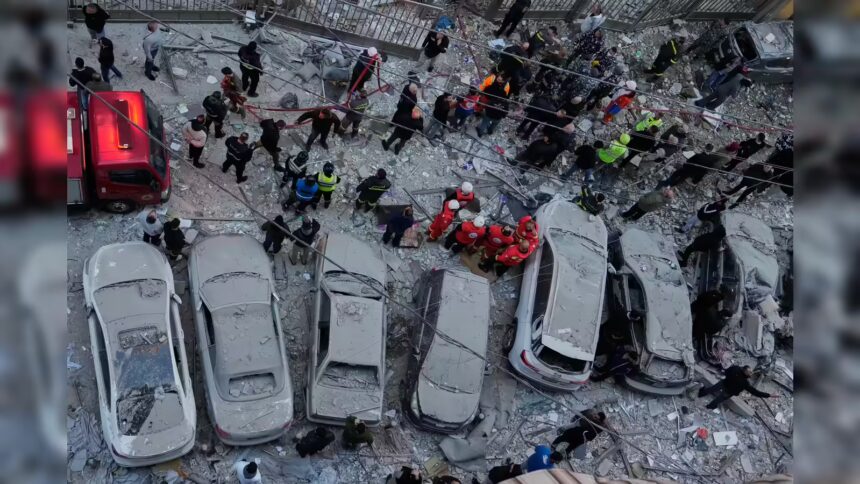
The conflict involving Iran, Israel and the United States entered its eighteenth day with the Middle East witnessing fresh military escalation and rising geopolitical tensions. Reports from the region indicated that missile warnings were issued in Dubai after authorities detected incoming aerial threats, while a major gas field in the United Arab Emirates caught fire following a suspected drone attack. These developments came amid growing concerns that the conflict, which began after joint U.S.-Israeli strikes on Iranian military infrastructure, could expand further across the Gulf region. At the same time, U.S. President Donald Trump called on allied nations to increase support in securing key maritime routes and preventing further escalation of the war. The latest incidents highlight the widening regional impact of the conflict and the growing risk that more countries could become involved in the crisis.
Missile alerts in Dubai and attack on UAE energy infrastructure
Security concerns intensified across the United Arab Emirates after missile warnings were issued in several areas, including Dubai. Residents reported hearing loud explosions in the sky, which authorities later said were caused by air defence systems intercepting incoming missiles and drones. As a precautionary measure, the UAE temporarily closed parts of its airspace while security forces assessed the situation. Flights were briefly disrupted before airspace operations were gradually restored once the threat had been neutralised. Around the same time, a gas facility in the UAE caught fire after being targeted in a drone strike, raising alarm about the vulnerability of critical energy infrastructure during the ongoing conflict. Emergency services quickly responded to contain the fire and secure nearby installations. Although officials confirmed that there were no immediate reports of casualties, the incident underscored the growing risks faced by Gulf countries as the war expands beyond its original theatres. Analysts warn that repeated attacks on energy facilities in the Gulf could disrupt global oil and gas supplies and create further instability in international energy markets.
Trump calls for allied support to secure Gulf shipping routes
As tensions escalated, U.S. President Donald Trump urged allied nations to contribute naval forces to protect key maritime routes, particularly around the Strait of Hormuz. The narrow waterway is one of the world’s most critical energy corridors, carrying a large share of global oil shipments from the Persian Gulf to international markets. Since the start of the conflict, Iran has warned that it could target shipping routes and energy infrastructure if military pressure continues. These threats have raised serious concerns about the security of commercial vessels and energy supplies moving through the region. Trump’s appeal for international support reflects growing fears that disruptions in the Strait of Hormuz could trigger a major global energy crisis. Several countries have expressed concern about deploying additional military assets in the area, while others have called for diplomatic engagement to prevent further escalation. Military analysts believe that safeguarding shipping routes will be crucial in preventing wider economic consequences if the conflict intensifies further.
Regional and global consequences of the escalating conflict
The Israel-Iran war has already had far-reaching consequences across the Middle East and beyond. Since the beginning of the conflict, missile and drone attacks have targeted military bases, energy infrastructure and strategic facilities across several countries. Gulf nations that host Western military bases have become increasingly vulnerable to retaliatory strikes. As a result, several governments in the region have heightened security measures and strengthened air defence systems to protect their territories. The escalation has also affected international aviation and shipping routes, with airlines adjusting flight paths and shipping companies reviewing operations in the Persian Gulf. Global energy markets have reacted strongly to the developments, with oil prices rising amid fears of supply disruptions. Analysts warn that prolonged instability in the region could have lasting consequences for global trade, energy security and geopolitical stability. As the war enters its third week, international observers continue to monitor the situation closely, concerned that further escalation could deepen the humanitarian, economic and security challenges already unfolding across the Middle East.