NDA Sweeps Bihar as Nitish Kumar and Allies Secure All Five Seats
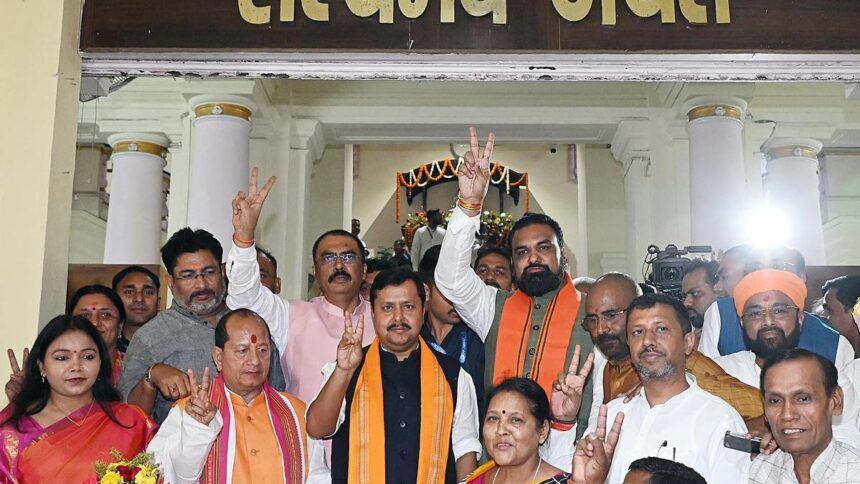
The biennial Rajya Sabha elections held in 2026 have significantly reshaped the political balance in India’s Upper House, with the National Democratic Alliance (NDA) emerging as the biggest winner in the latest round of polls. The elections were conducted to fill 37 Rajya Sabha seats across 10 states as the terms of several members are scheduled to end in April. Out of these, 26 candidates had already been elected unopposed earlier because the number of candidates matched the available seats. Voting was therefore required only for the remaining 11 seats, including five from Bihar, four from Odisha and two from Haryana. The results from these states have strengthened the ruling alliance in the Rajya Sabha and highlighted the continuing competition between the government and opposition parties.The most decisive outcome came from Bihar, where the NDA secured a clean sweep of all five Rajya Sabha seats. The alliance fielded prominent candidates including Bihar Chief Minister Nitish Kumar, BJP leader Nitin Nabin, Ram Nath Thakur, Upendra Kushwaha and Shivesh Ram. All five candidates were declared victorious, marking a significant political success for the ruling coalition. Nitish Kumar’s victory attracted particular attention because of his long political career and his decision to enter the Rajya Sabha after serving as Bihar’s chief minister for more than two decades. His move is widely viewed as an important step that may expand his role in national politics.The Bihar contest was closely watched because the opposition Mahagathbandhan attempted to challenge the NDA despite lacking sufficient numbers in the state assembly. The alliance, which includes parties such as the Rashtriya Janata Dal and the Congress, hoped to gather support from independent legislators and smaller parties to bridge the numerical gap. Opposition leaders claimed that they had managed to secure additional support and could pose a strong challenge. However, the final result favored the NDA, whose candidates obtained the required votes to win all five seats.The voting process also witnessed controversy regarding the absence of several opposition legislators during polling. Reports indicated that some MLAs belonging to opposition parties did not participate in the voting process. Leaders from the ruling alliance described this as evidence of disunity and poor coordination within the opposition camp. According to them, the absence of these legislators weakened the opposition’s chances and contributed significantly to the NDA’s sweeping victory.Opposition leaders, however, raised allegations that political pressure and irregularities may have influenced the outcome. Some claimed that certain legislators were prevented from voting or faced pressure during the election process. Despite these accusations, the official results confirmed the NDA’s dominance in the state. Political observers believe that the clean sweep in Bihar will strengthen the ruling alliance’s position in the Rajya Sabha and may also influence future political strategies in the state and at the national level.
Cross-Voting Drama in Odisha Gives BJP-Backed Candidates Advantage
Odisha witnessed one of the most dramatic contests in the 2026 Rajya Sabha elections. Four seats were contested in the state, and the results saw three seats going to candidates backed by the Bharatiya Janata Party while the Biju Janata Dal managed to retain one seat. The contest became politically significant because of allegations of cross-voting and heated exchanges between rival parties during the voting process.The most notable victory in Odisha came from former Union minister Dilip Ray, who contested the election as an independent candidate but was supported by the BJP. Ray defeated Datteswar Hota, who was the joint candidate backed by the BJD, Congress and the Communist Party of India (Marxist). His victory became one of the most discussed moments of the election because it was reportedly aided by cross-voting from legislators belonging to rival parties.Several legislators from the BJD and the Congress were accused of defying their party whip and voting in favor of Ray. This unexpected shift in votes significantly changed the dynamics of the election and helped BJP-backed candidates secure a stronger presence in the state’s Rajya Sabha representation. The cross-voting sparked strong reactions from political leaders, with several opposition figures accusing the BJP of influencing legislators through political pressure and inducements.The BJP rejected these allegations and insisted that the results reflected genuine political support for its candidates. Party leaders argued that the cross-voting demonstrated dissatisfaction among legislators in rival parties and indicated shifting political loyalties within the state assembly.The election process in Odisha was also marked by dramatic scenes inside the assembly building. During the voting process, tensions escalated between legislators from the BJP and the BJD. Reports suggested that a heated confrontation and scuffle briefly broke out between members of the two parties, highlighting the high political stakes involved in the contest.Despite the controversies, the final results confirmed that BJP nominees Manmohan Samal and Sujeet Kumar were elected to the Rajya Sabha, while Santrupt Mishra secured a seat for the BJD. The victory of Dilip Ray as a BJP-backed independent added to the NDA’s overall tally in the Upper House.Analysts believe that the outcome in Odisha reflects the BJP’s expanding political influence in a state that has traditionally been dominated by the BJD. The results may also have long-term implications for the state’s political landscape, particularly as parties prepare for upcoming elections and attempt to consolidate their support bases.
Haryana Results Delayed After Dispute Over Ballots
While Bihar and Odisha produced clear results, the Rajya Sabha election in Haryana turned into a high-drama political contest after counting was halted due to disputes over the validity of several votes. Elections were held for two Rajya Sabha seats in the state, but objections raised by both the Bharatiya Janata Party and the Indian National Congress delayed the declaration of results.The controversy reportedly began when rival parties challenged three votes during the counting process. The BJP objected to two ballots cast by Congress legislators, while the Congress raised objections to the vote cast by a BJP minister. The objections were related to allegations that some legislators may have shown their ballot papers while voting, which would violate the secrecy rules governing Rajya Sabha elections.Because of these objections, election officials decided to suspend the counting process and seek guidance from the Election Commission before proceeding further. The delay created political suspense in the state, as both parties claimed they had sufficient support to win the seats.Congress leaders accused the BJP of attempting to delay the results after sensing a possible defeat. According to them, no objections had been raised during the voting process itself and the disputes were introduced later to influence the outcome. BJP leaders rejected these accusations and insisted that their objections were raised to ensure that the election was conducted fairly and according to established rules.A delegation of Congress leaders later met the Chief Election Commissioner to lodge a formal complaint regarding alleged irregularities in the Haryana election. The delegation demanded that CCTV footage of the voting process be examined to determine whether any violation of rules had taken place. Since the entire voting process was recorded, opposition leaders argued that the footage would provide clear evidence regarding the disputed ballots.The Election Commission is now expected to review the matter and decide whether the challenged votes should be counted or invalidated. Its decision will ultimately determine the final outcome of the Haryana Rajya Sabha contest.The developments in Haryana highlight the intense political competition surrounding Rajya Sabha elections, where even a small number of votes can influence the final result. Because members of the Rajya Sabha are elected by state legislators through a system of proportional representation and preferential voting, the margin between victory and defeat can be extremely narrow.Overall, the 2026 Rajya Sabha elections have strengthened the NDA’s position in the Upper House. The alliance secured the majority of the contested seats, reinforcing its ability to push forward legislative agendas in Parliament. At the same time, the elections exposed several challenges for opposition parties, including allegations of cross-voting, absentee legislators and internal divisions.The results therefore represent more than a routine parliamentary exercise. They reflect the shifting dynamics of Indian politics and underline the importance of alliance unity, strategic voting and party discipline in determining electoral outcomes.