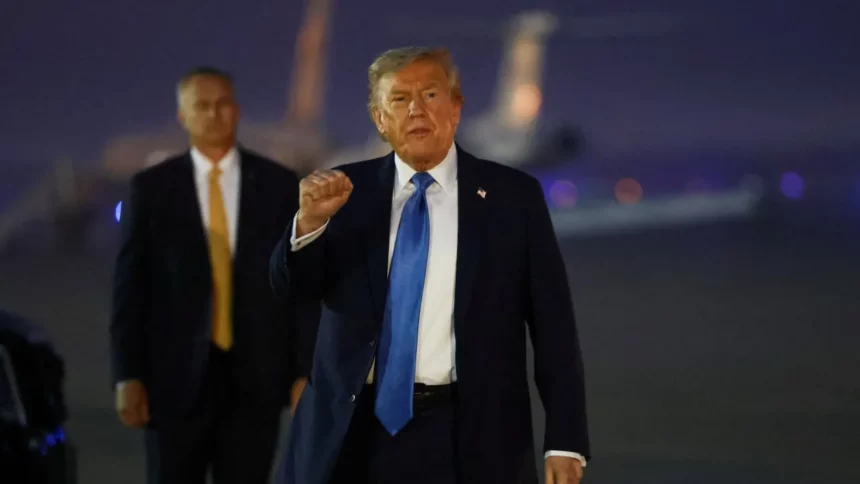
In a tense and fast-moving development, Israel intercepted multiple missiles launched from Iran just hours after U.S. President Donald Trump announced a ceasefire between the two long-standing adversaries. The missile interceptions came as Iranian officials declared they had halted military operations against Israel from 4 AM local time, though Tehran conditioned its ceasefire on Israel stopping its own military actions first. Despite Donald Trump’s announcement intended to calm the escalating conflict, fresh missile attacks and missile defense alerts in Israel highlighted the fragility and ongoing volatility of the situation.
Missile intercepts and ongoing alerts
Following Donald Trump’s claim of a ceasefire, Israeli Defense Forces (IDF) detected incoming missiles fired from Iranian territory toward Israel. Sirens wailed across several parts of Israel, alerting citizens to the threat as Israel’s missile defense systems worked to intercept and neutralize the projectiles. The interception footage circulated widely on social media, showing Israel’s efforts to defend its territory amid renewed aggression.
Iran’s announcement that it ceased attacks from 4 AM was paired with a stipulation: Tehran demanded that Israel also end its military operations against Iran. Iran’s foreign minister stated that no formal ceasefire agreement had been received from the United States, casting doubt on the official status of the truce Donald Trump declared. Israeli officials have so far remained silent on Donald Trump’s ceasefire claims, neither confirming nor denying their implementation.
Prolonged conflict and international involvement
The Iran-Israel conflict has entered its twelfth day, marked by escalating violence and extensive missile exchanges. The hostilities intensified after Israel launched ‘Operation Rising Lion,’ targeting Iranian military bases and nuclear facilities. These strikes prompted retaliatory attacks by Iran, including missile barrages that have caused significant casualties on both sides — approximately 400 dead in Iran and 24 in Israel.
The United States has also become directly involved in the conflict. In a bid to curtail Iran’s nuclear ambitions and military capabilities, U.S. forces launched airstrikes on three key Iranian nuclear sites: Fordow, Natanz, and Isfahan. These strikes aimed to disrupt Iran’s nuclear program but further inflamed tensions in the region.
The back-and-forth missile launches, defensive countermeasures, and diplomatic efforts have created a complex and unstable environment, where even announcements of ceasefires struggle to hold amid mutual distrust and strategic calculations. The recent missile interceptions and conflicting ceasefire claims underscore how delicate the situation remains and how quickly it can spiral back into open hostilities.