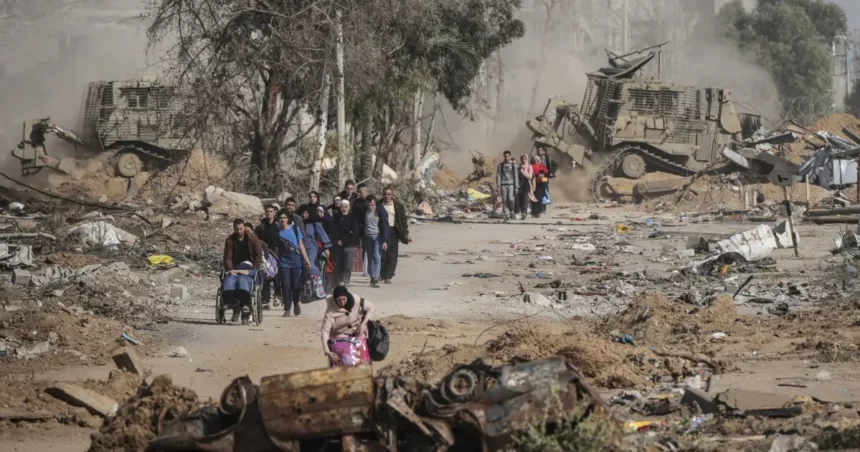
In the ongoing Israel-Hamas conflict Israel-Hamas conflict, Israel has announced that Palestinians displaced by the war can begin returning to the northern Gaza Strip starting Monday. This decision follows a breakthrough agreement with Hamas for the release of six more hostages, marking an important step toward maintaining a fragile ceasefire between the two sides. The Israeli Prime Minister’s office confirmed that the deal paves the way for further exchanges under a broader agreement aimed at halting the 15-month-long war, which has decimated the Gaza Strip and caused the displacement of nearly all of its residents.
This truce has led to a temporary lifting of Israel’s restrictions on Palestinian movements along the coastal road, which had previously been blocked. This road was crucial for the return of Palestinians to their northern Gaza homes. However, Israel had prevented large crowds from using this route, citing Hamas’s failure to release civilian women hostages as stipulated in the original ceasefire deal. The Israeli government had threatened to hold back the return of Palestinians until Hamas met its obligations. In a statement, Prime Minister Benjamin Netanyahu’s office confirmed that Hamas had agreed to a new phase of hostage releases, with three hostages expected to be freed on Thursday and another three on Saturday.
Meanwhile, Palestinian leaders have expressed strong condemnation of a proposal by US President Donald Trump to forcibly displace Palestinians from Gaza. The controversial suggestion, which Trump discussed with reporters aboard Air Force One, involves moving approximately 2.4 million Gazans either temporarily or permanently to neighboring countries like Egypt or Jordan. Trump referred to Gaza as a “demolition site” and argued that the displacement of Palestinians was a necessary step. However, this idea was met with immediate rejection from Palestinian officials, who denounced it as an attempt at forced ethnic cleansing.
Palestinian President Mahmud Abbas, currently based in the Israeli-occupied West Bank, called the proposal “unacceptable” and vowed that Palestinians would resist any efforts to displace them from their land. Abbas’s office released a statement expressing strong opposition to any international plans aimed at forcing Palestinians out of Gaza. His position was supported by Bassem Naim, a senior Hamas leader, who reiterated that Palestinians would never accept being displaced, drawing comparisons to previous attempts by Israel and the international community to displace them over the decades. The sentiment echoed across Gaza, where many displaced residents, such as Rashad al-Naji, voiced their determination to stay in their homeland. Al-Naji declared, “We will not leave Palestine or Gaza, no matter what happens.”
Trump’s remarks have further inflamed tensions in the region, particularly as they recall the painful memory of the 1948 Nakba, when hundreds of thousands of Palestinians were displaced during the founding of Israel. The idea of relocating Palestinians from Gaza has also been strongly rejected by both Jordan and Egypt, two countries that share borders with Gaza. Jordanian Foreign Minister Ayman Safadi reaffirmed his country’s stance, stating, “Jordan is for Jordanians, and Palestine is for Palestinians.” Egypt’s foreign ministry echoed this sentiment, emphasizing the inalienable rights of Palestinians to remain in their land.
In the midst of these diplomatic tensions, the humanitarian situation in Gaza continues to worsen. Despite the recent ceasefire, which has allowed the flow of humanitarian aid into Gaza, the United Nations has warned that the crisis remains dire. The conflict, which erupted after a Hamas attack on Israel on October 7, 2023, has claimed the lives of thousands. As of now, over 47,000 Palestinians, mostly civilians, have been killed, while the death toll in Israel stands at over 1,200. In addition to the loss of life, much of Gaza has been left in ruins, with entire neighborhoods destroyed in the Israeli offensive.
The humanitarian truce has seen several exchanges of hostages, including the release of four Israeli women soldiers and 200 Palestinian prisoners last Saturday. However, despite these exchanges, tensions remain high, with both sides accusing each other of violating the ceasefire agreement. Israel has continued to block the return of Palestinians to northern Gaza, citing security concerns and the ongoing hostage situation. The release of Arbel Yehud, an Israeli civilian woman hostage, is expected to take place in the coming days, as part of the next phase of the truce.
Despite these difficult circumstances, both sides are under intense pressure from the international community to bring about a lasting peace. The latest developments in Gaza highlight the complexities of the situation, with both sides entrenched in their positions and the suffering of civilians continuing unabated. The release of more hostages offers a glimmer of hope, but the road to a sustainable peace remains uncertain as the world watches closely.