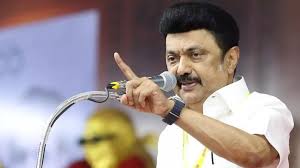
Tamil Nadu Chief Minister MK Stalin has emerged as a significant political force, reshaping his leadership approach and intensifying his stance on federalism and linguistic identity. His recent confrontation with the central government over language policy and state rights has placed him at the center of national discourse, challenging the dominance of the Bharatiya Janata Party (BJP) and its centralizing policies.
MK Stalin’s political evolution has been marked by a transition from his tenure as the Leader of the Opposition to his current role as Tamil Nadu’s Chief Minister. This shift has been facilitated in part by the internal decline of the All India Anna Dravida Munnetra Kazhagam (AIADMK), but also by his ability to consolidate power within the Dravida Munnetra Kazhagam (DMK). His leadership has drawn comparisons between the political struggles of the DMK in the 1960s and the present, highlighting the continuing fight for Tamil identity and autonomy in the face of perceived centralization efforts.
A recent flashpoint in this ongoing struggle was the central government’s alleged attempt to link education grants for Tamil Nadu to the adoption of the National Education Policy (NEP) 2020. Union Education Minister Dharmendra Pradhan’s statement suggesting a conditional release of funds provoked a sharp response from MK Stalin and the DMK government. MK Stalin reiterated Tamil Nadu’s firm commitment to a two-language policy and resisted any attempt to impose Hindi through the three-language formula embedded in the NEP. By rejecting these conditions, he underscored his government’s determination to uphold Tamil linguistic and cultural pride, even if it meant financial sacrifices.
The controversy over language is not an isolated issue but part of a broader political strategy by the BJP and its ideological parent, the Rashtriya Swayamsevak Sangh (RSS). MK Stalin’s resistance has found resonance beyond Tamil Nadu, garnering support from other non-Hindi-speaking states like Kerala, Karnataka, and West Bengal. His advocacy has helped reframe the language debate as a larger issue of federalism and state autonomy, rather than merely a Tamil Nadu-centric concern.
Further deepening the political divide, MK Stalin has also revived the contentious issue of parliamentary seat delimitation, a topic that has significant implications for representation in the Lok Sabha. With demographic shifts favoring the northern states, southern states like Tamil Nadu stand to lose political influence in a future delimitation exercise. By linking this issue to the broader language debate, MK Stalin has strategically positioned himself as a defender of southern interests against what he portrays as the BJP’s attempts to tilt power dynamics in favor of the north.
Adding to the symbolism of resistance, MK Stalin’s government made a notable change in the state budget presentation by replacing the official rupee symbol with a Tamil script. This move, while largely symbolic, sparked sharp reactions from BJP leaders, who accused the DMK of fostering separatist sentiments. However, Stalin clarified that these gestures were intended to reaffirm Tamil Nadu’s distinct identity within the Indian Union, not to challenge national unity.
The growing rift between the Tamil Nadu government and the central leadership reflects broader tensions between regional parties and the BJP’s centralized governance model. The DMK’s decision to allocate its own resources for education and other state initiatives, rather than bow to central conditions, highlights a deepening assertion of state autonomy.
As the 2026 Tamil Nadu assembly elections approach, MK Stalin’s confrontational stance on language, federalism, and state rights is expected to play a significant role in shaping political narratives. His ability to galvanize support both within and outside Tamil Nadu suggests that these issues will remain at the forefront of national politics. With regional parties increasingly rallying around concerns of federalism and cultural identity, MK Stalin’s leadership has the potential to influence not just Tamil Nadu’s political landscape but also the broader trajectory of Indian politics.