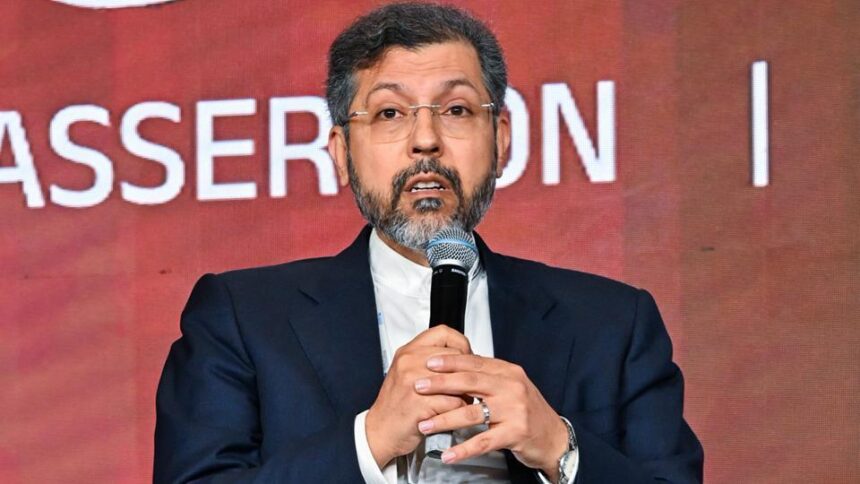
Iran’s Deputy Foreign Minister Saeed Khatibzadeh said Tehran has no option but to defend itself against what he described as US-Israeli aggression, declaring that Iran will resist “until the last bullet and the last soldier.” Speaking at the Raisina Dialogue 2026 in New Delhi, he characterised the ongoing conflict as a battle for Iran’s survival while stressing that Tehran does not seek to expand the war beyond its borders.
Iran vows resistance against US-Israeli pressure
Addressing policymakers, diplomats and global experts at the Raisina Dialogue in Delhi, Saeed Khatibzadeh said Iran is currently facing a state of war and must defend itself against external aggression. According to him, Tehran has been placed in a situation where resistance has become unavoidable, as attacks and political pressure continue to intensify.
Khatibzadeh said Iran’s citizens are living under constant threat as tensions escalate between Iran, the United States and Israel. He argued that defending the country’s sovereignty and security has therefore become the Iranian government’s highest priority. In his remarks, he emphasised that Iran would continue to resist any military or political attempts aimed at weakening the country.
The deputy foreign minister strongly criticised US President Donald Trump, accusing him of adopting what he described as a colonial mindset toward Iran. Khatibzadeh said that while Washington frequently speaks about promoting democracy around the world, it simultaneously discusses changing Iran’s leadership.
He pointed out that Trump had publicly spoken about replacing Iran’s leadership but does not have the authority to appoint the mayor of New York. According to Khatibzadeh, this contradiction reflects an unrealistic approach in which powerful countries attempt to dictate political outcomes in other nations.
Khatibzadeh also stated that Iran views the ongoing confrontation as more than a military conflict. He described it as a struggle to preserve the country’s independence and political system against foreign intervention. In his view, some international actors are attempting to destabilise Iran and reshape its government.
When asked about the possibility of a ground invasion by the United States, the Iranian diplomat said Tehran would resist any attempt to impose a colonial project on the country. He emphasised that Iran would firmly oppose any efforts aimed at changing its political system through external pressure.
Despite his strong rhetoric about resistance, Khatibzadeh maintained that Iran does not want the conflict to expand beyond its current scope. He said Tehran understands the risks associated with a broader regional war and is trying to avoid actions that could lead to further escalation.
During the discussion session, he also addressed questions about whether the conflict could spread to neighbouring countries. Khatibzadeh said Iran is actively trying to prevent such a development and has no intention of attacking other states in the region.
He claimed that some incidents blamed on Iran may actually be the result of false-flag operations carried out by intelligence networks seeking to escalate tensions. According to him, certain groups linked to Israeli intelligence allegedly attempted operations that could be attributed to Iran.
Khatibzadeh referred to reported attempts to target oil refineries and other facilities in order to create the impression of Iranian involvement. He said investigations indicated that Iran was not responsible for those incidents.
He further claimed that similar attempts had been uncovered in Gulf countries including Saudi Arabia and Qatar. According to him, these operations were designed to provoke conflict and draw additional countries into the confrontation.
Khatibzadeh insisted that Iran has no intention of spreading the conflict to other countries. Instead, he said Tehran’s objective is to defend its territory while preventing the war from escalating further across the region.
At the same time, he reiterated that Iran would not compromise on its sovereignty. If attacks against the country continue, he said, Iran will respond decisively and maintain its resistance.
Diplomacy, Kurdish identity and global security concerns
During the Raisina Dialogue session, Khatibzadeh also addressed questions related to Iran’s internal diversity, particularly the role of the Kurdish community within the country. He emphasised that Kurds are an important and integral part of Iran’s national identity.
According to him, Iran’s Kurdish population should not be associated with separatism. While acknowledging that some separatist groups exist, he said those organisations receive external support and do not represent the broader Kurdish community.
Khatibzadeh said Kurdish citizens have long been part of Iran’s political and social fabric. Many Kurds contribute significantly to the country’s cultural, economic and political life, making them an inseparable part of Iran’s national identity.
He warned that portraying the Kurdish population as separatist undermines the reality of their deep connection with the country. For this reason, he argued that discussions about Iran’s internal dynamics should avoid simplistic narratives that ignore the country’s diversity.
Another important theme in his remarks was the role of international law in global conflicts. Khatibzadeh said the current crisis demonstrates the risks of applying international legal principles selectively depending on political interests.
According to him, international law must be respected by all countries if global stability is to be maintained. He warned that ignoring these principles could weaken international institutions and increase the likelihood of future conflicts.
Khatibzadeh also raised concerns about the potential consequences of targeting national leaders during conflicts. He said such actions could create a dangerous precedent that undermines diplomatic norms and threatens global stability.
In his view, if powerful nations begin targeting political leaders in other countries, it could lead to a breakdown of established rules governing international relations. He emphasised that respecting sovereignty and diplomatic norms is essential for maintaining peace.
The Iranian diplomat also addressed questions about a recent maritime incident involving an Iranian vessel in the Indian Ocean. He said the ship had been participating in an international naval exercise organised at India’s invitation.
According to Khatibzadeh, the vessel was part of a formal multinational event and was not carrying weapons during the exercise. He described the incident as a tragic accident in which several young Iranian sailors lost their lives.
He expressed appreciation for the cooperation between India and Iran and highlighted the long-standing civilisational relationship between the two countries. Khatibzadeh said both nations attach great importance to maintaining strong bilateral ties.
During his visit to New Delhi, he also briefly met India’s External Affairs Minister and discussed areas of mutual cooperation. These included economic engagement, regional connectivity and broader diplomatic collaboration.
The Raisina Dialogue itself has emerged as one of the most prominent international forums for discussing geopolitics and economic security. The annual conference brings together policymakers, diplomats, military officials and industry leaders from across the world.
Prime Minister Narendra Modi inaugurated the 11th edition of the conference on March 5. The event is jointly organised by India’s Ministry of External Affairs and the Observer Research Foundation.
Over the years, the Raisina Dialogue has developed into India’s flagship platform for global strategic discussions. It focuses on a wide range of topics including international security, economic policy, emerging technologies and climate change.
This year’s edition has drawn around 2,700 representatives from more than 110 countries. Participants include government ministers, former heads of state, parliamentarians, military commanders, academics and business leaders.
Discussions at the conference are addressing several pressing global challenges, including geopolitical tensions, artificial intelligence governance, economic security and environmental sustainability.
The Raisina Dialogue is often compared with Singapore’s Shangri-La Dialogue, another major international conference focused on security issues. While the Shangri-La Dialogue primarily gathers defence ministers and military officials, the Raisina Dialogue attracts a wider range of political and diplomatic participants.
Organisers say the conference continues to grow in scale and influence each year. In 2026, more than 3,500 delegates from around 125 countries are expected to attend various sessions and side events.
The ongoing tensions involving Iran, Israel and the United States have become one of the key topics of discussion at the event. Diplomats and analysts attending the conference are closely following developments in the Middle East, given the potential impact on global stability and economic markets.
Khatibzadeh’s remarks at the conference therefore attracted considerable attention. By combining strong statements about resistance with calls for diplomacy, he outlined Iran’s perspective on the unfolding conflict and the broader geopolitical environment.