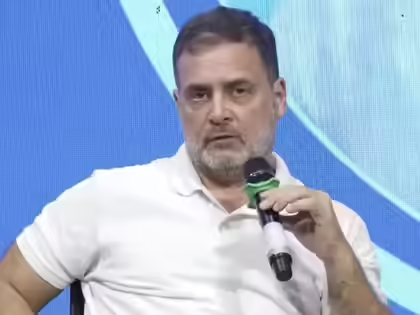
Congress MP Rahul Gandhi said that if he had not entered politics, he would likely have pursued entrepreneurship in the aerospace sector. Speaking during his visit to Kerala, Gandhi reflected on his aviation background while also discussing global manufacturing trends, China’s industrial strength and the need for India to build a strong production-based economy without compromising democratic values.
Rahul Gandhi reflects on aviation roots and praises China’s manufacturing model
During a public interaction in Thiruvananthapuram, Rahul Gandhi spoke about his personal interest in aviation and entrepreneurship. He said that if politics had not become his chosen path, he would have explored opportunities in the aerospace sector. Gandhi noted that he is a trained pilot and comes from a family with strong links to aviation.
He mentioned that aviation has long been a part of his family’s history. His father, former Prime Minister Rajiv Gandhi, worked as a commercial pilot before entering politics, while his uncle Sanjay Gandhi was also closely associated with aviation. According to Gandhi, this background influenced his own interest in flying and technology related to aircraft.
Gandhi made these remarks during a two-day visit to Kerala, where he attended several meetings and public engagements. One of the key events during his visit was an interaction with members of the Information Technology community at Technopark in Thiruvananthapuram, one of India’s largest technology hubs.
While speaking to IT professionals at the event, Gandhi discussed the global structure of industrial production and emphasised the importance of manufacturing in generating large-scale employment. During the conversation, he praised China’s industrial production system, describing it as one of the most advanced in the world.
According to Gandhi, China has built a powerful manufacturing ecosystem that currently has no comparable rival globally. He said the country’s industrial base allows it to produce a vast range of goods at scale and dominate global supply chains.
At the same time, Gandhi clarified that he does not support China’s political system. He described the Chinese governance model as coercive and non-democratic, emphasising that India must not replicate those political structures.
Instead, he argued that India should focus on strengthening its manufacturing capabilities while preserving democratic values. In his view, combining a strong industrial economy with democratic governance would make India a powerful example for the rest of the world.
During his remarks, Gandhi also highlighted the broader economic shift that has taken place globally. He said that countries such as India and the United States have become increasingly focused on consumption and services, while China has prioritised large-scale industrial production.
According to him, this imbalance has allowed China to dominate manufacturing sectors ranging from electronics to machinery and advanced technologies. Gandhi suggested that India must rethink its development strategy in order to compete effectively with such industrial strength.
He emphasised that sustainable employment is often generated through manufacturing rather than service-based sectors. Factories and production units create long-term jobs that can support large populations, while service sectors often rely more on consumption-driven demand.
Gandhi also said China is watching India’s industrial growth closely. As India begins to expand its manufacturing capacity, he believes Beijing sees the country as a potential competitor in global production networks.
Industrial policy, business criticism and technological competition
During his interaction with professionals and local communities in Kerala, Rahul Gandhi also discussed India’s economic structure and the challenges facing the country’s manufacturing sector. He argued that relatively few companies in India are deeply involved in large-scale industrial production.
Gandhi referred to major business figures such as Gautam Adani and Mukesh Ambani while discussing corporate priorities in the Indian economy. According to him, many large corporations focus more on selling and distributing products rather than producing them through manufacturing processes.
He suggested that a stronger emphasis on production would help India build a more resilient economy and generate broader employment opportunities. In his view, the current structure of industrial activity does not sufficiently encourage domestic manufacturing.
Gandhi also criticised the existing framework of the Goods and Services Tax. He argued that the present GST structure creates disadvantages for states that are heavily involved in manufacturing.
According to him, the tax system tends to benefit consumer-oriented states rather than production-oriented regions. He suggested that such policies could discourage industrial investment and weaken the manufacturing ecosystem.
Gandhi said economic policy should be designed in a way that supports industrial expansion and encourages businesses to invest in production capacity. He argued that strengthening manufacturing is essential if India wants to compete with major global economies.
As part of his Kerala visit, Gandhi also travelled to Kuttikkanam in the Idukki district. During the trip, he interacted with tea garden workers and discussed issues related to labour conditions, livelihoods and the challenges faced by plantation communities.
He later visited Sivagiri Mutt in Varkala, where he paid tribute at the samadhi of social reformer Sree Narayana Guru. Gandhi’s visit to the spiritual centre was intended to acknowledge the legacy of the social reformer, who played a major role in Kerala’s social transformation.
While discussing broader global developments, Gandhi also referred to ongoing international conflicts and their technological implications. He mentioned the Russia–Ukraine war and tensions between Israel and Iran as examples of how warfare is evolving through new technologies.
According to him, modern battlefields increasingly rely on advanced systems such as drones, electric motors and battery-powered optical devices. These technologies are gradually transforming the way military operations are conducted.
Gandhi explained that developments observed in Ukraine demonstrate how unmanned aerial systems and circular-motion technologies are beginning to replace traditional internal combustion engines in some military equipment.
He also said similar technological transitions are visible in conflicts involving Iran, where battery-based optical systems and electric motor-driven devices are becoming more prominent in military applications.
According to Gandhi, China currently dominates many of the supply chains associated with these emerging technologies. This includes production of batteries, electric motors, drones and several advanced electronic components.
He described this dominance as a strategic challenge for India. If India wants to remain competitive in the future, Gandhi said it must develop capabilities in advanced manufacturing sectors connected to emerging technologies.
These sectors include electric mobility, semiconductor production, robotics and next-generation defence systems. Strengthening these industries would allow India to reduce dependence on foreign supply chains and build technological self-reliance.
Despite the challenges, Gandhi expressed optimism about India’s potential to compete with China in these fields. He said the country has the talent, innovation capacity and entrepreneurial energy required to succeed.
However, he emphasised that success will depend on clear policy direction and long-term planning. Governments must create an environment that encourages manufacturing investment, research and technological development.
Gandhi concluded that India has a unique opportunity to combine industrial strength with democratic governance. If the country can build a powerful manufacturing base while maintaining democratic institutions and freedoms, he said it would not only benefit Indian citizens but also serve as an example for the wider world.