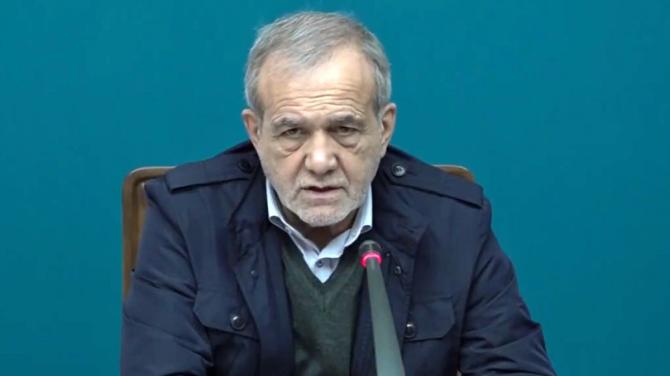
Iranian President Masoud Pezeshkian has apologised to neighbouring countries following recent attacks as tensions continue to escalate across the Middle East. In a televised address, he said Iran had no intention of invading other nations and announced that Tehran would suspend missile strikes against neighbouring states unless attacks were launched against Iran from those countries. The statement comes as the conflict involving Iran, Israel and the United States enters a more volatile phase, raising concerns about wider regional instability and global economic consequences.
Iran apologises to neighbouring countries and suspends attacks
Speaking during the broadcast, President Masoud Pezeshkian acknowledged growing concerns among regional governments after Iranian strikes targeted locations linked to United States military presence in parts of the Gulf. He apologised to neighbouring countries for the attacks and clarified that Iran’s actions were not meant to signal aggressive expansion or invasion plans.
Pezeshkian explained that Iran’s temporary leadership council had reviewed the situation and decided to halt missile launches and attacks against neighbouring states. According to him, the decision was aimed at preventing the regional conflict from expanding further and reducing tensions with countries that were not directly involved in the war.
The Iranian president emphasised that Tehran wanted peace and stability across the region and that neighbouring countries should not feel threatened by Iran’s military actions. He stated that Iran had no interest in invading or destabilising neighbouring states, adding that the suspension of strikes was a deliberate move to prevent escalation.
However, the decision also included a clear warning. Pezeshkian said Iran would reserve the right to respond if any neighbouring country launched attacks against Iranian territory. The suspension, therefore, does not represent a complete end to Iran’s military operations but rather a conditional pause meant to limit the geographic spread of the conflict.
Despite the halt on attacks against neighbouring countries, the broader conflict involving Iran and Israel continues to intensify. Military exchanges between the two countries have increased in recent days, with both sides launching strikes that have caused casualties and damage to infrastructure.
The conflict has also involved countries across the region because of the presence of United States military bases in several Gulf states. Iranian strikes targeting facilities linked to American forces have raised concerns among regional governments about being drawn deeper into the war.
Iran’s leadership has repeatedly argued that its military actions are defensive responses to attacks carried out by Israel and the United States. Officials in Tehran say their country has been forced to respond after a series of airstrikes targeted Iranian military infrastructure and strategic sites.
Pezeshkian’s apology therefore appears to be part of an effort to reassure neighbouring states that Iran does not seek a broader regional confrontation. By announcing the suspension of attacks, Tehran is attempting to contain the conflict and avoid further diplomatic fallout with nearby countries.
At the same time, Iran continues to insist that it will respond firmly to any threats against its sovereignty. The government has indicated that it will maintain military readiness while keeping its focus on the ongoing conflict with Israel and the United States.
The Iranian president also stressed that long-term peace in the Middle East should be ensured by countries within the region rather than external powers. According to him, regional governments must work together to resolve disputes and prevent foreign intervention from worsening tensions.
His remarks highlight a broader Iranian position that security in the Middle East should be determined by regional cooperation rather than reliance on outside alliances. This perspective has been a recurring theme in Tehran’s diplomatic messaging during periods of conflict.
War expands across region as Iran rejects US demands
While Iran attempted to reassure neighbouring countries, the wider conflict continues to escalate as exchanges of strikes between Iran and Israel intensify. The war has now entered its second week, with growing uncertainty about how long the hostilities will continue and whether diplomatic efforts can bring the fighting to an end.
The United States has taken a firm stance against Iran during the crisis. President Donald Trump recently issued a statement demanding what he described as Iran’s “unconditional surrender.” The demand was made through a message posted on his Truth Social platform, where he said there would be no agreement with Tehran unless it fully surrendered.
Trump suggested that once new leadership emerged in Iran, the United States and its allies would help rebuild the country’s economy. The statement reflected Washington’s position that Iran must fundamentally change its policies before any negotiations can take place.
Iran’s leadership has rejected these demands outright. President Pezeshkian responded by saying that expectations of unconditional surrender were unrealistic and unacceptable. He stated that those who believed Iran would surrender were holding on to illusions that would never materialise.
According to Pezeshkian, Iran would not compromise its sovereignty or independence under pressure from foreign governments. His remarks reinforced Tehran’s stance that it will continue resisting what it sees as external aggression.
The military confrontation between Iran and Israel has continued to expand across several fronts. Early on Saturday, missiles were seen heading toward Israeli territory as the country’s air defence systems were activated to intercept incoming attacks. Sirens sounded in several areas as authorities warned residents of potential strikes.
In response, Israel launched another wave of attacks targeting infrastructure in Tehran. Israeli officials said the strikes were aimed at facilities linked to Iran’s military operations and strategic capabilities.
Israel has also expanded its operations beyond Iran. In neighbouring Lebanon, Israeli forces carried out airstrikes targeting positions believed to be associated with Iranian-backed groups, including Hezbollah. These strikes were intended to disrupt networks that Israel says support Iranian military activities in the region.
Reports from Iranian state-linked media suggested that Tehran’s Mehrabad Airport was struck during one of the attacks. The airport is an important domestic aviation hub and also has connections to military operations. However, Iran’s Islamic Revolutionary Guard Corps did not immediately issue an official statement confirming the details of the strike.
The conflict has caused a significant rise in casualties across multiple countries. According to Iran’s ambassador to the United Nations, Amir Saeid Iravani, strikes carried out by the United States and Israel have killed at least 1,332 Iranian civilians and injured thousands more.
On the other side, Iranian attacks have resulted in casualties in Israel as well. Authorities reported that eleven people were killed during missile strikes launched from Iranian territory. In addition, at least six members of the United States military have reportedly died in attacks connected to the conflict.
The violence has also spread into Lebanon, where Israeli strikes have intensified in recent days. Areas including Beirut’s southern suburbs have experienced heavy bombardment, forcing thousands of people to flee their homes.
Humanitarian organisations say the situation in Lebanon is deteriorating rapidly. The Norwegian Refugee Council has estimated that nearly 300,000 people have been displaced as a result of the recent escalation. Many families have been forced to seek shelter in safer regions as fighting continues.
Lebanon’s health ministry has reported that Israeli attacks in the country have killed at least 123 people and wounded more than 680 others. Hospitals and emergency services are struggling to cope with the growing number of casualties.
The broader geopolitical consequences of the war are also becoming increasingly visible. Global financial markets have reacted sharply to the uncertainty created by the conflict. Stock markets in Europe and the United States have experienced significant declines as investors worry about the potential economic fallout.
Oil prices have surged to multi-year highs amid fears that the conflict could disrupt energy supplies. One of the main concerns involves the Strait of Hormuz, a narrow waterway that serves as a critical route for global oil shipments.
Nearly one-fifth of the world’s oil supply passes through the strait, making it one of the most strategically important maritime corridors. Any disruption to shipping in the area could have major consequences for global energy markets and economic stability.
Reports indicate that increased military activity in the region has already begun affecting shipping routes. Some vessels have been forced to reroute or delay journeys due to security concerns, adding further pressure on oil prices.
Diplomatic efforts to de-escalate the conflict have so far produced limited results. Earlier, President Pezeshkian suggested that some countries had begun mediation efforts aimed at reducing tensions. These developments briefly raised hopes that negotiations might begin.
However, the continued exchange of strikes between Iran and Israel has made a diplomatic breakthrough difficult. Both sides remain deeply entrenched in their positions, and the involvement of the United States has further complicated the situation.
Regional governments are now watching the conflict closely as they attempt to avoid being drawn deeper into the war. Iran’s apology to neighbouring countries appears to be part of an effort to reassure them that Tehran does not intend to expand the conflict beyond its current adversaries.
Despite these assurances, the risk of further escalation remains high. With multiple countries involved and tensions continuing to rise, the conflict has become one of the most serious security crises in the Middle East in recent years.
As military operations continue and diplomatic solutions remain uncertain, the region faces an increasingly complex and volatile situation that could shape geopolitical dynamics for years to come.