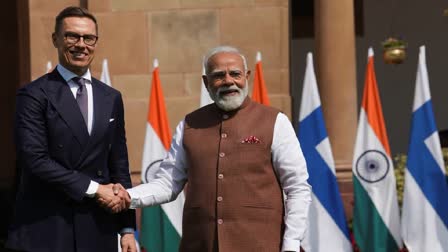
The 11th edition of the Raisina Dialogue began in New Delhi with Prime Minister Narendra Modi inaugurating the event, as Finland’s President Alexander Stubb highlighted India’s crucial role in shaping the future global order.
India hosted the opening session of the 11th edition of the Raisina Dialogue in New Delhi, bringing together global leaders, policymakers, diplomats and experts to discuss emerging geopolitical and technological challenges. Prime Minister Narendra Modi inaugurated the prestigious international conference, which has become one of the world’s most prominent forums for discussions on global strategy, diplomacy and international cooperation.
Delivering the keynote address at the event, Finland’s President Dr Alexander Stubb emphasized the growing importance of India and the Global South in shaping the next phase of the global order. According to him, the balance of power in international politics is gradually shifting away from traditional Western dominance toward emerging economies and developing nations.
President Stubb stated that the Global South possesses strong advantages in terms of both population and economic growth. These factors, he said, are increasingly influencing the direction of global politics and international decision-making.
The Finnish leader also remarked that while the era of a Western-dominated global order is gradually coming to an end, it may take time for many Western nations to fully recognize and adapt to this shift. He noted that the world is currently facing complex geopolitical challenges, which require collective international engagement and cooperation.
The Raisina Dialogue, organized annually in India, serves as a platform where world leaders and experts examine key issues ranging from geopolitics and security to technology and climate change.
Finland president highlights India’s growing role in global power balance
During his address, President Alexander Stubb spoke extensively about India’s strategic importance in the evolving global landscape. He suggested that India is well positioned to influence the emerging world order due to its diplomatic approach and growing economic strength.
According to him, the international system may experience instability if there is no functioning global power capable of maintaining balance and cooperation. He warned that abandoning international rules and institutions could lead to the collapse of the existing global order.
Stubb emphasized that global stability requires nations to continue supporting international norms and multilateral institutions. He argued that cooperation between countries is essential in a world where geopolitical competition is increasing.
The Finnish president also highlighted India’s foreign policy approach, describing it as pragmatic and balanced. He noted that India has avoided relying exclusively on any single international partner, instead maintaining strong relations with multiple global powers.
This strategy, he said, reflects a practical understanding of international politics. By engaging with a variety of partners rather than aligning exclusively with one bloc, India has strengthened its strategic flexibility and diplomatic influence.
Stubb further noted that India’s global influence is rooted in its active participation in international institutions and multilateral discussions. Rather than isolating itself, India continues to engage constructively with other nations on issues of global importance.
He also stressed that international institutions must become more representative of the current global reality. In particular, he argued that the voices of countries in the Global South should be given greater importance in global decision-making structures.
As part of this argument, Stubb reiterated his support for India’s long-standing demand for a permanent seat in the United Nations Security Council. Expanding representation in global institutions, he said, would help create a more balanced and inclusive international system.
Global challenges, technology and diplomacy take centre stage at forum
President Stubb also spoke about the concept of “values-based realism,” which he described as the foundation of Finland’s foreign policy. According to him, this approach combines ethical principles with practical political considerations when dealing with global issues.
He pointed out that India has practiced a similar approach for centuries through its diplomatic traditions and engagement with international institutions. India’s constructive role in organizations such as the United Nations reflects this balance between values and pragmatic decision-making.
The Finnish leader also highlighted how economic tools such as trade are increasingly being used as instruments of geopolitical influence. In this environment, he said, India’s leadership will be crucial in maintaining stability and promoting fair economic cooperation.
Another key issue addressed during his speech was the growing influence of emerging technologies, particularly artificial intelligence. Stubb cautioned that technological progress should not deepen the divide between developed and developing nations.
He stressed that the benefits of artificial intelligence and advanced technology must be shared more widely to ensure inclusive global development. If these technologies remain concentrated within a few countries, he warned, the global inequality gap could widen further.
President Stubb also referred to global challenges such as climate change, migration and economic instability, stating that these issues cannot be solved by individual nations acting alone. Instead, they require coordinated international responses and long-term cooperation.
Alongside President Stubb’s address, India’s External Affairs Minister Dr S Jaishankar also spoke at the event. He emphasized the importance of global awareness among Indian citizens, particularly in an era of rapidly changing geopolitical dynamics.
Jaishankar said the discussions at the Raisina Dialogue over the coming days would focus on a range of emerging topics, including technological transformation, artificial intelligence and evolving geopolitical capabilities.
He noted that the world is entering a new phase where technology, economic competition and strategic partnerships are reshaping international relations. In such a context, countries must adapt their thinking and develop new frameworks for cooperation and security.
The Raisina Dialogue continues to attract global attention each year as a forum where leaders and experts engage in discussions about the future of global governance. The conference provides a platform for exchanging ideas on diplomacy, security, economic development and technological transformation.
With participation from representatives of multiple countries and international organizations, the event highlights India’s growing role as a hub for strategic dialogue and global policy discussions.
As the sessions continue over the next few days, policymakers and experts are expected to examine key issues that will shape the future of international relations, including the role of emerging economies, technological innovation and the evolving structure of global governance.