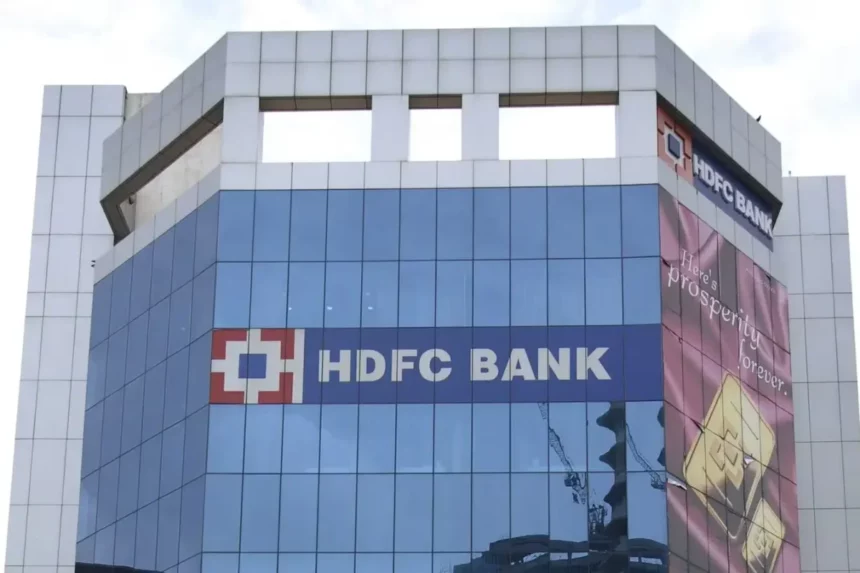
India’s equity markets witnessed sharp volatility last week, resulting in significant erosion in the valuation of some of the country’s biggest companies. A combined market capitalisation loss of over ₹1.02 lakh crore was recorded among five of the top-10 firms, reflecting cautious investor sentiment and global uncertainties. The biggest hit was taken by HDFC Bank, which alone accounted for more than half of the total decline. At the same time, select companies such as Reliance Industries and Bharti Airtel managed to buck the trend and post gains, highlighting the uneven impact of market fluctuations across sectors. The overall movement indicates that while the broader market remained relatively stable, sector-specific pressures and global cues played a major role in shaping investor behaviour during the week.
HDFC Bank Leads Losses as Financial and FMCG Stocks Decline
Among the biggest losers, HDFC Bank saw a massive erosion of ₹56,124 crore in its market capitalisation, bringing its valuation down significantly. The sharp decline in the banking giant reflects broader pressure on financial stocks, driven by concerns over liquidity, interest rates, and global economic signals. Alongside it, Hindustan Unilever also witnessed a substantial fall of over ₹18,000 crore, indicating weakness in the FMCG segment. This sector often reacts to inflationary pressures and changes in consumer demand, both of which have been influenced by rising input costs and global uncertainties.
Other major companies also experienced notable declines. Bajaj Finance lost over ₹15,000 crore in valuation, reflecting pressure on non-banking financial companies. Meanwhile, IT giant Tata Consultancy Services saw a drop of over ₹7,000 crore, indicating some weakness in the technology sector amid global demand concerns. ICICI Bank also recorded a decline of more than ₹6,000 crore, adding to the overall pressure on banking stocks. These losses collectively highlight how multiple sectors, including finance, FMCG, and IT, were affected during the week.
Reliance and Airtel Provide Support with Strong Gains
Despite the broader market pressure, several companies managed to deliver positive performance, providing some stability to the overall market. Reliance Industries emerged as the biggest gainer, adding nearly ₹46,000 crore to its market valuation. The company continues to maintain its position as India’s most valuable firm, supported by its diversified business model spanning energy, telecom, and retail.
Bharti Airtel also recorded strong gains of over ₹24,000 crore, reflecting investor confidence in the telecom sector. The company’s growth prospects, driven by expanding digital services and subscriber base, have continued to attract positive sentiment. Additionally, State Bank of India gained more than ₹10,000 crore, while Life Insurance Corporation of India and Infosys posted modest gains. These increases indicate that despite volatility, certain sectors and companies continue to show resilience and attract investor interest.
Market Sentiment Remains Cautious Amid Global Uncertainty
The broader indices reflected a mixed trend during the week. The BSE Sensex slipped marginally by 30.96 points, while the Nifty 50 declined by 36.6 points. Although the overall fall appears limited, it masks the underlying volatility that dominated trading sessions. The market started on a positive note, with gains recorded in the initial days, but a sharp sell-off later in the week wiped out most of the earlier gains.
Market experts attribute this volatility to a combination of global and domestic factors. Rising crude oil prices, geopolitical tensions, and cautious investor sentiment have contributed to uncertainty. Ajit Mishra of Religare Broking noted that investors are currently adopting a cautious approach, closely monitoring global developments and economic indicators before making significant investment decisions. This cautious stance is expected to continue in the near term, as markets react to evolving global cues and domestic economic data.
The divergence in performance among top companies highlights the importance of sector-specific dynamics in shaping market trends. While financial and FMCG stocks faced pressure, telecom and energy sectors showed relative strength. This indicates that investors are selectively allocating capital based on perceived growth potential and risk factors.
India’s stock market continues to demonstrate resilience despite periodic volatility, supported by strong fundamentals and long-term growth prospects. However, short-term fluctuations driven by global events and sector-specific challenges remain a key feature of the current market environment. As investors navigate these conditions, the focus will remain on balancing risk and opportunity, with careful attention to both domestic and international developments.