The fragile peace between Pakistan and Afghanistan stands at a critical juncture as the Taliban issued a stern warning to Islamabad ahead of their next round of negotiations in Istanbul. Scheduled for November 6, the talks are being held under the mediation of Turkey and Qatar, following the deadliest border clashes between the two South Asian neighbours since the Taliban’s return to power in 2021. With more than 70 people killed and hundreds injured in recent weeks, the escalating tension threatens to undo years of diplomatic engagement and humanitarian cooperation between the two Islamic nations.
The latest flare-up began after a series of explosions in Kabul on October 9, which the Taliban government swiftly blamed on Pakistan. The violence sparked heavy cross-border exchanges and led to a complete closure of the border between the two countries, crippling local economies and trade routes vital to both sides. Amid the unrest, Turkey’s foreign ministry announced that all parties had agreed to maintain a ceasefire until the upcoming high-level meeting in Istanbul. However, doubts persist about whether either side can sustain restraint in the face of mounting political and security pressures.
Taliban’s warning and message of restraint
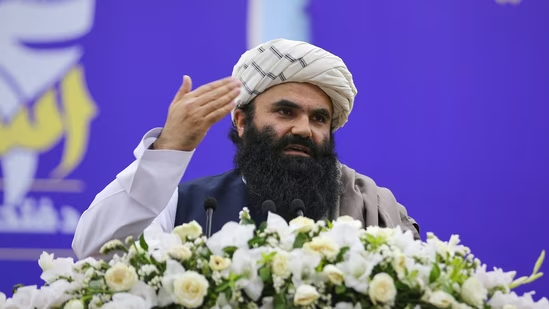
In a strongly worded statement on Thursday, Taliban interior minister Sirajuddin Haqqani cautioned Pakistan against actions that could destabilize the region further. “We are Muslims, brothers, neighbours, but some (in Pakistan), consciously or unconsciously, are playing with fire and war,” he declared. His message reflected the Taliban’s growing frustration with Islamabad’s recent military posture and political rhetoric, which they view as provocative.
Haqqani emphasized that while Afghanistan does not desire renewed conflict, it will not compromise on defending its sovereignty. “We do not want war, but defending the territory is one of our priorities,” he said. His comments underscore the Taliban’s shifting stance from a defensive diplomatic approach to a more assertive tone, signalling that patience with Pakistan’s demands is wearing thin.
The sharp rebuke came just hours after reports surfaced that the previously collapsed negotiations were likely to resume. Pakistan’s state broadcaster PTV, along with Afghanistan’s RTA, suggested that both sides were willing to re-engage under Turkish and Qatari mediation. Yet, RTA attributed the earlier breakdown of talks to what it called “the unreasonable demands of the Pakistani side,” hinting that Islamabad’s conditions may have pushed the discussions off track.
While neither government has released an official statement confirming the agenda for the Istanbul talks, the focus is expected to remain on de-escalation, border security, and preventing further violence. The Taliban leadership, meanwhile, appears determined to project itself as a legitimate government capable of managing foreign relations — an image that continues to face skepticism from much of the international community.
Rising tensions and economic strain along the border
The Pakistan-Afghanistan border, stretching over 2,600 kilometres, has long been a flashpoint of tension. What was once a line of cultural and economic exchange has increasingly become a militarized frontier. Islamabad accuses the Taliban government of harbouring militants from the Tehreek-e-Taliban Pakistan (TTP), who it claims use Afghan soil to launch attacks inside Pakistan. The Taliban, in turn, has repeatedly denied these allegations, insisting that it does not allow its territory to be used for cross-border terrorism.
Despite a temporary ceasefire, both sides continue to exchange barbs through media and diplomatic channels. Earlier this week, Pakistani Defence Minister Khawaja Asif issued a stern warning to Kabul, saying, “Any terrorist attack or suicide bombing inside Pakistan will give you the bitter taste of such misadventures.” His remarks, widely covered in Pakistani media, reflected the frustration of a government struggling to curb domestic militancy while facing accusations of mishandling its foreign policy toward Afghanistan.
The human cost of this renewed hostility has been devastating. According to the United Nations Assistance Mission in Afghanistan (UNAMA), at least 50 Afghan civilians were killed and over 447 injured in a single week of violence. Pakistan’s military also reported casualties, stating that 23 personnel were killed and 29 others wounded during the October clashes. While official figures do not specify civilian losses on the Pakistani side, reports from border towns indicate that several families have been displaced, and local infrastructure severely damaged.
For traders and residents living near the frontier, the continued closure of the border has meant economic despair. In Kandahar, Afghan cloth merchant Nazir Ahmed expressed his exhaustion with the conflict. “Our nation is tired and their nation is also tired,” he told AFP. His sentiment was echoed across the border in Chaman, where Pakistani trader Abdul Jabbar described the immense losses both sides were suffering. “Trade suffers greatly. Both countries face losses — both are Islamic nations,” he said.
The border shutdown has disrupted not only the movement of goods but also of humanitarian aid. Food and medicine shortages have begun to surface in some Afghan districts dependent on supplies from Pakistan. Similarly, Pakistani transporters and exporters complain of mounting losses as trucks loaded with perishable goods remain stranded for weeks. Local officials have urged both governments to reopen the crossing points for trade even as broader political issues remain unresolved.
Beyond trade, the crisis has also strained cultural and familial ties across the border. Generations of Pashtun families share heritage and relationships that transcend the political boundary. Yet, with increased militarization and security checks, movement has become nearly impossible, leaving many separated from loved ones on the other side.
Diplomatic efforts and the road ahead
As the date for the Istanbul meeting approaches, diplomatic efforts are intensifying to prevent another breakdown in talks. Turkey and Qatar, both seen as trusted interlocutors, have invested heavily in mediating the discussions. Turkish officials confirmed that representatives from both nations will attend the November 6 summit to decide on “the modalities of implementing the ceasefire.” The meeting aims to establish a framework for long-term border security, intelligence-sharing, and economic cooperation.
However, the success of these talks will depend on both sides’ willingness to compromise. Pakistan’s demand for decisive action against the TTP remains a core issue, while the Taliban seeks international recognition and the easing of trade restrictions. Analysts believe that unless these broader concerns are addressed, any temporary ceasefire will be short-lived.
Regional experts have also cautioned that the continued instability between Pakistan and Afghanistan could spill over into neighbouring countries, affecting security dynamics across South and Central Asia. With the United States and NATO’s withdrawal in 2021, the responsibility for maintaining regional peace has increasingly fallen on regional powers like Turkey, Qatar, China, and Russia.
Inside Afghanistan, public opinion appears divided. While some citizens express hope that the Taliban’s engagement with Pakistan will prevent another war, others remain skeptical of the group’s ability to balance diplomacy and governance. Meanwhile, in Pakistan, political parties have used the border crisis to attack the government, accusing it of weak foreign policy and inconsistent handling of the Afghan issue.
Despite the uncertainty, one sentiment remains common among civilians on both sides — a deep fatigue from decades of conflict. The recurring violence has left scars on both nations’ populations, economies, and psyches. Traders, farmers, and families long for peace that can sustain beyond temporary truces and political posturing.
As the Taliban and Pakistani delegations prepare for the Istanbul talks, the international community will be watching closely. Whether these negotiations lead to meaningful progress or dissolve into another cycle of blame could determine not just the future of bilateral ties but also the broader stability of the region.
For now, the warning from Sirajuddin Haqqani echoes ominously: “We are brothers, but some are playing with fire.” The coming weeks will reveal whether both nations choose diplomacy over destruction — or continue down the perilous path of hostility that has already cost so many lives.