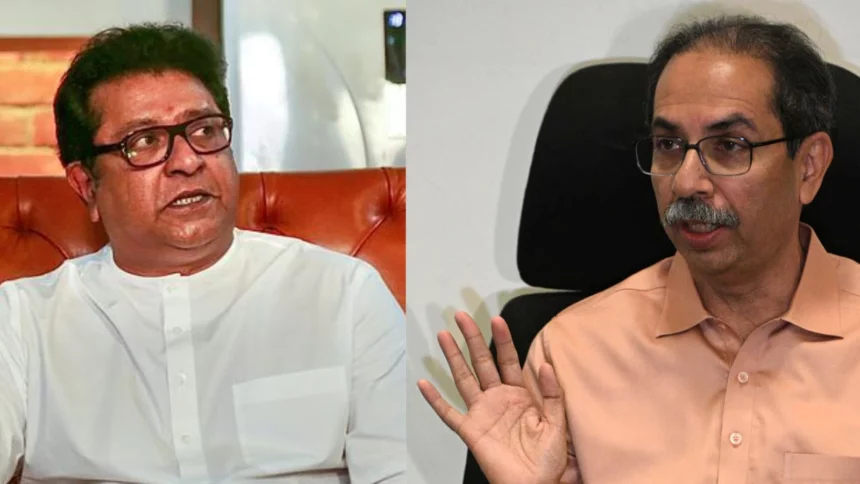
In a move that has ignited Maharashtra’s political landscape, Uddhav Thackeray and Raj Thackeray have announced separate protests against the state government’s decision to make Hindi the default third language in primary schools, calling it an imposition on Marathi identity and labelling it as a “language emergency.” Their stance has fueled discussions about potential political realignment ahead of local body elections, while the ruling coalition defends the decision as a continuation of earlier policies.
Uddhav Thackeray, Raj Thackeray Lead Opposition to Hindi Mandate
Uddhav Thackeray, former chief minister and Shiv Sena (UBT) chief, and his cousin Raj Thackeray, president of Maharashtra Navnirman Sena (MNS), have called for protests on July 7 and July 6 respectively against the policy, which mandates Hindi as the third language in Marathi and English medium schools unless at least 20 students opt for an alternative.
Uddhav Thackeray criticised the BJP-led Mahayuti government, accusing it of creating a “language emergency” and claimed the move was designed to divide Marathi and Hindi-speaking communities for political gain. He clarified that while his party does not oppose Hindi as a language, it is firmly against the compulsory nature of the policy, arguing that it threatens Maharashtra’s linguistic identity.
Raj Thackeray echoed similar sentiments, announcing a rally from Girgaum Chowpatty to Azad Maidan, calling it a people’s protest rather than a political event. He said he would reach out to writers, artists, parents, and students to join the protest, stating, “It is a conspiracy to reduce the importance of Marathi in Maharashtra.”
Both leaders accused the BJP of pushing a “one nation, one ideology” agenda, using the language policy as a tool to centralise control and erode regional identity. Uddhav Thackeray also claimed that the timing of the decision was intended to distract from corruption allegations against the state government ahead of the legislative session.
Government Defends Policy Amid Political Backlash
The state’s Marathi language minister and Shiv Sena leader Uday Samant countered the criticism, arguing that the policy’s foundations were laid under the previous Maha Vikas Aghadi (MVA) government when Uddhav Thackeray was chief minister. Samant pointed out that in January 2022, the MVA cabinet approved a recommendation from the Dr Raghunath Mashelkar committee under the National Education Policy (NEP), which called for the mandatory teaching of Marathi, English, and Hindi from classes 1-12.
Samant asserted that the current government has no intention of imposing Hindi but aims to implement NEP guidelines fairly. He claimed that opposition parties were misrepresenting the policy for electoral benefits, stating, “There is no plan to mandate Hindi forcibly, but some are trying to mislead people before elections.”
The report from the task force in 2021 had recommended introducing English and Hindi as second languages from the first standard onwards, aligning with the three-language formula under the NEP. The government argues that the policy is a step toward aligning Maharashtra’s education system with national standards while preserving Marathi as the primary language in the state.
As protests gather momentum, the debate over language imposition versus educational policy implementation continues to resonate in Maharashtra, with the controversy likely to shape political narratives as local body elections approach.