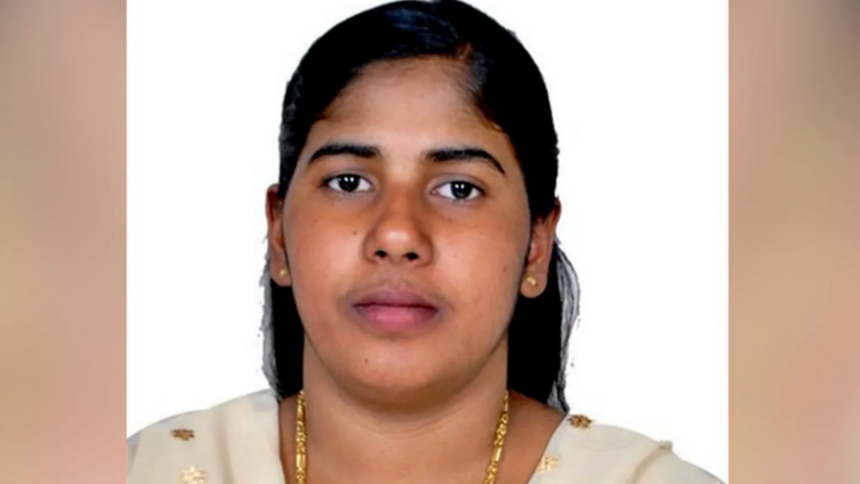
In a desperate bid to save the life of Nimisha Priya, a 34-year-old Indian nurse sentenced to death in Yemen, her family is placing their last hopes on securing a pardon from the victim’s family. Nimisha was sentenced to death for the murder of her former business partner, Talal Abdo Mahdi, whose dismembered body was found in a water tank in 2017. The Indian nurse has been imprisoned in Yemen’s capital, Sanaa, and her execution is imminent, with the approval of her death sentence recently confirmed by Mahdi al-Mashat, the president of the Houthi rebel group’s Supreme Political Council.
Under Yemen’s Sharia law, a pardon from the victim’s family is the only legal avenue to halt the execution. Nimisha’s family, along with supporters, have been striving for months to raise money for what is known as ‘diyah,’ or blood money, which could be paid to Mahdi’s family in exchange for a pardon. Negotiations have been ongoing, but as time runs out, the family’s hopes rest solely on the decision of Mahdi’s relatives.
Social worker Samuel Jerome, who holds a power of attorney on behalf of Nimisha’s mother, explained that if Mahdi’s family agrees to pardon her, the death sentence would be immediately revoked. He added that while forgiveness from the family is the first step, the decision to accept the blood money comes only after that. According to Yemeni law, Nimisha’s family cannot approach Mahdi’s relatives directly; they must hire negotiators to carry out the discussions.
Subhash Chandran, an Indian lawyer who has represented Nimisha’s family in the past, stated that they have raised $40,000 for Mahdi’s family as part of the negotiation process. The amount has been provided in two installments to the lawyers hired by the Indian government to mediate the case. While there has been a delay in sending the second tranche, efforts are still being made to continue the negotiations. Chandran emphasized that further discussions can only take place with the backing of the Indian government.
India’s foreign ministry has assured Nimisha’s family that they are aware of her situation and are offering all possible assistance. While the family remains anxious, they cling to the hope that a resolution is still possible. Nimisha’s husband, Tony Thomas, who spoke to her shortly before her death sentence was approved, expressed his concern for their daughter, saying that Nimisha’s only wish is to know if their daughter is safe.
Nimisha’s mother, Prema Kumari, is currently in Sanaa, having traveled to Yemen with permission from an Indian court last year. She has visited her daughter twice in prison. During their first emotional meeting, Nimisha asked her mother to remain strong and not to be sad. In their second meeting, Kumari was accompanied by two nuns who prayed for Nimisha’s safety.
Nimisha was just 19 years old when she moved to Yemen, a decision driven by the hope of improving her family’s financial situation. Hailing from a modest background, she worked as a nurse in a government-run hospital in Sanaa for several years. In 2011, she married Tony Thomas, a tuk-tuk driver from Kochi, and the couple later moved to Yemen together. After struggling with low-paying hospital jobs, Nimisha opened her own clinic in Yemen. To comply with local law, she partnered with Mahdi, a store owner, to run the clinic.
While their business relationship initially seemed cordial, Tony Thomas claimed that Mahdi’s attitude shifted drastically when the civil war broke out in Yemen in 2014. Nimisha was trying to finalize paperwork so that her husband and daughter could join her in Yemen, but travel restrictions imposed by the Indian government due to the war prevented this. With growing financial struggles, Nimisha chose to stay in Yemen despite the risks, as she had taken out significant loans to open her clinic.
Around this time, she began reporting incidents of mistreatment by Mahdi, including allegations of physical abuse. A petition filed by an advocacy group, the Save Nimisha Priya International Action Council, accused Mahdi of taking her money, seizing her passport, and even threatening her with a gun. In 2017, Mahdi’s body was found, and Nimisha was charged with his murder. She was accused of giving him an overdose of sedatives and then dismembering his body.
Nimisha has consistently denied the allegations, maintaining that her intent was never to kill Mahdi, but to subdue him in order to retrieve her passport. Her defense claimed that she accidentally overdosed him during the process. In 2020, she was sentenced to death by a local court, and in 2023, her family appealed the decision in Yemen’s Supreme Court, but the appeal was rejected.
Despite the complexities of the case and the ongoing legal battle, Nimisha’s family has not given up hope. Her husband, Tony Thomas, expressed his belief that a settlement could still be reached to save her life. “My heart says that we can arrive at a settlement and save Nimisha’s life,” he said. More than anything, he worries about their daughter, who is now 13 years old and has never experienced the love of her mother.
Each week, Nimisha speaks to her daughter on the phone, and her daughter becomes upset if she misses the call. Tony Thomas expressed his concern about the emotional toll this situation is taking on their child, who is left wondering what will happen to her mother.
As the deadline for the execution approaches, the family remains hopeful that the victim’s family will show mercy and grant the pardon that could save Nimisha’s life. The family’s determination to continue fighting for justice, despite the dire circumstances, highlights the emotional and legal complexities surrounding this case in Yemen.