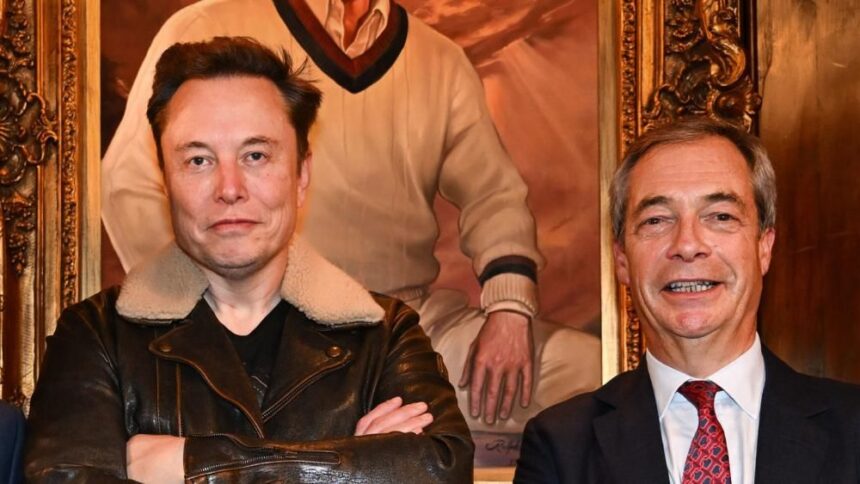
In a significant political development, Nigel Farage, the leader of the Reform UK party, has publicly distanced himself from tech billionaire Elon Musk’s support for jailed far-right activist Stephen Yaxley-Lennon, better known as Tommy Robinson. The controversy emerged after Elon Musk voiced his support for Yaxley-Lennon, who was imprisoned in October for contempt of court after repeating false claims about a Syrian refugee. This public endorsement of Yaxley-Lennon has caused unease within Nigel Farage’s political circles, leading the Reform UK leader to clarify his position on Elon Musk’s stance.
Nigel Farage, who has been outspoken about his support for Elon Musk in the past, particularly praising the tech mogul for his role in promoting free speech and for his involvement in the US presidential election, expressed discomfort with Elon Musk’s recent backing of Yaxley-Lennon. Elon Musk, known for his controversial social media presence, had posted several messages on X (formerly Twitter) calling for the release of Yaxley-Lennon, who had been convicted for contempt of court after making false claims about a Syrian refugee. Elon Musk’s intervention in the case has raised eyebrows, especially given Yaxley-Lennon’s history as a far-right figure, known for his involvement in anti-immigrant activism.
Although Nigel Farage has long admired Elon Musk for his entrepreneurial success and his commitment to free speech, particularly for purchasing Twitter and making it a platform for open discourse, he made it clear that he does not share Elon Musk’s views on Yaxley-Lennon. Speaking at the Reform UK’s East Midlands conference in Leicester, Nigel Farage stated that while he agreed with many of Elon Musk’s opinions, especially regarding the importance of free speech, he disagreed with Elon Elon Musk’s stance on Yaxley-Lennon. Nigel Farage referred to Elon Musk as a “remarkable new entrant” in American politics, but also acknowledged that Elon Musk held a wide range of opinions, some of which he did not fully agree with.
Nigel Farage’s disassociation from Elon Musk on this particular issue highlights the complex nature of their political relationship. Nigel Farage had previously expressed his admiration for Elon Musk, especially in the context of his support for former President Donald Trump and his involvement in the 2020 US elections. Elon Musk’s backing for Trump, especially his public endorsement of Trump’s bid for re-election, had earned him praise from Nigel Farage, who had even traveled to Florida to meet the tech billionaire. Elon Musk’s outspoken approach to political issues, however, has now caused some tension between the two figures, with Nigel Farage distancing himself from Elon Musk’s more controversial stances.
In addition to his comments on Elon Musk’s support for Yaxley-Lennon, Nigel Farage also addressed the political climate surrounding the ongoing controversies about grooming gangs in the UK. Health Secretary Wes Streeting recently criticized Elon Musk for his comments on the issue, describing them as “misjudged and certainly misinformed.” Elon Musk had accused UK Labour leader Sir Keir Starmer of failing to prosecute grooming gangs that systematically groomed and raped young girls. He also called for the imprisonment of Jess Phillips, the UK’s safeguarding minister, further stoking the political controversy. In response, Streeting emphasized that the UK government took child sexual exploitation very seriously, and many members of the Conservative Party also criticized Elon Musk for spreading “factually inaccurate” information.
Despite the tensions over Musk’s political interventions, Nigel Farage acknowledged that Musk remained an important ally to Reform UK, especially in terms of his potential financial support. There were reports that Musk was considering a sizable donation to the party, and Nigel Farage, ever pragmatic, indicated that such contributions would be highly beneficial for the party’s cause. Nigel Farage reiterated that Elon Musk’s influence, particularly in relation to his backing of free speech and his ability to challenge established narratives, made him a significant figure in both UK and global politics. He referred to Elon Musk as a “hero” for his actions surrounding Twitter, highlighting how Elon Musk’s ownership of the platform had restored a sense of free speech, which Nigel Farage viewed as crucial for modern politics.
The political landscape surrounding Musk, Nigel Farage, and Yaxley-Lennon is complex, with competing interests and values playing a significant role in shaping their public positions. While Nigel Farage continues to value Elon Musk’s contributions to the political discourse, particularly in promoting free speech, he has made it clear that some of Elon Musk’s more controversial positions, such as his support for Tommy Robinson, are not aligned with the Reform UK party’s ideals. As the political climate in the UK continues to evolve, it remains to be seen how Elon Musk’s influence and Farage’s leadership will intersect in the future, particularly as both figures navigate the complex and often polarizing world of contemporary politics