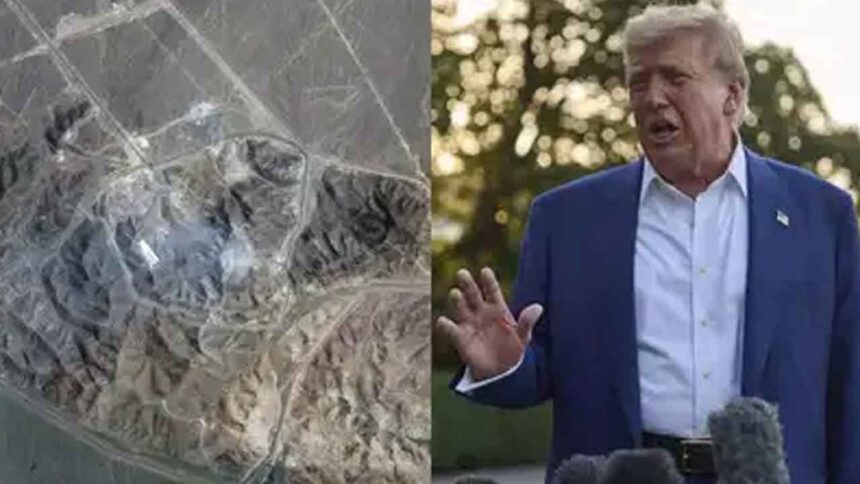
A fresh U.S. intelligence report has raised doubts over the extent of damage caused by the recent American airstrikes on Iran’s nuclear facilities, suggesting that the infrastructure remains mostly intact and only temporarily set back. The findings have triggered a sharp rebuttal from President Donald Trump and the White House, who insist the mission was a complete success and accuse the media of distorting the outcome for political reasons.
DIA Report Disputes Claims of Total Destruction
The controversy erupted following a classified report by the Defense Intelligence Agency (DIA), disclosed first by CNN, which concluded that while the June 22 airstrikes inflicted “substantial” damage on Iranian sites at Fordo, Natanz, and Isfahan, they failed to dismantle Iran’s core nuclear infrastructure. The report estimates that Iran’s nuclear capabilities have been delayed by only a few months.
According to the intelligence findings, entrances to the fortified Fordo enrichment site were collapsed by U.S. bunker-buster bombs, but key components of the facility survived. Additionally, equipment like uranium-enriching centrifuges had likely been moved prior to the strike and remain functional. Satellite imagery reportedly shows heavy truck movement before the attack, hinting that Iran may have anticipated the strike and relocated parts of its 60% enriched uranium stockpile.
These conclusions contradict recent public statements by both Donald Trump and Israeli Prime Minister Benjamin Netanyahu, who have touted the strikes as having “obliterated” Iran’s nuclear program. Benjamin Netanyahu claimed in a televised address that the joint Israeli-American operation had “brought to ruin” Iran’s atomic ambitions, describing it as “historic.”
Donald Trump, Allies Push Back Against Intelligence Assessment
President Donald Trump reacted furiously to the intelligence assessment, dismissing it as “fake” and accusing the media of undermining the success of the mission. Posting on Truth Social, Smear campaign, claiming, “Fake news CNN, together with the failing New York Times, have teamed up in an attempt to demean one of the most successful military strikes in history.”
White House Press Secretary Karoline Leavitt also criticized the report, calling it “flat-out wrong.” She argued that the leaked assessment was a deliberate attempt to discredit President Donald Trump and the fighter pilots involved. “Everyone knows what happens when you drop fourteen 30,000-pound bombs perfectly on their targets: total obliteration,” Leavitt said.
Vice President JD Vance defended the administration’s stance, stating in an interview with Fox News that preventing Iran from enriching uranium beyond 60% and halting weaponization efforts is tantamount to mission success. “If they don’t have the ability to reach weapons-grade uranium or convert it, that’s obliteration,” Vance said.
Steve Witkoff, Donald Trump’s special envoy, took the rhetoric further, labeling the leak of the DIA report as “treasonous” and demanding an investigation into how the assessment reached the press.
The Central Intelligence Agency (CIA) and the Office of the Director of National Intelligence have not commented on the report, while the Israeli government has also refrained from offering any independent verification or analysis of the airstrikes’ impact.
The debate over the true impact of the June 22 strikes reflects ongoing divisions over how best to contain Iran’s nuclear ambitions. While the Donald Trump camp continues to assert the strikes were a decisive blow, intelligence assessments suggest Iran’s nuclear program, though damaged, remains far from dismantled.