India has firmly rejected Pakistan’s reference to Jammu and Kashmir at the United Nations General Assembly (UNGA), calling it an unjustified attempt to mislead the global community. Responding to Pakistan’s remarks, India denounced the neighboring country’s “fanatical mindset” and history of religious intolerance while reiterating that Jammu and Kashmir remains an integral part of India.
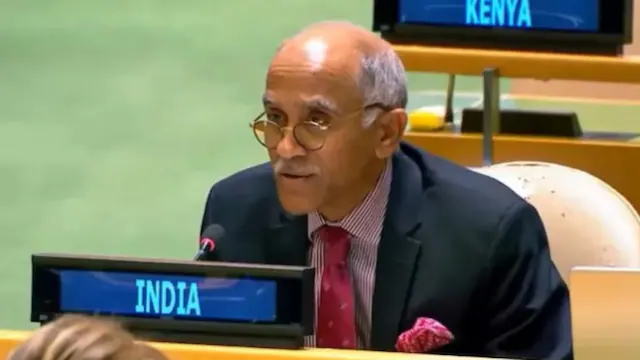
The strong response came after Pakistan’s former foreign secretary, Tehmina Janjua, mentioned Jammu and Kashmir during her speech at an informal meeting of the UNGA plenary, which was convened to commemorate the International Day to Combat Islamophobia. India’s Permanent Representative to the UN, Ambassador P. Harish, dismissed these references as baseless and accused Pakistan of attempting to divert attention from its own domestic and international issues.
Harish asserted that Pakistan’s repeated statements on Kashmir will neither change the ground reality nor justify its long-standing support for cross-border terrorism. He emphasized that such remarks are a habitual tactic employed by Pakistan to push its agenda despite global rejection of its claims. According to Harish, Pakistan’s “bigoted record” and “fanatical approach” are well known, and these repeated attempts at misinformation will not alter the fact that Jammu and Kashmir was, is, and will always be an integral part of India.
India has consistently maintained that any issues related to Jammu and Kashmir are internal matters and that no external interference will be tolerated. The Indian government has also repeatedly pointed out Pakistan’s role in sponsoring terrorism in the region, urging the international community to hold Islamabad accountable for its actions. Pakistan, on the other hand, continues to raise the Kashmir issue in global forums, despite facing strong rebuttals from India and a lack of international support.
New Delhi’s response at the UNGA is part of its broader strategy to counter Pakistan’s propaganda on the world stage. India has often highlighted Pakistan’s own human rights issues, including the persecution of religious minorities and suppression of political dissent. By addressing these concerns in global forums, India seeks to expose Pakistan’s double standards and shift the focus to Islamabad’s internal challenges.
As diplomatic tensions between the two nations persist, India remains firm in its position that Pakistan must first address its own domestic issues, end its support for terrorism, and respect international norms before making unwarranted statements about Jammu and Kashmir. India’s latest rebuttal serves as yet another reminder that Pakistan’s attempts to internationalize the Kashmir issue will continue to be met with strong opposition and factual counterarguments.