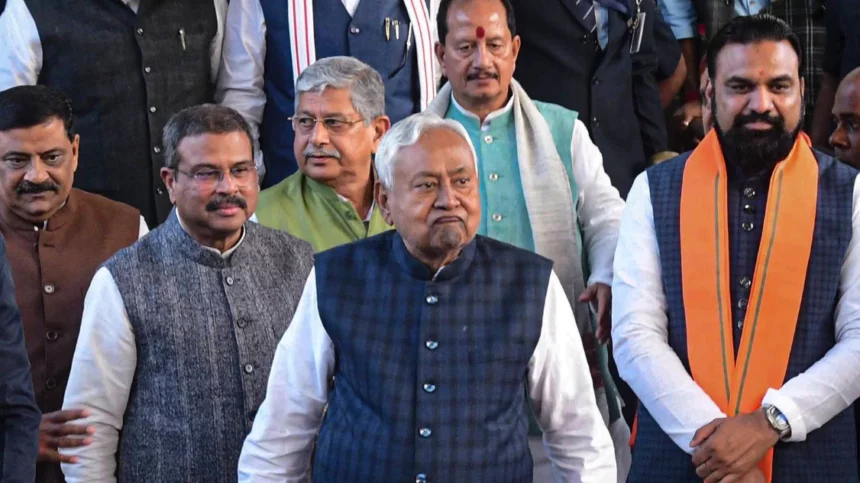
The political journey of Nitish Kumar has come full circle as he prepares to take oath as Bihar’s chief minister for a record tenth time, decades after his first brief stint in 2000, which lasted barely a week. Thursday’s swearing-in ceremony at Gandhi Maidan in Patna marks not only a milestone in his personal political career but also reflects the extraordinary resilience, adaptability, and enduring relevance of a leader who has repeatedly navigated the complex and often turbulent political landscape of Bihar. At 75, Kumar’s return to power is backed by a decisive victory for the National Democratic Alliance, which secured 202 seats in the 243-member Bihar legislative assembly, signaling strong public endorsement and political stability.
The One-Week Tenure: A Turbulent Beginning
Nitish Kumar’s first foray into Bihar’s top political office in 2000 was characterized by fragility, uncertainty, and intense political maneuvering. After the BJP-led central government under Atal Bihari Vajpayee and LK Advani returned to power in 1999, the party decided to focus on Bihar as a strategic state. Nitish Kumar, then serving as a Union minister, was chosen to be the face of the party in Bihar, reflecting the confidence of senior leadership in his organizational abilities and leadership potential.
The February 2000 Bihar assembly elections, however, produced a fractured mandate. Lalu Prasad Yadav’s Rashtriya Janata Dal secured 124 seats in the 324-member assembly, while the NDA, led by the BJP and Samata Party, obtained 122 seats. Both parties fell short of the majority mark of 163, leaving the state in a politically precarious position. Despite being numerically behind, Nitish Kumar received an invitation from Governor Vinod Chandra Pande to form the government, reflecting both his reputation and the central leadership’s support for a stable administration.
On March 3, 2000, backed by 151 NDA and allied MLAs, Kumar was sworn in as chief minister. His appointment was strongly supported by the Vajpayee government, with senior leaders like LK Advani and George Fernandes playing critical roles in facilitating the transition. Yet the political climate was far from stable. The RJD, with 159 MLAs, protested the move, arguing their numerical strength and right to form the government. This period saw one of the most intense episodes of political strategy and negotiation in Bihar’s history, with both camps attempting to woo and poach MLAs to secure the majority.
Despite efforts on both sides, neither party succeeded in consolidating the required numbers. Within just eight days, the Nitish Kumar-led government collapsed on March 11, 2000. This short-lived tenure remains one of the briefest chief ministerial terms in Bihar, a reminder of the unpredictability and volatility of coalition politics in a state known for its fragmented mandates and shifting alliances.
From Fragility to Political Mastery: The Road to the Tenth Term
Twenty-five years later, Nitish Kumar’s political trajectory has transformed dramatically, moving from the vulnerabilities of a one-week government to commanding a decisive majority in the state assembly. The upcoming swearing-in ceremony, marking his tenth term, highlights a political career characterized by strategic acumen, pragmatism, and a deep understanding of Bihar’s socio-political landscape. Unlike 2000, Kumar now enjoys the backing of a cohesive and powerful alliance in the form of the NDA, which secured an emphatic 202 seats out of 243. This overwhelming majority provides both political stability and a mandate to pursue his vision of development-centric governance.
Over the decades, Kumar has cultivated a reputation as a leader focused on administrative efficiency, social welfare, and economic development. Since his return to power in 2005, he has implemented policies that have sought to improve infrastructure, law and order, and governance mechanisms across Bihar. His political strategy has combined coalition-building with policy continuity, allowing him to maintain relevance in a state often marked by unpredictable electoral outcomes. The new term provides an opportunity to consolidate these achievements while accelerating development initiatives with the support of both the central government and local partners.
Kumar has consistently framed his leadership around pragmatic governance rather than purely ideological lines, a strategy that has helped him navigate multiple political upheavals, realign alliances, and maintain his position as a central figure in Bihar politics. From addressing rural infrastructure challenges to promoting social development programs, his tenure reflects a blend of administrative competence and political adaptability. The lessons from his one-week tenure in 2000 — the fragility of coalition politics, the importance of numerical majority, and the need for strategic negotiation — have informed his approach in subsequent years, making him a seasoned statesman capable of managing complex political environments.
As he steps into this tenth term, Kumar’s priorities include accelerating development projects, strengthening governance frameworks, and ensuring that Bihar’s growth trajectory remains inclusive and sustainable. With the NDA’s overwhelming majority and experienced partners by his side, he is positioned to implement policies with a sense of continuity, efficiency, and focus that were unattainable during his first brief stint. The contrast between his political fragility in 2000 and his commanding position today underscores not only his personal resilience but also the evolving nature of Bihar’s political landscape, where experience, adaptability, and public mandate converge to shape governance.
Nitish Kumar’s journey from a one-week chief minister to a ten-term leader exemplifies the enduring nature of political acumen, strategic foresight, and the ability to learn from past experiences. His return to power is a testament to both his personal political skill and the faith of the electorate in his vision for Bihar’s development. This milestone reflects the culmination of decades of political negotiation, alliance-building, and policy execution that has enabled him to transform initial setbacks into sustained leadership, ultimately shaping the trajectory of Bihar’s governance and political stability.