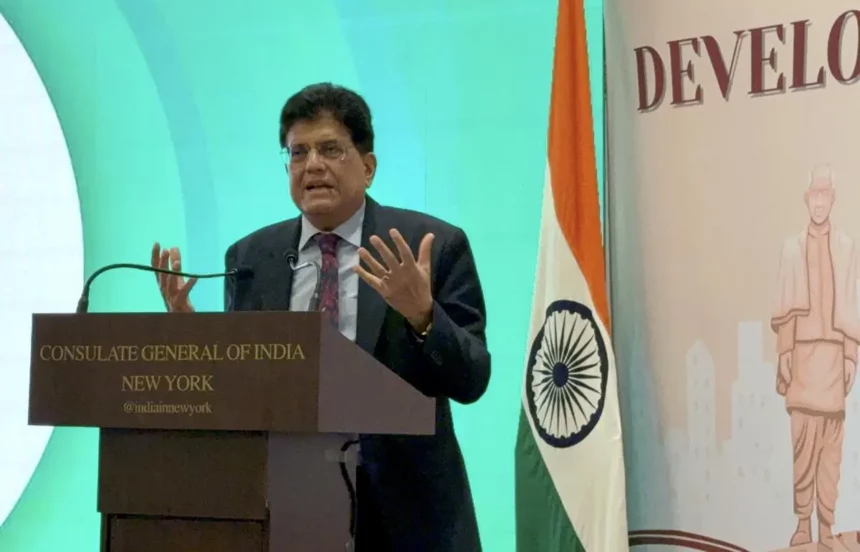
India is set to deepen its energy trade with the United States as Commerce and Industry Minister Piyush Goyal emphasized the growing bilateral economic partnership while addressing the US-India Strategic Partnership Forum in New York. The minister underscored how India not only strengthens America’s energy security through increasing crude oil, LPG, and LNG imports but also powers its innovation ecosystem by providing top-tier engineering talent and technological solutions. His remarks come at a time when energy flows between the two countries are scaling unprecedented levels, reflecting India’s efforts to diversify its energy basket while boosting strategic economic ties with Washington.
Sharp Rise in US Crude and LNG Imports by India
Official data confirms that India’s imports of US crude oil and gas products have surged significantly in 2025, marking a structural shift in trade flows. Between January and June, India’s crude imports from the United States increased by 51 percent year-on-year, moving from 0.18 million barrels per day (mb/d) in 2024 to 0.271 mb/d in 2025. The trend has been even sharper in the April–June quarter, with imports recording a dramatic 114 percent jump compared to the previous year. In value terms, the inflows more than doubled, rising from $1.73 billion in the first quarter of FY25 to $3.7 billion in FY26.
The momentum carried into July 2025 as well, when crude imports from the US climbed 23 percent over the previous month, lifting the American share in India’s overall oil imports from 3 percent to 8 percent. The Business Today report that highlighted these numbers also pointed to larger procurement plans by Indian refiners and energy companies, which could substantially expand the US share of India’s crude basket in the years ahead.
Alongside oil, purchases of American natural gas products have also grown rapidly. LNG imports nearly doubled in FY25, reaching $2.46 billion as compared to $1.41 billion in FY24. Industry reports suggest that Indian buyers are currently negotiating a long-term LNG supply agreement with the United States, potentially worth tens of billions of dollars. Such a deal, if finalized, would lock in a steady stream of American gas to India for decades and reshape bilateral trade dynamics in the energy sector. Similarly, imports of liquefied petroleum gas (LPG) have also climbed sharply, catering to India’s rising household demand and industrial use.
Sources cited by ANI earlier this year indicated that Indian companies were considering increasing their crude imports from the US by nearly 150 percent during the financial year 2025–26. If realized, this would mark one of the most significant shifts in India’s energy sourcing strategy, underscoring New Delhi’s efforts to build resilience by diversifying away from traditional suppliers while deepening its alignment with Washington on energy security.
India Powers US Growth With Talent, Innovation and Policy Advice to Europe
In his address, Piyush Goyal not only spotlighted the scale of energy cooperation but also emphasized India’s contribution to America’s growth story beyond commodities. He noted that Indian engineers, researchers, and graduates form the backbone of the US tech ecosystem, providing the talent and innovation that drives new products, research, and development. His remarks came in the backdrop of the Donald Trump administration’s new H-1B visa laws, which have created uncertainty in the US technology sector that heavily depends on Indian, Chinese, and Korean professionals.
“We provide a huge amount of talent and innovation, for which Indian engineers and graduates are famous,” Goyal told the gathering. “That also provides us an opportunity to provide solutions for corporations across the world, including in the US, to support their growth plans, to focus on new research and development, and new ideas.”
Beyond the US, Goyal also issued a strong advisory to the European Union regarding its carbon border adjustment mechanism (CBAM). He warned that pushing forward with CBAM could isolate Europe and damage its economy, undermining its trade partnerships with key players like India. The minister stressed that India was committed to sustainability and clean energy transitions but argued that unilateral mechanisms like CBAM could distort global trade and hurt competitiveness rather than advance environmental goals.
His comments reflect India’s broader positioning in the global economic landscape: deepening ties with the US, diversifying its energy imports to strengthen energy security, contributing to the global innovation workforce, and simultaneously pushing back against protectionist measures that may hinder free trade. The sharp rise in India’s American crude and LNG imports, coupled with Goyal’s remarks on talent and policy, underscore how New Delhi seeks to balance its economic diplomacy by strengthening strategic relationships while defending its long-term growth interests on the global stage.