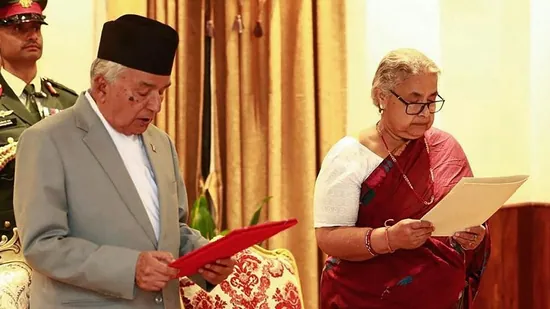
In a historic political transition in Nepal, Sushila Karki, the former Chief Justice of the Supreme Court and a prominent anti-corruption campaigner, was sworn in as the country’s first woman Prime Minister, heading an interim government after days of turmoil and violent protests. Indian Prime Minister Narendra Modi, in his first reaction, extended his greetings and pledged that India remained firmly committed to Nepal’s peace, stability, and prosperity. The development has attracted significant attention across the region, given the fragile political situation in Nepal and the broader implications for South Asian geopolitics.
A Historic Moment in Nepal’s Political Landscape
The swearing-in of Sushila Karki as interim Prime Minister marks a watershed in Nepal’s turbulent democratic journey. A respected jurist and activist with a reputation for fighting corruption and defending constitutional integrity, Sushila Karki was chosen to lead an interim administration following unprecedented student-led protests that swept through Kathmandu and several major cities over the past week. These protests, initially sparked by outrage over the government’s move to impose restrictions on social media platforms, rapidly expanded into a broader uprising against corruption, misgovernance, and the authoritarian tendencies of former Prime Minister KP Sharma Oli’s administration.
The demonstrations were led by student groups, particularly members of Generation Z, who have become increasingly vocal about political accountability in Nepal. Their mobilization drew tens of thousands of participants, many of whom were angered by what they saw as a deepening culture of corruption, lack of transparency, and misuse of state power. The protests took a tragic turn when police opened fire and cracked down on demonstrators, leading to the deaths of more than 20 students and leaving hundreds injured. The violence triggered nationwide outrage and intensified calls for Oli’s resignation.
Facing growing dissent and escalating unrest, Oli ultimately resigned from office. However, his departure did not immediately calm the situation. Within hours of his resignation, mobs ransacked several government buildings, including the Parliament in Kathmandu, and torched the residences of political leaders linked to the administration. More than 50 people were killed in violent clashes and arson attacks, forcing the Nepalese army to step in and restore order. The severity of the crisis underscored the fragility of Nepal’s democratic institutions and the depth of public anger at the political class.
In the wake of these developments, political parties, civil society, and student groups turned to Sushila Karki, who had long been admired for her fearless pursuit of justice during her tenure as Nepal’s Chief Justice. Sushila Karki, known for challenging corruption at the highest levels of government, was seen as a consensus figure capable of restoring public trust and steering the nation towards stability. On Friday, she was formally sworn in at the presidential office, with the backing of student organizations and interim political stakeholders. Her appointment makes her the first woman ever to serve as Nepal’s Prime Minister, a symbolic milestone that carries both domestic and regional significance.
India’s First Response and Prime Minister Modi’s Assurances
India was quick to respond to the dramatic shift in Kathmandu. Prime Minister Narendra Modi, in his first official statement on Saturday, extended warm wishes to Sushila Karki as she assumed office and reiterated New Delhi’s unwavering support for Nepal’s progress. Posting on social media, PM Modi said: “I extend my best wishes to Right Hon. Mrs. Sushila Karki on assuming office as the Prime Minister of the Interim Government of Nepal. India remains firmly committed to the peace, progress and prosperity of the people of Nepal.”
PM Modi’s statement reflected not just diplomatic courtesy but also New Delhi’s longstanding strategic interest in ensuring stability in Nepal, a close neighbour with which India shares deep cultural, historical, and economic ties. The Prime Minister’s words came after days of intense deliberations within the Indian establishment, particularly as violence in Nepal escalated. Earlier in the week, PM Modi had convened a meeting of the Cabinet Committee on Security to review the crisis in the Himalayan nation. Expressing anguish over the loss of young lives in police crackdowns, he had described the developments in Nepal as “heart-rending” and urged all sides to prioritize peace and dialogue.
The Indian Ministry of External Affairs also issued a statement late on Friday night, officially welcoming the formation of the interim government under Sushila Karki’s leadership. The ministry emphasized that India, as a close neighbour, a fellow democracy, and a long-term development partner, would continue to work closely with Nepal to promote the well-being and prosperity of both nations. This message was carefully worded to underline India’s supportive stance without appearing to interfere in Nepal’s domestic affairs, a balance that New Delhi has often sought to maintain in dealing with Kathmandu’s sensitive political landscape.
Sushila Karki’s appointment is viewed in India as an opportunity for Nepal to restore political stability and credibility. India has historically had to navigate complex relations with successive governments in Nepal, often balancing its strategic priorities with the sensitivities of Nepali nationalism. The latest upheaval, marked by student-led movements and widespread discontent, has reinforced the need for India to maintain a steady and supportive engagement with Nepal’s evolving political scenario.
At the same time, Sushila Karki’s reputation as a strong anti-corruption crusader and her independence from entrenched political elites may create new opportunities for bilateral cooperation. Analysts in New Delhi believe that her leadership could help reset Nepal’s governance agenda in ways that are more people-centric and transparent, which in turn could strengthen democratic institutions. For India, this is particularly significant, given the potential spillover effects of instability in Nepal on border security, trade, and regional peace.
Regional and Geopolitical Implications of Nepal’s Crisis
The turmoil in Nepal has also highlighted the broader challenges facing South Asian democracies, where youth-led movements and social media activism are increasingly shaping political outcomes. The protests that began against a social media ban reveal the deep generational divide in Nepal, with young people demanding greater freedom of expression, accountability, and responsiveness from their leaders. The violent response of the state only deepened their determination and turned a specific grievance into a sweeping demand for systemic change.
For India, the crisis is particularly sensitive given the shared border and deep cultural linkages with Nepal. Any prolonged instability in Kathmandu risks creating security concerns, including the potential for refugee flows, disruption of cross-border trade, and opportunities for external powers to increase their influence. India has historically viewed stability in Nepal as integral to its own strategic environment. As such, New Delhi’s rapid outreach to Sushila Karki’s interim administration is not only a gesture of goodwill but also a calculated move to ensure that Nepal’s trajectory remains aligned with regional stability.
Beyond the bilateral dimension, the crisis has been closely watched by other regional players, including China and the United States. Both countries have interests in Nepal, with China investing heavily in infrastructure projects under the Belt and Road Initiative and the United States supporting democratic consolidation and development programs. Sushila Karki’s interim leadership will thus have to navigate not only domestic expectations but also the competing geopolitical pressures of its powerful neighbours and international partners.
At a symbolic level, Sushila Karki’s rise as the first woman Prime Minister of Nepal also carries weight in South Asia, where women leaders have historically played transformative roles in moments of political crisis. Her appointment is seen as a victory for gender representation in a society still grappling with entrenched patriarchal norms. For many in Nepal, her leadership embodies a chance for moral renewal and a break from the corruption and cronyism that have plagued the political class for decades.
As Nepal enters this critical transitional phase, India’s messaging has remained consistent: it supports Nepal’s democratic aspirations, respects its sovereignty, and is committed to working together for mutual prosperity. PM Modi’s emphasis on peace, progress, and prosperity encapsulates India’s strategic calculus—acknowledging the volatility of the moment while reaffirming the importance of a stable Nepal for regional balance.