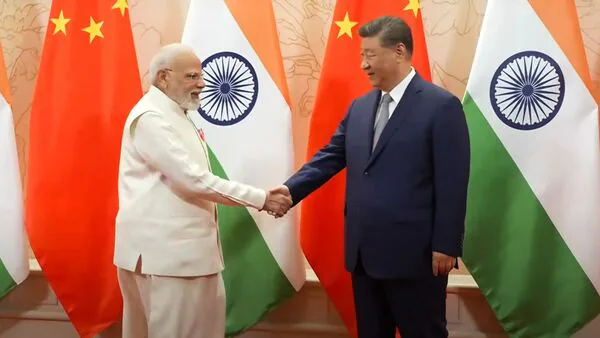
Days after Prime Minister Narendra Modi and Chinese President Xi Jinping met in Tianjin, Chinese Ambassador to India Xu Feihong stressed that relations between New Delhi and Beijing have been “overwhelmingly defined by friendly cooperation” despite longstanding challenges. Speaking at a reception to mark the 76th anniversary of the founding of the People’s Republic of China, Xu emphasized the need to strengthen dialogue, expand trade, and deepen exchanges as the two countries celebrate 75 years of diplomatic ties.
Four Priorities for Strengthening Bilateral Relations
Xu laid out four clear priorities to guide the next phase of India-China relations. He urged both sides to maintain a strategic perspective, reminding that as two major ancient civilizations and large developing nations, their relationship carried global and strategic weight beyond just bilateral concerns.
The envoy highlighted economic ties as a key pillar, noting that trade between the two nations has grown significantly. Between January and August this year, bilateral goods trade rose 10.4 percent year-on-year, reaching $102 billion. He also pointed to renewed cultural and religious exchanges, citing the resumption of pilgrimages for Indian devotees to Tibet’s sacred sites. More than 700 official pilgrims and nearly 20,000 private visitors undertook journeys this year, he said. Meanwhile, Chinese consulates issued more than 265,000 visas to Indian citizens by September 22.
Xu stressed that dialogue and communication remained crucial for resolving differences, particularly the boundary question, which he argued should not be allowed to dominate or derail broader cooperation. He further called for enhanced multilateral coordination, drawing on shared historical legacies of resisting fascism and colonialism, and urged both sides to work together in defending the interests of the Global South, resisting power politics, and contributing to a “shared future for humanity.”
China’s Economic Growth and Multilateral Engagements
Linking the bilateral relationship to China’s broader achievements, Xu noted that the Communist Party of China has led the country through remarkable transformations in the past 76 years, moving from poverty to prosperity and now strength. He cited China’s stronger-than-expected GDP growth of 5.3 percent in the first half of 2025, which contributed around 30 percent to global growth. Advances in green energy and manufacturing, particularly electric vehicles, were highlighted as examples of China’s innovative capacity.
The ambassador also spoke of the country’s record in poverty reduction, having lifted nearly 100 million people out of poverty in the past decade and meeting the UN’s 2030 sustainable development goals ten years ahead of schedule. In the first half of 2025 alone, over 30,000 new foreign-invested companies were established in China, an 11.7 percent increase year-on-year. Major trade events such as the Canton Fair and the China International Import Expo, Xu said, continued to create new opportunities for global partners, including India.
On the multilateral stage, Xu pointed to China’s recent hosting of the Shanghai Cooperation Organization summit in Tianjin, which drew leaders from 23 nations, including Prime Minister Modi, and heads of 10 international organizations. He said President Xi used the summit to launch the Global Governance Initiative, calling for sovereign equality, respect for international law, genuine multilateralism, and people-centered development. According to Xu, this was China’s contribution to tackling global governance challenges and building a more balanced order.
Concluding his remarks, Xu invoked the spirit of the season, saying that as the monsoon recedes and the Rabi sowing season begins, both nations should “work diligently to bear more fruits in our friendly relations” and ensure greater benefits for their peoples. He toasted to the 76th anniversary of the People’s Republic of China and to the enduring friendship between India and China.