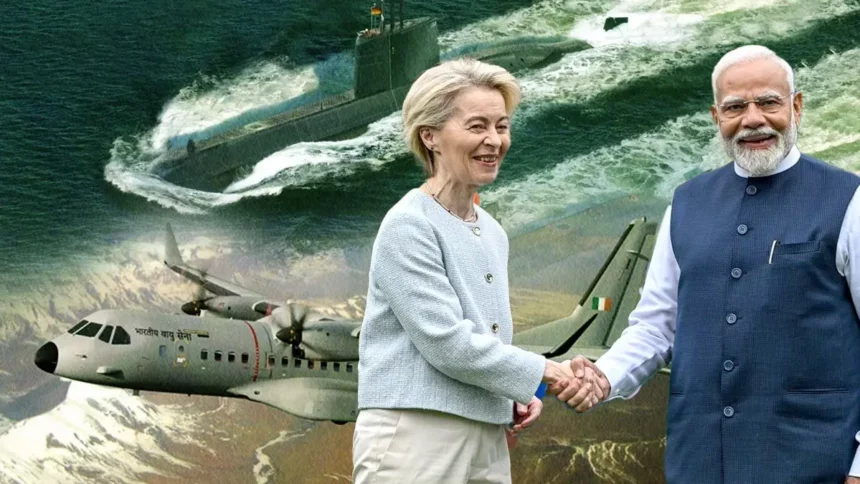
India and the European Union are set to take a decisive step in strengthening their strategic relationship with the signing of a comprehensive defence and security partnership in New Delhi next week, reflecting a shared resolve to respond collectively to an increasingly uncertain global security environment.
The proposed agreement marks the first time that India and the European Union will formalise defence cooperation at an institutional level, elevating their engagement beyond political dialogue and economic collaboration. The pact is expected to be signed during a high-level bilateral summit in the Indian capital and will lay the foundation for long-term cooperation across defence policy, maritime security, cybersecurity, counterterrorism, and defence industrial partnerships. Coming at a time of heightened geopolitical tensions and shifting power equations, the agreement signals a convergence of strategic interests between New Delhi and Brussels.
The move also underscores the growing recognition on both sides that security challenges are no longer confined to national borders. From maritime disruptions and cyber intrusions to terrorism and hybrid warfare, India and the EU increasingly face overlapping threats that require coordination, intelligence sharing, and structured engagement. The forthcoming pact aims to address these challenges through regular consultations, operational cooperation, and joint initiatives designed to enhance resilience and preparedness.
Expanding strategic alignment amid global security uncertainty
The defence and security partnership represents a significant evolution in India–EU relations, which for decades focused primarily on trade, development cooperation, and diplomatic engagement. While defence ties existed through bilateral arrangements between India and individual European countries, the new pact introduces a collective EU framework that brings coherence and scale to security cooperation.
One of the central pillars of the agreement is maritime security, an area of growing importance for both partners. India, located at the heart of the Indian Ocean region, plays a critical role in safeguarding vital sea lanes that carry a large share of global trade and energy supplies. The EU, with its strong dependence on maritime commerce, shares similar concerns about freedom of navigation, piracy, and the protection of undersea infrastructure. Through the pact, both sides aim to improve coordination in maritime domain awareness, information sharing, and capacity-building initiatives.
Cybersecurity is another key area addressed by the partnership. As digital infrastructure becomes increasingly interconnected, cyber threats have emerged as a major security concern for governments and defence establishments. The agreement is expected to promote cooperation on cyber threat assessment, incident response, and the protection of critical infrastructure. By establishing structured channels for dialogue and collaboration, India and the EU seek to enhance their ability to prevent, detect, and respond to cyberattacks that could have far-reaching consequences.
Counterterrorism cooperation also features prominently in the pact. India’s long-standing experience in dealing with terrorism and Europe’s own challenges related to radicalisation and transnational extremist networks have created a shared understanding of the need for closer coordination. The partnership will facilitate exchanges on best practices, intelligence cooperation, and strategies to counter terrorist financing and online radicalisation.
The agreement further reflects a broader alignment on global security norms and principles. Both India and the EU have consistently emphasised respect for international law, sovereignty, and the peaceful resolution of disputes. In a world marked by strategic competition and contested regions, the defence pact reinforces their commitment to a rules-based international order and multilateral cooperation.
Defence industry cooperation and long-term institutional engagement
Beyond operational security cooperation, the defence pact is expected to open new avenues for collaboration between Indian and European defence industries. Over the past decade, India has expanded its domestic defence manufacturing capabilities, encouraging joint ventures, technology transfers, and indigenous production. European defence companies, known for advanced technologies and innovation, see growing opportunities in partnering with Indian firms.
The agreement is likely to promote defence industrial cooperation through structured platforms that bring together policymakers, military officials, and industry stakeholders. Such engagement could support joint research and development projects, co-production of defence equipment, and collaboration in emerging areas such as space security, artificial intelligence, and advanced materials. For India, this aligns with its objective of strengthening self-reliance in defence manufacturing while integrating with global supply chains. For the EU, it offers access to one of the world’s fastest-growing defence markets and a trusted strategic partner.
Training and capacity-building initiatives are also expected to form part of the partnership. Joint exercises, professional military education exchanges, and personnel training programmes can enhance interoperability and mutual understanding between Indian and European armed forces. These initiatives not only strengthen operational readiness but also build long-term institutional relationships that underpin strategic cooperation.
The pact also envisages regular high-level dialogues and working groups to oversee implementation and adapt cooperation to evolving security challenges. By institutionalising defence engagement, India and the EU aim to ensure continuity and depth in their partnership, regardless of political changes or short-term fluctuations in global affairs.
Importantly, the defence agreement complements ongoing discussions in other areas of India–EU relations, including trade, technology, climate action, and mobility. Together, these strands form a comprehensive strategic partnership that reflects the multifaceted nature of contemporary international relations, where economic strength, technological leadership, and security resilience are increasingly interconnected.
As preparations for the signing continue, diplomatic engagements on both sides highlight a shared ambition to translate political intent into concrete outcomes. The defence and security pact, once formalised, is expected to serve as a cornerstone of India–EU relations in the coming years, shaping how the two partners engage with regional and global security challenges.