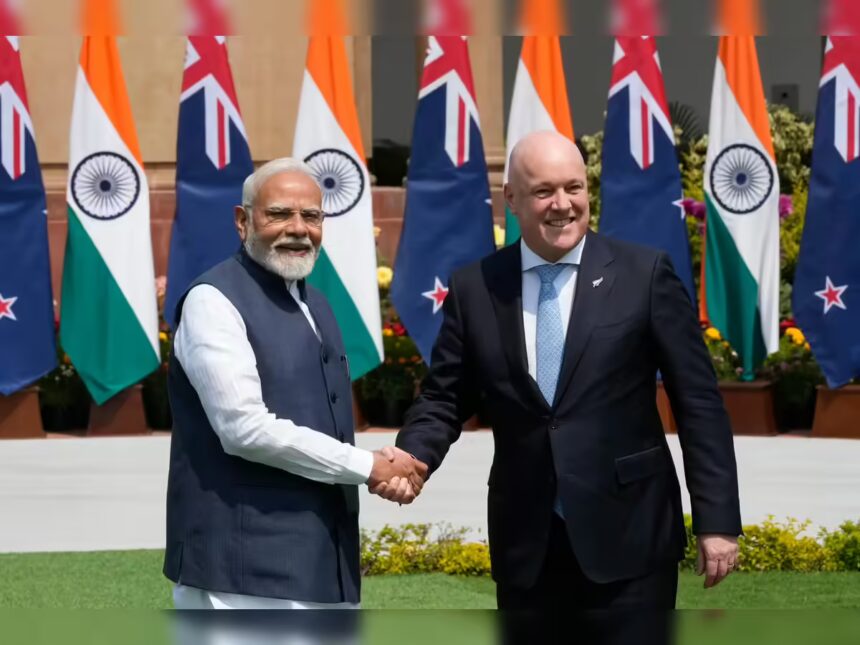
After nearly a decade of stalled negotiations, India and New Zealand have formally concluded a comprehensive Free Trade Agreement, marking a significant milestone in their economic relationship and opening a new chapter in bilateral trade. The deal, finalised on Monday after talks were revived earlier this year, reflects the growing strategic and economic convergence between the two countries and signals New Zealand’s intent to deepen its presence in one of the world’s fastest-growing major markets. By dramatically reducing import duties on a wide range of goods, the agreement is expected to have tangible effects on trade flows, exporters, and everyday consumers, particularly in India’s expanding middle class.
The announcement was made by New Zealand Prime Minister *Christopher Luxon*, who described the agreement as a breakthrough that would make it significantly easier for New Zealand exporters to access the world’s most populous country. For India, the deal adds another pillar to its evolving trade strategy, which increasingly relies on targeted free trade agreements to integrate the economy with global supply chains while offering consumers greater choice and competitive prices. The conclusion of the pact comes at a time when India’s economic scale and purchasing power are drawing renewed attention from global trading partners.
Tariff reductions, market access, and immediate impact on consumers
One of the most consequential aspects of the India–New Zealand Free Trade Agreement is the scale and speed of tariff liberalisation. Under the terms of the deal, import duties on around 95 percent of goods coming from New Zealand into India will either be eliminated entirely or sharply reduced over time. More than half of these products will become duty-free from the very first day the agreement comes into force, an unusually high level of immediate liberalisation that underscores New Zealand’s eagerness to secure early gains in the Indian market.
For Indian consumers, the effects are likely to be visible relatively quickly. Fresh fruits imported from New Zealand, particularly kiwifruit and apples, will be taxed at substantially lower rates than before, making them more affordable in Indian markets. Wool and wool-based products, an area in which New Zealand is a major global supplier, will also become cheaper, potentially benefiting India’s textile and apparel sector as well as consumers purchasing finished garments. In addition, wood products and selected dairy items will see reduced duties, widening the range of competitively priced imported goods available in India.
From New Zealand’s perspective, the agreement dramatically improves access to India’s vast and increasingly affluent consumer base. The country’s exporters of dairy, fresh produce, wine, and wool have long viewed India as a market with enormous potential but limited practical access due to high tariffs and regulatory barriers. By removing or lowering these duties, the FTA lowers entry costs and improves price competitiveness, allowing New Zealand producers to scale up their presence in a market that was previously difficult to penetrate.
The New Zealand government has emphasised that the “day-one” benefits of the deal are particularly significant. With more than 50 percent of goods facing zero duty from the outset, exporters can immediately adjust pricing and distribution strategies without waiting for long transition periods. This is expected to encourage a faster ramp-up in trade volumes and help New Zealand firms establish brand recognition among Indian consumers at an early stage.
For India, while the immediate benefits are most visible on the consumer side, the agreement also fits into a broader strategy of using trade liberalisation to moderate inflationary pressures and expand consumer choice. Cheaper imported food products and raw materials can help stabilise prices and improve supply resilience, especially in urban markets where demand for high-quality imported goods is rising rapidly. At the same time, Indian policymakers have sought to balance such openness with safeguards for domestic producers, a consideration that shaped the lengthy negotiations leading up to the deal.
Strategic context, economic projections, and the end of a decade-long impasse
The conclusion of the FTA is closely linked to India’s growing economic weight and long-term growth projections. New Zealand officials have explicitly framed the agreement as a bet on India’s future trajectory, noting that the Indian economy is expected to expand dramatically over the coming years. According to estimates cited by the New Zealand government, India’s economy could be worth around 12 trillion New Zealand dollars by 2030, reflecting both rapid growth and the sheer scale of its population and domestic market.
This anticipated expansion makes India an especially attractive destination for New Zealand exporters, whose domestic market is relatively small. For sectors such as dairy, fresh fruit, and wool, sustained growth increasingly depends on access to large overseas markets. India’s rising middle class, with greater disposable income and changing consumption patterns, represents a particularly promising opportunity. The FTA is designed to position New Zealand companies to benefit from these trends by reducing structural barriers that previously limited trade.
The deal also brings closure to a negotiation process that had been stalled for nearly ten years. Talks between India and New Zealand began more than a decade ago but failed to make meaningful progress due to differences over market access, tariff schedules, and sensitivities in agriculture and dairy. For years, the negotiations remained dormant, reflecting both countries’ caution and shifting trade priorities.
That impasse was broken earlier this year when discussions were revived in March. Remarkably, after a decade of stagnation, negotiators were able to reach a final agreement in just nine months. This accelerated timeline reflects changes on both sides: India’s greater openness to selective trade liberalisation through bilateral agreements, and New Zealand’s willingness to accommodate India’s concerns while securing meaningful access for its exporters.
The India–New Zealand FTA also fits into a broader pattern of India’s recent trade diplomacy. Over the past five years, India has signed seven free trade agreements, including major pacts with Australia and the United Arab Emirates. These agreements signal a shift away from a more defensive trade posture toward a calibrated approach that seeks to integrate India more deeply into global trade networks while retaining policy flexibility. By adding New Zealand to this list, India strengthens its trade ties in the Asia-Pacific region and diversifies its economic partnerships.
For New Zealand, the agreement complements its strategy of expanding trade links beyond traditional partners. By securing preferential access to India, Wellington reduces its reliance on a narrower set of export destinations and positions itself to benefit from one of the most dynamic growth stories in the global economy. The FTA is thus not only about immediate tariff reductions but also about long-term strategic positioning in a changing global trade landscape.
As the agreement moves toward implementation, attention will turn to how quickly businesses on both sides are able to capitalise on the new opportunities it creates. Exporters will need to navigate regulatory requirements, build distribution networks, and adapt products to local preferences. For consumers, the most visible outcome will be a wider range of imported goods at lower prices, symbolising how a decade of negotiations has finally translated into everyday economic impact.