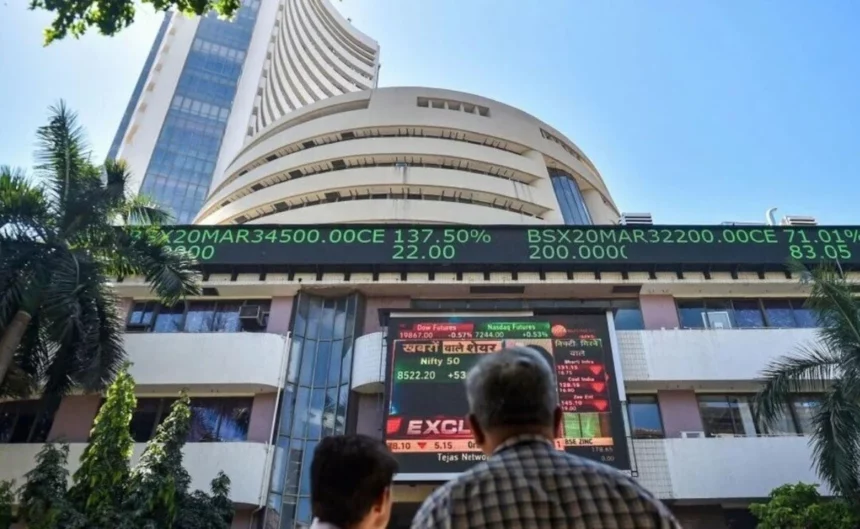
Indian equity markets began the new week on a firm and confident note on Monday, December 22, as benchmark indices posted strong gains supported by broad-based buying, positive global cues, and sustained domestic institutional support. Investor sentiment remained upbeat through the session, pushing the Sensex sharply higher and helping the Nifty regain the psychologically important 26,000 mark, reinforcing optimism about the near-term direction of the market.
The Sensex settled at 85,567.48, rising by 638.12 points, while the Nifty closed comfortably above the 26,000 threshold. The rally reflected strength across most sectors, with metal and information technology stocks leading the advance. Except for consumer durables, all major sectoral indices on the National Stock Exchange ended the day in positive territory, highlighting the breadth of the buying interest.
Sectoral momentum and stock-specific performance drive the rally
Buying activity on Monday was concentrated primarily in metal and information technology stocks, which benefited from a mix of global cues, currency movements, and renewed risk appetite among investors. Metal stocks moved higher as traders responded to firm signals from global commodity markets and expectations of steady demand. IT stocks, meanwhile, gained as sentiment improved following positive trends in global technology shares and a supportive outlook for outsourcing demand.
Among the 30 stocks that make up the Sensex, several heavyweight names posted notable gains and contributed significantly to the index’s rise. Infosys emerged as one of the top performers, supported by buying interest in large-cap IT counters. Tata Steel advanced alongside other metal stocks, reflecting optimism around pricing and global demand conditions. Tech Mahindra and HCL Technologies also moved higher, adding to the strength in the technology pack.
Trent registered solid gains as investors continued to show confidence in select consumption-oriented names outside the underperforming consumer durables segment. Bharti Airtel also featured among the top gainers, supported by expectations of stable revenues and continued growth in the telecom sector. The strong performance of these heavyweight stocks helped lift the broader market and maintain momentum through the trading session.
The overall tone of the market suggested that investors were willing to selectively add exposure to sectors perceived to offer earnings visibility and relative resilience. While consumer durables lagged, the strength in metals, IT, telecom, and select retail-oriented stocks ensured that the broader indices remained firmly in the green.
Market participants also drew comfort from the fact that the rally was not confined to a handful of stocks, but was spread across multiple sectors and market capitalisations. This breadth is often viewed as a healthier sign for the sustainability of an uptrend, as it indicates wider participation rather than narrow, speculative moves.
Global cues and domestic institutional flows reinforce investor confidence
Supportive global market cues played a key role in shaping sentiment at the start of the week. Asian equity markets traded largely higher, providing a positive backdrop for Indian equities. South Korea’s KOSPI recorded a sharp rise of 1.86 percent to close at 4,095, while Japan’s Nikkei surged 1.97 percent to settle at 50,480. Hong Kong’s Hang Seng index edged up 0.28 percent to 25,763, and China’s Shanghai Composite advanced 0.71 percent to 3,917.
The positive mood in Asia followed a strong performance in US markets late last week. On December 19, Wall Street indices ended higher, with the Dow Jones Industrial Average gaining 0.38 percent to close at 48,134. The Nasdaq Composite rose 1.31 percent, while the S&P 500 advanced 0.88 percent, reflecting strength in technology shares and renewed risk appetite among global investors. These gains helped set the tone for Asian markets and, in turn, supported Indian equities.
Domestic institutional flows also played a crucial role in underpinning the rally. On December 19, foreign institutional investors turned net buyers, purchasing shares worth ₹1,830.89 crore. More importantly, domestic institutional investors continued to provide strong support, with net purchases of ₹5,722.89 crore on the same day. The steady participation of domestic investors has been a key stabilising factor for the market in recent months, especially during periods of foreign selling.
The broader trend in institutional flows highlights this dynamic clearly. So far in December, foreign institutional investors have sold shares worth ₹19,857.37 crore, reflecting caution amid global uncertainties and portfolio rebalancing. However, domestic institutional investors have more than offset this selling by purchasing shares worth ₹52,032.12 crore during the month. In November as well, domestic investors played a decisive role, investing ₹77,083.78 crore even as foreign investors sold ₹17,500.31 crore worth of equities.
This sustained domestic support has helped cushion the Indian market against global volatility and has reinforced confidence among retail and long-term investors. Market participants view the strong inflows from domestic institutions as a sign of underlying faith in India’s economic prospects and corporate earnings growth, even as global conditions remain mixed.
The positive close on Monday also built on the momentum from the previous trading session. On Friday, December 19, the market had already ended higher, with the Sensex gaining 447 points to close at 84,929 and the Nifty rising 150 points to settle at 25,966. The continuation of this upward trend into the new week has strengthened technical sentiment and encouraged traders to maintain a constructive outlook.
Overall, the strong start to the week reflects a combination of favourable global cues, sector-specific buying, and robust domestic institutional participation. While investors remain mindful of global risks and valuation concerns, the ability of the market to absorb foreign selling and move higher suggests resilience. As the indices hold on to key levels, attention is likely to remain on upcoming global developments, corporate updates, and the sustainability of domestic inflows in shaping the next phase of market movement.