The United Nations Security Council is preparing for a decisive vote on a United States–drafted proposal to establish an international stabilisation force in Gaza, a plan that now includes a cautious reference to a future Palestinian state. The reference was added only after persistent pressure from Arab governments, marking a rare moment in which multiple world powers, rival blocs and regional actors are simultaneously attempting to shape Gaza’s political and security future. As the vote approaches, tensions are rising across diplomatic circles, within Israel’s governing coalition and among Arab states navigating competing proposals tabled by major powers.
The US Proposal, Saudi Pressure and the Political Repercussions in Israel and the Region
The American resolution under consideration draws heavily from former president Donald Trump’s twenty-point plan for Gaza, a document that outlines the creation of a multinational international stabilisation force, calls for the disarmament of Hamas, and proposes the long-term demilitarisation of Gaza. The plan also envisions the reconstruction of the war-torn territory and its administration under a technocratic Palestinian authority ultimately answerable to what Trump termed a “board of peace,” chaired by the American president.
Under the draft resolution, the proposed stabilisation force would receive a two-year mandate. Its responsibilities would include securing border regions, protecting civilians, maintaining humanitarian aid corridors and overseeing the permanent dismantling of weapons held by non-state armed groups. These tasks would, in theory, create conditions for a larger political process in Gaza and potentially lay groundwork for the territory’s restructuring after years of war.
The draft received backing in principle from the Gulf states, the United Kingdom and France. However, the plan became the subject of intense diplomatic negotiations once Saudi Arabia insisted that the resolution must at least contain language acknowledging a credible future pathway to Palestinian statehood. After prolonged discussions, the United States added the clause that “the conditions may finally be in place for a credible pathway to Palestinian self-determination and statehood,” provided that reforms are implemented and Gaza’s reconstruction is underway.
This insertion, although vague, has triggered significant controversy. For Saudi Arabia and several Arab states, the clause is the minimum acceptable gesture toward the long-standing idea of a two-state solution. At the same time, the wording remains tentative enough to satisfy Washington’s political constraints, particularly considering Trump’s direct influence over the plan. Saudi officials described it as remarkable that Trump would support a resolution acknowledging the possibility of Palestinian statehood, given the previous administration’s dismissal of UN-based diplomacy and repeated use of vetoes during the Gaza conflict.
Yet the US draft is not the only resolution before the Security Council. Russia and China have introduced a rival proposal, one that more closely aligns with the majority opinion within the Arab world regarding Palestinian statehood and the structure of a future governing authority in Gaza. Despite this alignment, many Gulf nations are reluctant to adopt the Russian-Chinese text because they believe Israel will accept only a proposal backed or endorsed by Trump.
Trump’s vision places specific responsibilities on Arab and Muslim states, as he expects them to contribute troops to the multilateral stabilisation force. For Arab nations, this participation is politically sensitive; therefore, the mandate of the force and its political goals must be acceptable to them. Saudi Arabia pushed for the stabilisation force to be accountable to the United Nations rather than the US-chaired “board of peace,” but Washington refused to incorporate this change.
The Israeli political scene has been shaken by the proposed language referencing Palestinian statehood. Prime minister Benjamin Netanyahu faced immediate backlash from his far-right coalition partners. During a cabinet meeting, he stated that he did not need encouragement from anyone to oppose a Palestinian state but argued that the clause was necessary because no country was willing to join a multinational force in Gaza without broader political commitments.
The far-right ministers Itamar Ben-Gvir and Bezalel Smotrich publicly demanded that Netanyahu reject even the mild suggestion of Palestinian statehood. Smotrich accused Netanyahu of “silence and diplomatic disgrace,” while Ben-Gvir threatened to quit the coalition, a move that could topple the government long before elections scheduled for 2026. The political pressure within Israel highlights the fragility of the governing coalition and the ideological divides over Gaza’s future.
Statements from defence minister Israel Katz and foreign minister Gideon Saar reinforced Israel’s opposition to a Palestinian state. Without naming Netanyahu, they declared that Israel would never accept “a Palestinian terror state in the heart of the Land of Israel.” Netanyahu reiterated that Israel’s stance “has not changed at all.”
The broader geopolitical context has also shifted. During the war in Gaza, pressure increased globally for meaningful political steps toward Palestinian statehood. In September, the United Kingdom, Australia and Canada formally recognised a Palestinian state encompassing Gaza and the West Bank. At the same time, violence against Palestinians in the West Bank escalated, and several Israeli politicians issued escalating warnings of annexation.
The US proposal outlines a phased Israeli military withdrawal from Gaza as the stabilisation force gains control and restores order. The precise milestones for withdrawal would be defined through discussions among the United States, Israel, the stabilisation force and other relevant stakeholders. This conditional framework aims to prevent a security vacuum, though it leaves many uncertainties unresolved.
Parallel to diplomatic discussions, leaked reports describe American plans to divide Gaza into two zones: a “green zone” under joint Israeli and international military control where reconstruction would begin, and a “red zone” left in a devastated state for an undetermined period. This division reflects ongoing debates over rebuilding priorities, security logistics and political oversight.
A coalition of nine countries—including Saudi Arabia, Qatar, Egypt, Pakistan, Jordan, Turkey and Indonesia—has released a joint statement expressing support for the idea of an international stabilisation force. These nations are considered likely contributors of troops, although concerns remain about the structure and political implications of the mission. The United Arab Emirates and Jordan have already declared that they cannot contribute forces, while Israel has vetoed Turkey’s participation, arguing that Turkey’s ideological proximity to Hamas undermines its suitability for the mission.
One of the central points of contention is the division of authority between the international stabilisation force and a vetted Palestinian civilian police force. The resolution assigns the sensitive responsibility of dismantling Hamas’s military capabilities to the stabilisation force rather than to Palestinian officers. This arrangement underscores the political sensitivity of the mission and the central role it plays in Israel’s willingness to consider eventual military withdrawal.
However, there are growing fears in Israel that the United States may compromise on the requirement of fully disarming Hamas. The task of convincing or compelling the organisation to surrender weapons is widely acknowledged as difficult, and some Israeli analysts worry that any dilution of this condition would weaken the agreement’s foundations and enable Hamas to retain operational capacities.
Regional Calculations, Security Risks and the Uncertain Future of Gaza’s Governance
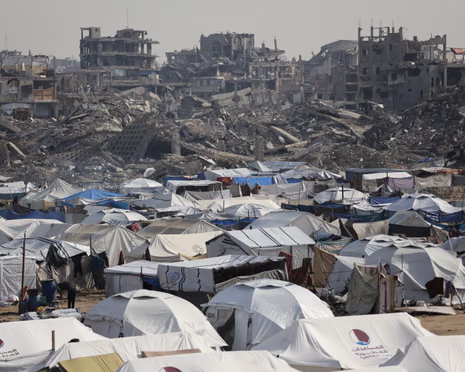
Beyond the immediate political debates, the prospect of a stabilisation force raises long-term questions about Gaza’s reconstruction, regional diplomacy and the practicality of forming a Palestinian state under current conditions. The situation in Gaza remains catastrophic, with families living in makeshift shelters among ruins, struggling to find food, clean water and medical supplies. For many residents, discussions in New York and world capitals feel disconnected from their daily battle for survival.
Arab governments find themselves navigating competing pressures. Public sentiment in the region overwhelmingly supports Palestinian statehood and demands accountability for destruction in Gaza, while geopolitical realities compel some governments to work pragmatically with the US draft. Saudi Arabia, Egypt, Qatar and Jordan are positioned at the centre of these dynamics as potential diplomatic and military contributors to the stabilisation effort.
The United States sees the stabilisation force as a mechanism to control Gaza’s post-war environment, prevent the resurgence of Hamas and create political conditions acceptable to both Israel and Arab states. However, the underlying tension between political ambition and practical execution looms large. Establishing a secure environment, coordinating military forces from multiple nations, dealing with Hamas’s ideological resilience and addressing humanitarian needs are challenges of a magnitude seldom seen in recent UN operations.
The debate over the stabilisation force highlights unresolved questions about who will govern Gaza in the long run. The idea of a technocratic Palestinian administration responding to a US-chaired oversight body remains contentious. Palestinian leaders have expressed concerns about external control over their political institutions, while Arab nations worry that the arrangement could place them in a politically vulnerable position if the mission faces resistance or failure.
The Russian-Chinese rival draft further complicates matters. While closer to Arab preferences regarding Palestinian statehood, it is unlikely to be accepted by the United States or secure Israel’s cooperation. The possibility of dual vetoes casts uncertainty over whether any resolution will gain the necessary support to move forward.
Diplomatically, the upcoming vote reflects the fragmentation of the international system. The Security Council, divided by geopolitical rivalries, may struggle once again to reach consensus on a major global crisis. Meanwhile, governments worldwide are under pressure from their domestic populations, humanitarian organisations and political opposition to take firmer positions.
As the Security Council prepares to vote, the future of Gaza remains deeply uncertain. The stabilisation force could become a pivotal mechanism for rebuilding the territory—or another unrealised diplomatic blueprint overshadowed by political conflict and regional instability. The stakes extend far beyond the immediate battlefield, touching questions of statehood, sovereignty, regional power balances and the credibility of the international system.