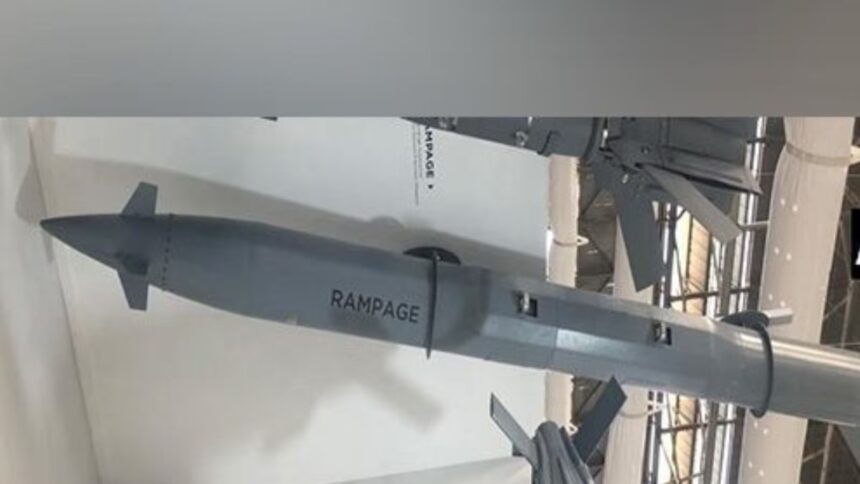
Following the resounding success of Operation Sindoor, where the Indian Air Force (IAF) employed Rampage air-to-ground missiles with precision against strategic targets in Pakistan, the IAF is preparing to place a substantial order for these advanced weapons from Israel. The Rampage missile, officially designated as the High Speed Low Drag-Mark 2 within the Indian Air Force, has already been integrated into Su-30 MKI, Jaguar, and MiG-29 fighter fleets, demonstrating exceptional operational effectiveness. The strategic deployment against terrorist headquarters in Muridke and Bahawalpur has underscored the missile’s capabilities, boosting the offensive potential of the IAF’s fighter aircraft. As India explores further integration across its combat fleets and potential domestic production under the Make in India initiative, the acquisition of Rampage missiles marks a significant step in enhancing India’s aerial strike capabilities.
Operational Success and Tactical Integration
The IAF’s deployment of Rampage missiles during Operation Sindoor showcased the missile’s high precision and lethality against critical targets within Pakistani territory. Sources familiar with the operation stated that multiple missions were flown using Su-30 MKI aircraft to neutralize terrorist infrastructure and air bases in Pakistan’s Punjab region, including Muridke and Bahawalpur. The missiles successfully struck the designated coordinates, demonstrating their high-speed flight profile, low drag characteristics, and the ability to evade enemy air defenses. Analysts have noted that this operational success not only reinforces India’s aerial deterrence posture but also validates the effectiveness of integrating Israeli missile technology into Indian combat aircraft fleets.
The integration of Rampage missiles with Su-30 MKI aircraft has significantly increased the strike capacity of India’s most advanced fighter jets. With the capability to carry multiple long-range air-to-ground missiles, the Su-30 MKI fleet can now conduct precision strikes over distances exceeding hundreds of kilometers, complementing the BrahMos supersonic missile systems already in service. The missile’s compatibility with other platforms, including Jaguar and MiG-29 fighters, expands the operational flexibility of the IAF, allowing for coordinated strikes across diverse mission profiles. Defence experts have highlighted that such integration ensures that India maintains a technological edge in air-to-ground combat capabilities, enhancing both deterrence and rapid-response operational readiness.
Furthermore, the IAF is reportedly assessing the potential to equip other aircraft fleets with Rampage missiles, broadening their tactical utility. This move aligns with strategic objectives to standardize high-speed precision munitions across multiple platforms, reducing logistical complexity while increasing overall combat efficacy. The combination of operational deployment experience, proven effectiveness, and multi-platform integration strengthens India’s airpower in both conventional and asymmetric conflict scenarios.
Future Acquisitions and Make in India Prospects
Following the operational success of the Rampage missiles, the IAF is expected to place substantial orders from Israel under fast-track acquisition procedures, aiming to equip all fleets already integrated with the missile system. Defence sources indicated that these orders would not only expand the current inventory but also prepare for large-scale induction across additional platforms, potentially including future-generation fighter aircraft. The acquisition is expected to strengthen India’s strategic posture in South Asia, providing an advanced capability for long-range precision strikes and rapid deployment in response to emergent threats.
In parallel, the Indian Air Force is exploring the potential for domestic production of Rampage missiles under the Make in India initiative. Defence analysts suggest that local manufacturing could facilitate faster production timelines, cost efficiency, and technological self-reliance. Producing such high-speed, low-drag missiles domestically would mark a significant milestone for India’s defence industry, reinforcing its ability to meet evolving operational requirements while minimizing dependence on foreign suppliers. The potential for collaborative research and development with Israeli defence manufacturers further strengthens the prospects of indigenous production, offering opportunities for technological transfer and skill development in advanced missile technologies.
The IAF’s interest in expanding its Rampage arsenal follows a broader trend of modernizing India’s combat capabilities with precision-guided munitions. Alongside the Rampage, the Indian Air Force has tested other advanced missile systems, including the ROCKS (Crystal Maze-2) missile in the Andaman and Nicobar Islands, highlighting an ongoing emphasis on developing a multi-layered, long-range aerial strike capability. These developments demonstrate India’s commitment to enhancing its operational readiness, ensuring that the Air Force remains capable of executing precise and decisive action across a wide spectrum of scenarios, from counter-terrorism operations to conventional warfare.
Strategic analysts have noted that the integration of Rampage missiles into multiple aircraft fleets provides the IAF with a potent combination of speed, range, and precision. The missile’s ability to strike deep within enemy territory with minimal exposure risk enhances India’s deterrence posture and operational versatility. Additionally, the demonstrated effectiveness during Operation Sindoor provides a blueprint for future operations, reinforcing confidence among military planners regarding the missile’s reliability and tactical value.
The planned acquisition of Rampage missiles also reflects India’s broader defence modernization objectives. By augmenting the firepower of existing aircraft fleets, the IAF strengthens its capacity to conduct high-intensity operations while maintaining flexibility across different mission profiles. Analysts suggest that such developments are crucial for maintaining strategic stability in the region, particularly given evolving threat perceptions along India’s borders and the need for rapid, precise, and effective aerial responses to emerging challenges.
The Indian Air Force’s move to expand its Rampage missile inventory following the successful deployment in Operation Sindoor represents a significant enhancement of India’s aerial combat capabilities. The combination of operational validation, multi-platform integration, strategic acquisitions, and potential domestic production positions the IAF to effectively leverage advanced missile technology in support of national defence objectives. The ongoing expansion of the missile arsenal not only strengthens India’s strike capabilities but also reflects a broader commitment to maintaining technological superiority, operational readiness, and strategic deterrence in the region.