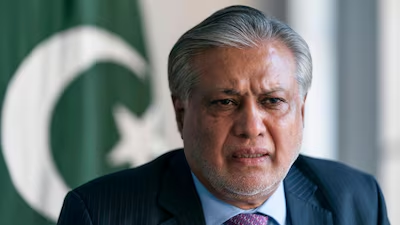
Pakistan’s Deputy Prime Minister and Foreign Minister Ishaq Dar, in a statement outside the Parliament in Islamabad, has reiterated Islamabad’s willingness to engage in talks with India on all outstanding issues, including the long-standing and sensitive matter of Kashmir. Speaking to reporters, Dar emphasized that any future dialogue will not be limited to Kashmir alone but will encompass the full spectrum of bilateral concerns, signaling a renewed effort by Pakistan to re-establish diplomatic engagement after months of tense relations. These remarks, coming shortly after his similar statement in July, underline Pakistan’s persistent interest in reviving structured dialogue mechanisms and exploring avenues for cooperation with India, even as historical distrust and recent military confrontations continue to shape the strategic environment. Analysts note that Dar’s comments reflect Pakistan’s attempt to project a flexible stance while highlighting that the initiative for talks lies with New Delhi, an appeal intended to shift pressure onto India to respond positively to diplomatic overtures.
The context of Dar’s statement is critical to understanding the delicate balance Pakistan seeks to maintain in its foreign policy. The July interaction with the Atlantic Council think tank had already indicated Islamabad’s openness to engage on a wide range of subjects, from trade to counter-terrorism. Dar had emphasized that Pakistan is ready to collaborate on multiple fronts, suggesting that the country seeks to normalize relations and reduce tensions in ways that extend beyond the traditional focus on Kashmir. His repeated assertion that “the ball is now in India’s court” is a strategic signal to New Delhi, reinforcing the narrative that Pakistan is prepared for dialogue but awaits a concrete response. This approach underscores Islamabad’s effort to maintain an image of responsibility in the international arena, while also appealing to global stakeholders for mediation and support in fostering bilateral engagement.
Kashmir and Composite Dialogue: Renewed Pakistani Outreach
At the heart of Pakistan’s diplomatic initiative lies the Kashmir issue, a central point of contention in India-Pakistan relations for decades. Dar’s remarks indicate that while Kashmir remains a priority, Pakistan seeks to frame future discussions in a comprehensive context, encompassing trade, cross-border security, cultural exchange, and people-to-people contacts. The suggestion to resume the composite dialogue process, a structured mechanism previously employed to address multiple bilateral issues, highlights Islamabad’s desire for a systematic and formalized approach to negotiations. This process, which historically included discussions on cross-border terrorism, trade cooperation, cultural ties, and political concerns, had been suspended amid escalating tensions and incidents of violence along the Line of Control. Pakistan’s current outreach reflects a tactical effort to reintroduce a multidimensional framework that balances its strategic interests with the imperative of dialogue.
Dar’s emphasis on a broad-based dialogue signals a recognition of the complex interlinkages between Kashmir and other bilateral issues. By positioning talks as not solely Kashmir-centric, Pakistan aims to create a more conducive environment for engagement and reduce the perception that the dialogue is exclusively a zero-sum contest over territory. Analysts interpret this as an effort to soften the negotiation stance, projecting Pakistan as willing to cooperate on economic and security issues while maintaining its core political positions on the Kashmir dispute. This strategic framing also allows Pakistan to present itself to the international community as committed to constructive engagement, even as historical incidents and recent military operations, such as India’s Operation Sindoor, continue to generate mistrust.
However, India has remained firm in its approach, maintaining that dialogue can only occur with countries that demonstrate a commitment to peace, stability, and anti-terrorism norms. Defence Minister Rajnath Singh, responding to Dar’s remarks in Parliament, reiterated that India will not engage in talks with nations that support or glorify terrorism. Singh criticized Pakistan for providing military funerals to individuals involved in terrorist activities, describing such acts as a form of endorsement for violence and a direct contradiction to the principles necessary for meaningful dialogue. By linking Pakistan’s internal and regional behavior to the feasibility of talks, India underscores its insistence that any diplomatic engagement must be predicated on accountability, credible actions against terrorism, and a clear shift toward responsible state conduct.
The strategic backdrop of these interactions is further complicated by recent military developments. India’s Operation Sindoor, conducted on May 7, served as a direct response to the April 22 terror attack in Pahalgam, which resulted in the deaths of 26 civilians. Indian forces carried out precision strikes targeting terrorist camps across Pakistan and Pakistan-occupied Kashmir, emphasizing India’s capability and willingness to respond decisively to cross-border terrorism. This operation not only altered the security calculus but also reinforced India’s position that bilateral relations must be rooted in a mutual commitment to peace, rather than rhetoric alone. The continuation of such military actions has implications for both diplomatic engagement and regional stability, influencing public perception and policy debates in both countries.
Balancing Diplomacy and Security: Pakistan’s Strategic Calculus
Pakistan’s outreach, as articulated by Dar, reflects a nuanced strategy aimed at balancing domestic expectations, international optics, and its strategic interests vis-à-vis India. Domestically, presenting a willingness to engage on multiple fronts serves to demonstrate proactive governance and a commitment to diplomatic solutions, while maintaining a firm position on Kashmir to satisfy political constituencies. Internationally, the repeated signal of openness to dialogue allows Pakistan to project an image of responsibility and willingness to cooperate on global security concerns, especially in the context of counter-terrorism and regional trade. At the same time, by emphasizing that the initiative now lies with India, Pakistan seeks to maintain leverage in negotiations and to shape the terms of engagement in ways favorable to its strategic objectives.
The interplay between diplomatic outreach and security considerations continues to define India-Pakistan relations. Analysts note that any forward movement in talks will require a careful calibration of trust-building measures, verification mechanisms, and confidence-building steps. The legacy of mistrust, historical conflicts, and ongoing incidents of cross-border violence complicates efforts to resume structured dialogue. Pakistan’s call for comprehensive talks, including Kashmir, underscores the persistent centrality of the issue while simultaneously seeking to broaden the negotiation agenda to include economic, cultural, and security dimensions. Such an approach allows Islamabad to signal flexibility without appearing to compromise on core territorial and political claims.
India, on its part, emphasizes that dialogue must be anchored in realism, accountability, and shared commitments to countering terrorism. Defence Minister Rajnath Singh’s remarks, highlighting that “the language of terrorism is fear, blood, and hate, not dialogue,” reinforce the notion that engagement without credible actions against militancy will not be recognized as legitimate or constructive. This position reflects a broader Indian strategy to condition diplomatic talks on demonstrable behavioral change, ensuring that dialogue is linked to practical outcomes rather than symbolic gestures. Analysts argue that India’s insistence on accountability and anti-terrorism measures is likely to shape the parameters, pace, and substance of any potential future dialogue, determining whether Islamabad’s overtures can translate into actionable negotiations.
The broader regional implications of this dialogue initiative are significant. Stability in South Asia, particularly along the India-Pakistan border, is contingent upon effective management of conflict drivers, including terrorism, territorial disputes, and historical grievances. Pakistan’s public statements, including Dar’s reaffirmation of willingness to engage, are closely monitored by international stakeholders, including the United States, the European Union, and multilateral security forums. These actors view potential dialogue as essential for reducing the risk of escalation, promoting economic cooperation, and fostering regional connectivity. Successful engagement, however, will depend on the credibility of commitments, concrete steps toward de-escalation, and sustained follow-through by both governments.
As Pakistan signals readiness to engage on multiple issues, including Kashmir, the international community remains attentive to whether such overtures translate into tangible progress. Analysts highlight that the duality of strategic signaling—projecting willingness while maintaining core positions—demonstrates Islamabad’s understanding of both domestic and global pressures. The challenge for India lies in evaluating these signals against historical patterns of dialogue and conflict, balancing the imperatives of national security with the potential benefits of renewed engagement. The intersection of military operations, diplomatic messaging, and strategic planning creates a complex environment in which both countries must navigate competing priorities and risks.
The current state of India-Pakistan relations is thus characterized by cautious diplomacy, conditional engagement, and strategic posturing. While Pakistan emphasizes comprehensive dialogue, India continues to link the possibility of negotiations to actionable changes in Pakistan’s behavior regarding terrorism and cross-border militancy. Operation Sindoor and similar military responses underscore India’s commitment to defending its citizens and territory, while simultaneously influencing the diplomatic calculus on the other side. The interplay between offensive operations, international diplomacy, and domestic political considerations shapes the contours of bilateral relations and determines the feasibility of sustained engagement.
Ishaq Dar’s remarks reflect Pakistan’s attempt to project flexibility and willingness for dialogue, covering Kashmir and other critical issues. However, the success of such efforts depends on the alignment of political intent, credible actions against terrorism, and reciprocal engagement from India. The strategic, historical, and operational context highlights the challenges inherent in resuming talks, illustrating the complex dynamics that continue to define one of the most sensitive and strategically important bilateral relationships in South Asia.