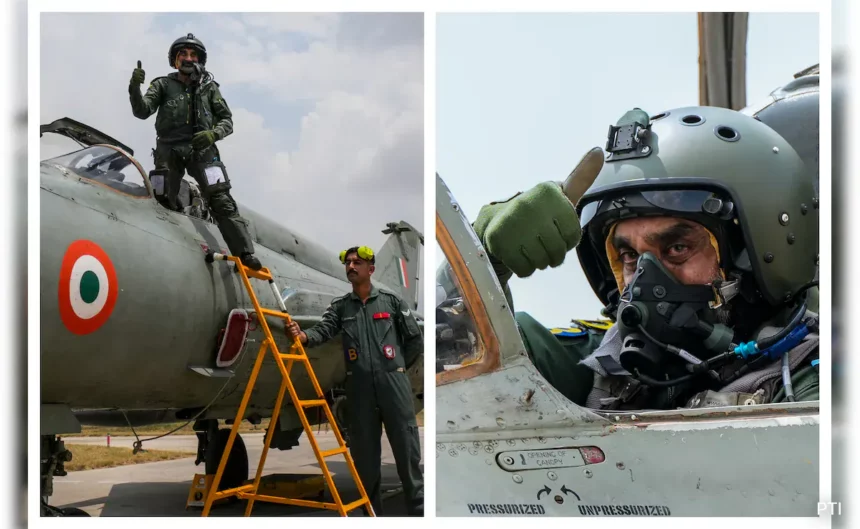
The Indian Air Force bid an emotional and historic farewell to its iconic MiG-21 fighter jets, which have been an integral part of India’s aerial combat capabilities for over six decades. As part of a symbolic send-off, Air Chief Marshal A P Singh personally undertook solo sorties of the MiG-21 from the Nal Air Force Station in Bikaner on August 18-19, demonstrating the jet’s enduring legacy and unmatched contributions to India’s defense. This final operational flight came a month before the formal retirement ceremony scheduled in Chandigarh on September 26, where the aircraft, first inducted in 1963, will be officially retired, marking the end of a remarkable chapter in Indian aviation history. The MiG-21, often referred to as the backbone of the IAF’s fighter fleet, has been synonymous with agility, speed, and combat reliability, earning the respect and admiration of generations of pilots who trained and flew on this legendary Russian-origin aircraft. The farewell reflects not only nostalgia but also the evolution of the IAF toward more modern, technologically advanced platforms like Tejas, Rafale, and Su-30s, signaling a new era in India’s aerial warfare capabilities.
MiG-21 Legacy and Its Pioneering Role in Indian Combat Aviation
Since its induction in the 1960s, the MiG-21 has played a pivotal role in India’s air defense strategy, earning its place as one of the most mass-produced supersonic fighter jets in history. With over 11,000 aircraft operated by more than 60 countries, the MiG-21’s operational versatility and combat prowess made it a formidable interceptor and a highly reliable component of air forces worldwide. Air Chief Marshal Singh reminisced about his first experience with the Type-77 variant at Tezpur in 1985, describing it as agile, highly maneuverable, and relatively simple to operate, yet requiring careful training to harness its full potential. The MiG-21’s design emphasized speed and intercept capabilities, with maximum reheat climb rates exceeding 250 meters per second, enabling pilots to respond swiftly to aerial threats. Its adaptability allowed for numerous upgrades over the years, culminating in the Bison variant, equipped with modern avionics, advanced radar systems, and beyond-visual-range missile capabilities, which maintained the jet’s relevance even in an era of rapidly evolving aerial warfare technology.
The aircraft’s operational history is both illustrious and emblematic of India’s military achievements. In the 1965 Indo-Pak war, the MiG-21 was instrumental in maintaining air superiority and supporting strategic operations. Its contribution was further highlighted during the 1971 war, particularly in the attack on the governor’s residence in Dhaka on December 14, which directly led to the governor’s resignation and contributed to Pakistan’s eventual surrender on December 16, with 93,000 troops laying down arms. The MiG-21’s role extended to the Kargil conflict under Operation Safed Sagar in 1999, when it successfully intercepted and shot down a Pakistani Atlantic aircraft intruding into Indian airspace. Even in 2019, decades after its induction, the MiG-21 captured headlines by downing a Pakistani F-16, underlining its enduring combat effectiveness and continued relevance in modern aerial operations. These milestones underscore the aircraft’s versatility, operational reliability, and its symbolic status as a guardian of Indian skies across multiple generations of air warriors.
Symbolic Farewell and Transition to Modern Air Platforms
The final flights of the MiG-21 at Nal Air Force Station were more than operational sorties; they were a symbolic tribute to an aircraft that has shaped the careers and lives of countless Indian Air Force pilots. Air Chief Marshal Singh emphasized the jet’s unparalleled legacy while also highlighting the imperative of modernization, noting that while the MiG-21 served India remarkably well, technological advancements have made its continued operation increasingly challenging. The transition to platforms like the indigenous Tejas fighter jet, along with the Rafales and Su-30s, represents the IAF’s commitment to maintaining strategic superiority while adopting modern avionics, weapons systems, and multi-role capabilities. Tejas, designed as a direct replacement for the MiG-21, embodies continuity in design philosophy, retaining the compact form and operational agility of its predecessor, while offering improved technology, weapons integration, and operational versatility to meet contemporary combat requirements.
The MiG-21’s farewell also reflects the human element of aviation heritage. Pilots, engineers, and ground crews who dedicated decades to mastering, maintaining, and supporting the aircraft witnessed a historic moment as the IAF paid homage to a machine that had become more than just a fighter jet—it became a symbol of resilience, skill, and national pride. Wing Commander Jaideep Singh recounted the jet’s numerous contributions in combat, highlighting not only its role in past wars but also its ability to inspire confidence, tactical precision, and innovation in training and operational exercises. As two squadrons of MiG-21s are set to be phased out next month, the official ceremony in Chandigarh will mark both an end and a beginning—the conclusion of a storied legacy and the formal embrace of next-generation platforms poised to define the future of India’s air combat capabilities.
The emotional farewell underscored the duality of nostalgia and progress. While the MiG-21’s operational chapter closes, its imprint on Indian aviation history remains indelible. The solo sorties by the Air Force Chief offered pilots and personnel a moment to reflect on the technological advancements, tactical expertise, and unwavering commitment that the aircraft represented. The MiG-21, for decades, was a testament to human ingenuity, courage, and strategic foresight, qualities that continue to inform the evolution of India’s aerial combat fleet. As the IAF looks toward a future dominated by next-generation fighter jets, the lessons, skills, and memories associated with the MiG-21 will continue to inspire and shape the ethos of India’s air power, ensuring that its legacy remains an integral part of the nation’s defense narrative.